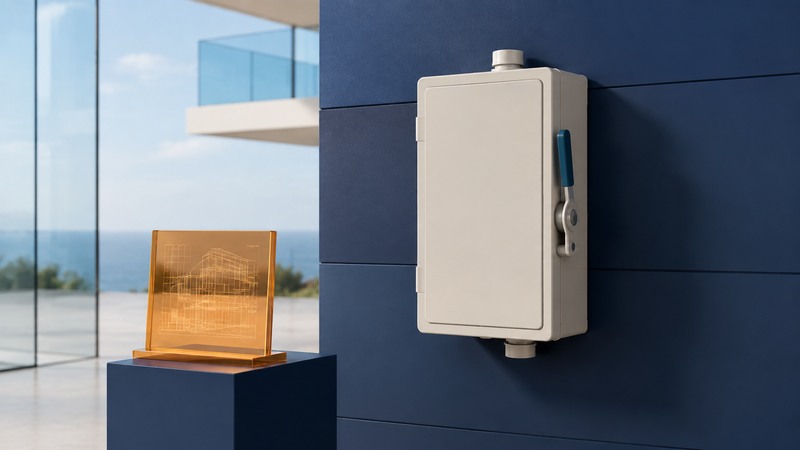
In U.S. equipment catalogs, a safety switch commonly means an enclosed disconnect used to open a circuit. It may include fuses or depend on separate overcurrent protection. For an owner or facility manager, the useful first task is to identify the equipment and intended function so a qualified electrician can assess the complete installation.
This guide supports a documentation brief. Gather existing drawings, manuals and labels visible from a normal safe position. Do not open an enclosure, approach damaged equipment or operate unfamiliar switching equipment to complete the brief.
Separate the functions behind the names
Schneider Electric’s enclosed safety-switch catalog distinguishes fusible and non-fusible equipment and describes conditional short-circuit ratings. The switching function and the protective function need separate consideration.
Square D’s enclosed-switch history reaches back to the early twentieth century. Schneider’s brand history records its 2003 centenary celebration and acquisition by Schneider in 1991. That history explains the familiar name; suitability of installed equipment still depends on its exact documentation and condition.
On a narrow screen, scroll the table sideways. Keyboard users can focus the table region and use the arrow keys.
| Term | Main function | Question for the electrician |
|---|---|---|
| Enclosed disconnect | Provides an identified means of disconnecting a circuit | Which sources and conductors does it disconnect? |
| Fusible safety switch | Combines a switch with provisions for specified fuses | Which fuse class and rating support this application? |
| Non-fusible safety switch | Provides switching with protection supplied elsewhere as required | What upstream protection and fault-current conditions apply? |
| Circuit breaker | Provides specified overcurrent interruption; additional functions depend on its listing | Is the exact device suitable for the required disconnecting function? |
| RCD or GFCI | Provides a defined form of residual-current or ground-fault protection | Which protection, trip characteristics and local requirements apply? |
Terminology changes by country. Queensland’s Electrical Safety Office uses safety switch for residual-current protection intended to reduce electric-shock risk. Some devices combine functions. Record the actual manufacturer and part number instead of relying on a name or lever shape.
Read the complete rating context
The nameplate current rating is only one field. The assessment also needs voltage, AC or DC suitability, poles, load type, enclosure rating, installation location and available fault current. A motor application can introduce horsepower and switching-duty requirements. Outdoor suitability and corrosion resistance require the exact enclosure designation.
Short-circuit current rating, or SCCR, concerns the assembly under specified fault conditions. It is different from its normal load-current rating. When a catalog ties SCCR to particular fuses or upstream devices, preserve those conditions with the number. A rating copied without its conditions cannot establish suitability.
Give the electrician the load or equipment identifier, existing circuit documentation, enclosure model and readable external label photographs obtained safely. Mark unknown fields as unknown. The professional should verify the installation and resolve the missing information before specifying a replacement.
Treat isolation as a verified work practice
A handle position is a limited observation. Multiple supplies, stored energy and backfeed can matter. In U.S. general-industry electrical work, OSHA 29 CFR 1910.333 addresses deenergization, lockout/tagging and verification by a qualified person. Its requirements apply within that workplace scope; local rules and other sectors can impose additional or different requirements.
The practical implication for an owner is to arrange qualified work under the applicable procedures, with enough information about all energy sources. Do not use an ordinary stop button or an apparent off position as permission to touch electrical parts. The contractor should identify who controls the work area and how the equipment will be returned to service.
Prepare a useful service request
Fictional request: “The loading-area equipment needs a disconnect assessment. The external label identifies model X; the drawings show two possible supply sources. We need confirmation of isolation function, environmental suitability, fault-current coordination and any required replacement. Please identify the applicable documentation and work arrangements.” This gives a professional a defined question without inventing a device rating or a switching sequence.
Include the purpose of the visit, symptoms and when they occur, affected equipment, available manuals and access constraints. If there is damage, heat, arcing or another immediate hazard, keep clear and use the site’s emergency arrangements or appropriate emergency service.
Keep the final equipment identification, manufacturer instructions, relevant drawings and service report together. For backup supplies, the backup-power planning guide explains why transfer arrangements and supported loads belong in the wider system assessment.
Disconnect assessment documentation brief
Disconnect assessment documentation brief — plain-text download. Save a copy and fill it in with your own information. The file includes instructions, assumptions and references so it can be used independently.