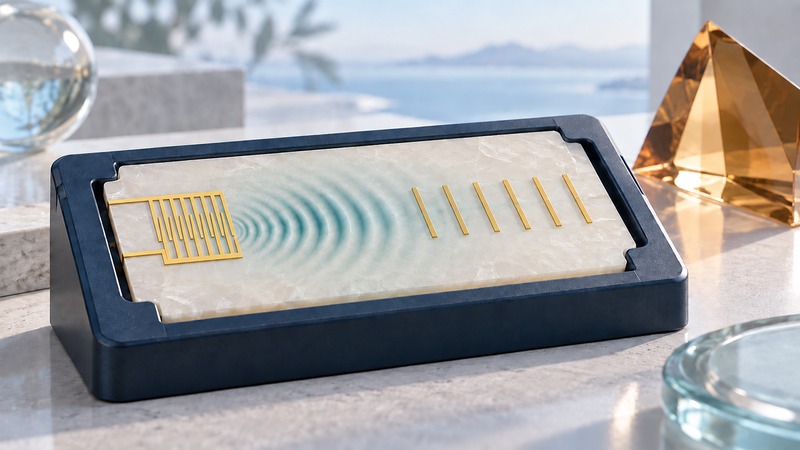
A surface acoustic wave (SAW) RFID tag uses a piezoelectric device to turn received radio energy into an acoustic wave travelling along a solid surface. A patterned set of reflectors shapes the returning signal. The reader interprets that response as an identity and, in a suitably designed system, a measurement.
The useful distinction is the physical encoding mechanism. This guide concentrates on reflective delay-line tags. Other SAW devices, including resonators used for sensing, require their own explanation and reader design.
Follow the RF-to-acoustic-to-RF sequence
An antenna receives the interrogation. An interdigital transducer, formed from interleaved electrodes on a piezoelectric substrate, converts the electrical signal into surface motion. Reflectors return portions of that wave at characteristic delays; the transducer converts the returning acoustic energy into an electrical response that the antenna radiates.
RFSAW’s 2004 Global SAW Tag white paper explains this mechanism for its lithium-niobate design and describes encoding through pulse timing and phase. Read its market, range and worldwide-operation statements as dated manufacturer claims. They require separate current evidence for any proposed deployment.
On a small screen, scroll sideways to read all columns.
| Part | Role | Evidence to request |
|---|---|---|
| Antenna and package | Couple radio energy to the device in its installed surroundings. | Operating band, mounting and tested environmental conditions. |
| Transducer and substrate | Convert between electrical signals and surface acoustic waves. | Device construction and specified operating conditions. |
| Reflector pattern | Create the coded response used by the decoder. | Code definition, identification capacity and ambiguity handling. |
| Reader and processing | Excite, capture and interpret the response. | Supported tag family, decoding output and repeatable test method. |
Keep identity encoding distinct from stored data
In a fixed-pattern reflective tag, the fabricated pattern supplies the identity response. Application information can be associated with that identity in a database. Ask whether a proposed product has any writable capability and how it is implemented; a description of a SAW identity code alone establishes only the coded response.
Compatibility needs an exact reader-and-tag pairing. Request a demonstration using the intended tag family and reader firmware, with exported identity results. A shared use of the word RFID or an overlapping frequency band is insufficient evidence that a conventional RAIN reader can decode a SAW response.
Ask how the response becomes a measurement
A 2017 original study of 2.45 GHz coded SAW temperature sensors fabricated reflective delay-line devices and evaluated response changes with temperature. It reported results for a particular substrate, code, processing method and experimental setup. That is evidence of the studied device, with a scope narrower than a generic temperature rating for every SAW tag.
For a sensing proposal, ask for the calibration function, reference instrument, uncertainty, repeatability and usable range of the complete packaged sensor. Clarify whether mounting stress or other environmental effects can influence the reported quantity. Retain raw or diagnostic response information when the system provides it.
Identification and sensing impose separate acceptance questions. Can the system associate the response with the correct tag? Can it convert that response into the intended quantity with the required quality? Define what the application should do when either answer is uncertain.
Assess a real proposal with bounded evidence
- Record tag family, package, reader, antenna, firmware, processing and operating band.
- Demonstrate identity and any measurement using the actual mounting and representative objects.
- Test the intended number of tags, orientations, spacing, movement and reporting interval.
- Retain failed or ambiguous reads as well as successful results.
- Check the exact equipment’s regional radio approval and the complete package’s environmental rating.
- Agree acceptance thresholds, calibration responsibility and a repeat test after component or software changes.
Avoid turning a laboratory result into a purchasing guarantee. Ask the supplier which parts of the demonstration are measured, simulated or projected. A useful conclusion identifies the tested conditions and the remaining work needed to establish performance in your application.
Keep a working record
Download the editable working record (plain text). It includes purpose, instructions, evidence fields and this guide's source links. Save a separate copy for each evaluation and record unresolved issues with their owner.
Related reading
Researched and updated September 20, 2026. Recheck source documents when equipment, software or applicable requirements change.