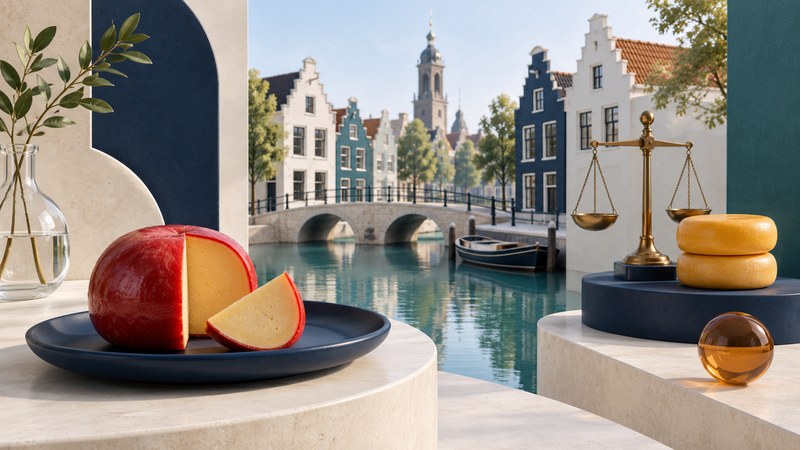
Edam’s cheese story is also a story of trade: farms supplying a town, waterways moving goods, and a market establishing weight and price. A useful visit connects that history with the present-day demonstration and the wider town museum.
Follow the cheese from farms to market
According to the Edam cheese-market foundation’s history (Dutch), the small round cheeses originated in villages around Edam, and the town became an important dairy-export port. The foundation links the name with cheese shipped through Edam. That makes the town a place to understand the trade, while the label on a cheese bought today identifies its actual producer and origin.
The foundation describes the market’s move to the present square around 1680, the weighhouse dating from 1778, the end of the commercial market in 1922 and its revival as a visitor event in 1989. These dates distinguish the history of commercial exchange from the demonstration visitors see now.
Know what you are watching
At the heritage market, look for the sequence the organizers describe: cheese arriving by boat, carriers moving it, buyers and sellers bargaining, and weighing. Ask what each step accomplished in a trade where quantity and price had to be agreed. The performance becomes easier to interpret when you follow one transaction rather than only photographing the piles of cheese.
Check the cheese market’s official agenda (Dutch) for the specific date you intend to visit. The market is seasonal; a town visit and a market visit are different plans. Avoid assuming that an event shown in a summer photograph will run on any Wednesday of the year.
Add the town around the cheese
Edam Museum’s history and buildings describes two locations: a merchant’s house built in the sixteenth century and rooms in the old town hall, which dates from 1737. Its collections place cheese trade in a wider setting of shipbuilding, crafts and everyday life. The merchant’s house also contains the museum’s floating cellar, a distinctive feature of the building.
the museum’s historic-map exhibition uses a greatly enlarged 1697 town plan by Joan Blaeu to explore earlier streets, waterways and trades. Look for how water, storage and commercial buildings fit together. This provides historical context even when your visit falls outside market season.
Build a visit around what is open
On a narrow screen, focus the table and use the arrow keys to scroll.
| Before the visit | Official place to check | Decision to make |
|---|---|---|
| Choose the date | Cheese-market foundation agenda | Market demonstration day or a town-and-museum visit |
| Check museum access | Edam Museum visitor information | Which locations and opening times suit your group |
| Plan the journey | Current journey planner linked by the museum | Outward and return services for the actual day |
| Choose food purchases | The seller and each product label | Portion size, origin and transport requirements |
Edam Museum’s visitor information lists the museum locations at Damplein 8 and Damplein 1. It also warns that the historic buildings have stairs, thresholds and narrow passages and are not wheelchair accessible. Check directly with the museum if mobility access affects your plans. Opening hours, admission arrangements and transport should be verified for your date rather than copied from an old itinerary.
Suggested visit structure: if the market is running, let its published time anchor the day and fit a museum visit around it. Outside that season, make the museum your anchor and explore the town’s public spaces at your own pace. Allow time to find the correct location and for breaks; this is a planning framework rather than a measured walking route.
Take home a cheese you understand
Ask where a cheese was made, how mature it is, what its coating is, and how it should travel and be stored. Save the label. A round shape, a town souvenir or red wax provides less detail than the producer information. Buy the quantity you can transport appropriately and use.
The Edam buying, wax and storage guide covers the cheese at home. For something to share, use the small-board planner; for transporting a perishable food gift, follow the packing and handover guide and the actual product’s instructions.