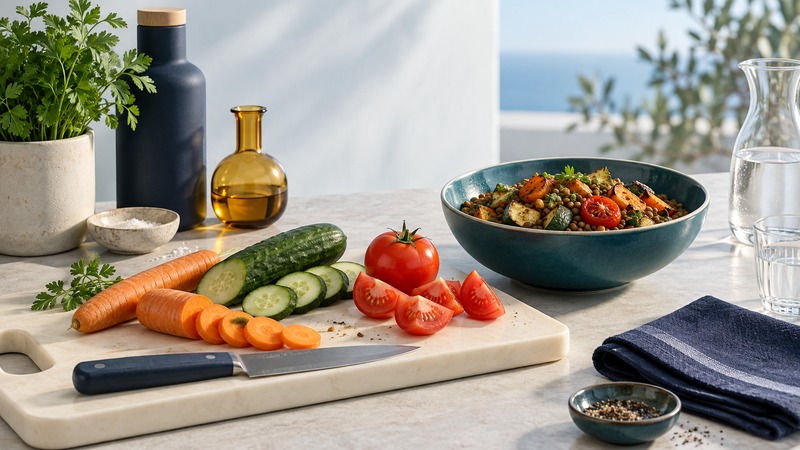
Raw-food eating ranges from adding salads and fruit to restricting nearly every meal to uncooked ingredients. Those patterns have different nutritional demands. A useful approach begins with what you enjoy eating raw, what the rest of the meal supplies, and how you will handle it safely.
Define what you intend to change
In the mid-2000s, Kathy Feldman’s The Raw Crunch Diet promoted raw fruits, vegetables, nuts, and seeds for much of the day with a flexible dinner. It belongs to a wider family of diets that place special value on uncooked or minimally processed foods. A mixed pattern and a strict raw vegan diet should be evaluated separately.
Write down your actual rule: more uncooked vegetables at lunch, raw breakfasts, or a nearly all-raw diet. Then list the foods the rule removes. Eliminating cooked beans, grains, fortified foods, or animal foods may remove convenient nutrient sources as well as cooking steps.
The question to test is whether your new pattern remains varied, adequate, enjoyable, and practical. “Raw” describes preparation. Nutritional completeness depends on the foods and amounts eaten across the day.
Check the whole pattern, especially vitamin B12
A 2005 cross-sectional study of 201 raw-food adherents found vitamin B12 deficiency in 38% of participants. It also reported a mixture of favorable and unfavorable blood markers. Because participants were observed rather than randomly assigned, the study cannot establish what would happen to everyone adopting the diet. It does identify a concrete planning concern.
NIH’s B12 fact sheet explains that unfortified plant foods do not naturally supply vitamin B12. People eating a vegan diet need a reliable source through suitable fortified foods or supplementation. A rule that excludes both requires reconsideration with a qualified professional.
Also review energy, protein, calcium, vitamin D, iron, zinc, and iodine when restricting major food groups. Assess these needs using the complete food pattern and portions. A registered dietitian can assess your actual food amounts, particularly during pregnancy, childhood, illness, or unintended weight loss.
For specific food planning, see calcium-rich foods and zinc intake and food sources. Include the form you actually eat when consulting nutrient information; a spoonful of seeds and a full bowl of beans are different portions.
Build a satisfying meal around the raw ingredients
Keep the texture or freshness you wanted, then add what the meal needs. This is a culinary planning exercise, not a prescribed menu or a complete daily nutrient calculation.
On a narrow screen, scroll the table sideways. Keyboard users can focus the table region and use the arrow keys.
| Starting point | A practical addition | What to check |
|---|---|---|
| Tomato and cucumber salad | Add cooked lentils, a grain if desired, and olive-oil dressing. | Does the portion keep you satisfied until your next planned meal? |
| Fruit at breakfast | Pair with yogurt or a suitable fortified alternative and oats or nuts. | Read the alternative’s protein and fortification information. |
| Vegetable wraps | Fill with cooked tofu or another appropriate protein food and a sauce. | Plan storage and enough filling for the meal’s role. |
If large raw salads are uncomfortable, try smaller raw portions alongside cooked vegetables. Cooking also makes many dry beans and grains usable as ordinary meal ingredients. Let convenience, enjoyment, and nutritional coverage guide the balance of preparation methods.
Use food-safety guidance for the actual ingredient
FDA’s produce guidance recommends washing produce under running water before preparation, keeping it separate from raw meat and its utensils, and refrigerating perishable cut produce. Soap and household detergents are unsuitable for washing produce. Follow the package directions for produce labeled ready-to-eat or prewashed.
Raw sprouts deserve particular attention because warm, moist growing conditions can allow bacteria to multiply. People at higher risk of foodborne illness should avoid raw or lightly cooked sprouts. Washing alone does not reliably make contaminated sprouts safe.
The CDC’s safer-food choices also distinguishes pasteurized dairy and juice from unpasteurized products, and fully cooked animal foods from raw or undercooked ones. A wish to eat more raw vegetables supplies no reason to add raw milk, eggs, meat, or fish to the plan.
Use a refrigerator and food containers suited to the meal you are packing. If your workday makes reliable cold storage difficult, change the menu or arrange an insulated bag and appropriate cold packs instead of assuming “fresh” means safe at room temperature.
Ask what a diet promise actually demonstrates
For a claim about cleansing, energy, skin, or weight, ask for the measured outcome, study population, comparison, and duration. A testimonial can explain someone’s experience; it cannot establish which part of a complex lifestyle caused the result.
Try a modest, observable change: prepare a vegetable side you enjoy three times this week, then review cost, preparation time, comfort, and waste. If you are considering a restrictive pattern, assess nutritional coverage before removing more foods. The weight-management planning guide offers a broader framework for reviewing behavior goals.