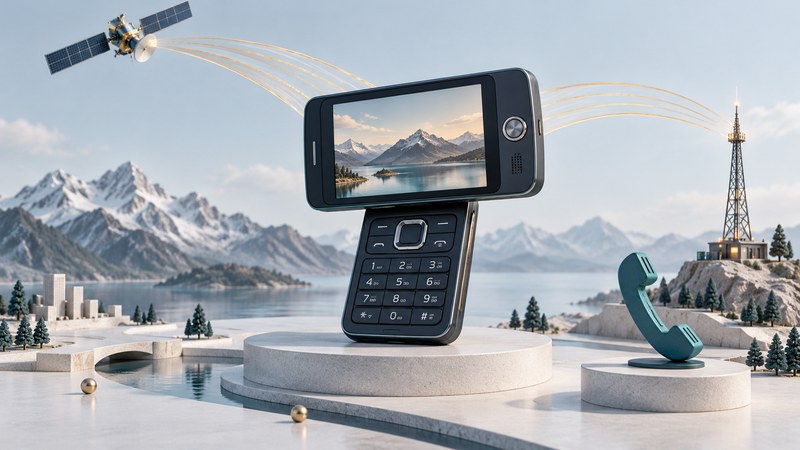
A DMB phone combined a telephone with a receiver for digital multimedia broadcasts. The Samsung SCH-B200 and SPH-B2000 illustrate that idea: a sliding handset could rotate its screen for television viewing. The satellite in satellite DMB delivered programming; it did not turn the handset into a satellite voice telephone.
A screen arranged around television
Samsung's B200/B2000 launch description places the design at the MIPTV/MILIA 2005 exhibition in Cannes. The display slid upward and rotated 90 degrees; a rear support let the device stand for viewing. The same landscape arrangement could serve other media functions.
This mechanical choice made a compact telephone serve a second posture: watching a rectangular television picture. Samsung also described handling a call or text while receiving a broadcast. These were parallel functions within one handset, not evidence that the television and telephone used the same delivery network.
The manufacturer's launch material and later model announcement establish the B200 family's place in its 2005 DMB range. Regional model suffixes matter when identifying documentation and accessories. A specification for another Samsung DMB phone should not automatically be assigned to the B200.
Receiving a program is different from requesting a stream
| Function | Simplified delivery path | What must match |
|---|---|---|
| DMB television reception | Broadcaster sends a multiplex of programming to compatible receivers. | Broadcast system, coverage, receiver capability, and any service authorization. |
| Ordinary on-demand internet video | An application requests content through an internet connection. | Network access, application or browser, media format, and server. |
| Cellular voice call | The phone communicates through a cellular service to another caller. | Handset radio, operator service, account, and supported calling functions. |
| Satellite voice call | A suitable terminal uses a satellite communications service. | A terminal and subscription designed for that service; a DMB receiver alone does not supply them. |
A broadcast multiplex carries multiple services together. The receiver selects the desired service from what is transmitted. In a basic on-demand streaming example, the viewer instead requests a particular item through an application. Real delivery systems can be more elaborate, but these two paths explain why “plays TV” is an incomplete description.
DMB names more than one broadcast system
Terrestrial DMB uses terrestrial broadcasting infrastructure. Satellite DMB refers to a satellite-based broadcast system, which can include terrestrial relays. A shared DMB label does not establish receiver interchangeability. The B200 family discussed here was marketed for satellite DMB.
ETSI TS 102 428 (PDF) specifies DMB video services carried through DAB, including their component and multiplexing arrangements. It is documentation for that DAB-based system, not a universal description of every product advertised as satellite DMB.
Service history matters as much as hardware history. A 2015 presentation hosted by the ITU (PDF, slide 30) records the end of South Korea's satellite-DMB service in 2012. A surviving B200 therefore should be understood as a historical device, with local functions assessed separately from its original television service.
Describe what is present and what was tested
For a collection record, identify the exact model, region, screen mechanism, supplied accessories, and matching manual. List local demonstrations separately: screen movement, an existing media file, or a camera image. Record television reception as its own result, with the relevant service history alongside it.
This keeps a mechanical demonstration, a local media test, and a network claim from being confused. The B200's lasting design lesson is that one handheld could bring together several services while retaining different technical dependencies. Explore a different display experiment in glasses-free 3D phones, or trace the broader connections in the telecommunications network guide.