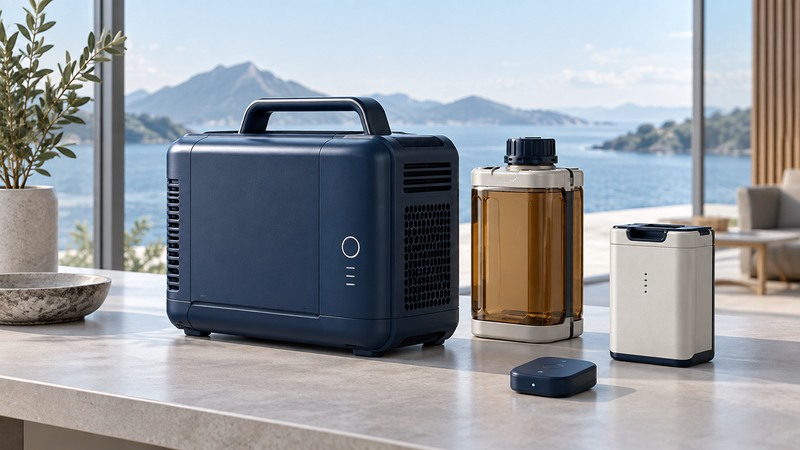
Evaluate a direct methanol fuel-cell system by the electrical service it can sustain: usable output at the required conditions, the battery that handles changing loads and the approved fuel supply available for the mission. A cartridge’s energy content becomes useful only after those system limits are included.
Collect the load profile and exact fuel-cell, battery and cartridge documentation. Remote monitoring, mobile equipment and other small power applications can have very different peak demand and service-access requirements.
Understand the complete power system
A direct methanol fuel cell feeds methanol to the electrochemical anode process without first reforming it into a separate hydrogen supply. The U.S. Department of Energy’s fuel-cell types overview describes this distinction. The packaged system also needs air, controls and management of heat, water and exhaust.
Some commercial systems operate as automatic battery chargers. The battery supplies the load while the fuel cell replenishes energy according to its control logic. Confirm that architecture in the exact manual: a charger rating and an appliance’s peak power must be reconciled through the battery and any DC/DC converter or inverter.
On a narrow screen, scroll the table sideways. Keyboard users can focus the table region and use the arrow keys.
| Item | Ask for | Use in the decision |
|---|---|---|
| Net electrical output | Output at the relevant temperature, altitude, voltage and service age | Check sustained energy production against daily demand. |
| Battery and conversion | Compatible chemistry, usable capacity, charge limits and conversion losses | Check peak loads, startup and recharge behavior. |
| Fuel | Approved cartridge, usable electrical yield and conditions | Estimate mission endurance on a consistent energy basis. |
| Installation and service | Ventilation, exhaust, weather protection and maintenance requirements | Verify that the deployment and service access fit the manual. |
Read output ratings with their conditions
The manufacturer’s March 2022 data sheet for EFOY 80, 150 and Pro 2800 distinguishes maximum output from output associated with operating hours and specifies test conditions. It is an example of why the headline maximum needs context. Obtain the latest matching documentation for a purchase or an installed serial number.
Record auxiliary and standby consumption where they affect the energy budget. Check whether a fuel-yield figure describes stack output, charger output or energy delivered to the load. Carry conversion losses once at the appropriate boundary.
Check daily balance before counting cartridges
Fictional remote-load example
A 40 W average load needs 40 × 24 = 960 Wh/day, or 0.96 kWh/day. With an assumed 80% delivery factor between charger output and the load, the required charger energy is 1.2 kWh/day.
An assumed sustainable net charger output of 60 W for 24 hours could produce 1.44 kWh/day, leaving 0.24 kWh/day above that requirement. An illustrative cartridge providing 6 kWh at the same charger-output boundary would cover 5 days at 1.2 kWh/day, before the chosen mission reserve.
All figures are invented and refer to no named product. Actual cycling, startup, environmental limits, service age and reserve policy can change the result. Peak loads still require a separate battery and converter power check.
If daily production is below daily demand, more fuel extends fuel availability but leaves a continuing battery-energy deficit. Reduce the load, revise the power system or change the service plan. If energy balances but peak power fails, review the battery and power-conversion path.
Match the installation and fuel to the manual
The April 2023 EFOY/EFOY Pro operating instructions require ventilation and managed exhaust and specify approved fuel cartridges. Methanol is toxic and flammable. Do not open or refill cartridges or improvise fuel mixtures; follow the exact manufacturer instructions and applicable transport/storage requirements.
For deployment, confirm the current mounting instructions, environmental range, battery compatibility, fuel availability and service interval. Ask how alarms are received and what happens when fuel is exhausted or the system stops. A short acceptance run should establish the required load service under the authorized installation procedure, with measured energy and operating conditions recorded.
For broader technology comparisons, see the fuel-cell guide.