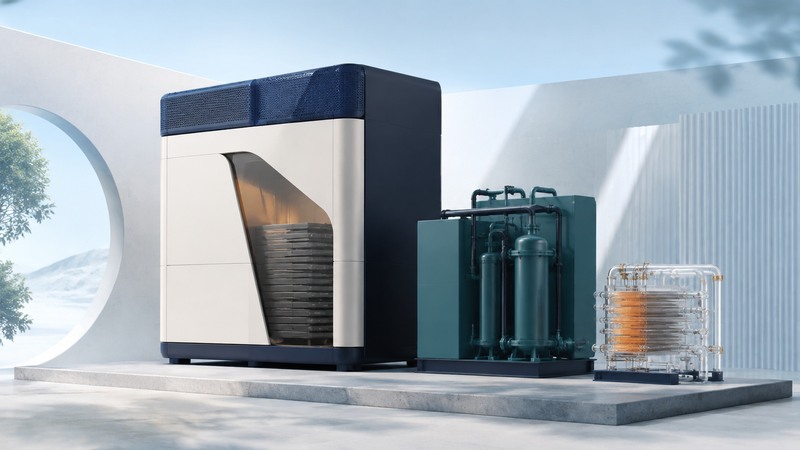
Choose a fuel-cell system around its intended service: portable power, vehicle propulsion, backup electricity or steady building and industrial supply. Compare the required fuel, response time, net electrical output, usable heat and maintenance under the same operating conditions.
A hydrogen-fed fuel cell combines hydrogen and oxygen electrochemically to produce electricity, water and heat while fuel and oxidant are supplied. The practical product includes more than the cell stack, and the fuel’s production and delivery affect cost and emissions.
Define the complete equipment boundary
DOE’s fuel-cell systems explanation identifies the stack, fuel processing, power conditioning and other supporting components. The stack produces direct-current electricity. The installed system may condition the fuel and convert electricity to the form required by the load.
Ask whether the advertised rating is stack DC, gross system output or net AC at the customer connection. Include auxiliaries, ambient-temperature limits, fuel conditions and the intended load. For backup service, specify startup time, transfer behavior, islanded operation, black-start capability and any bridging battery. A generator-like cabinet alone establishes none of those capabilities.
For stationary equipment, request the installation manual, connection requirements, usable footprint, clearances, service access and fuel specification from the exact manufacturer. A vendor must confirm whether the proposed configuration supports the application.
Use technology differences to narrow the application
DOE’s fuel-cell type guide explains how the electrolyte and operating conditions influence fuel requirements and applications. The comparison below is a screening aid. Actual startup, efficiency and durability depend on the complete product.
On a narrow screen, scroll the table sideways. Keyboard users can focus the table region and use the arrow keys.
| Type | Characteristic relevant to use | Question for the supplier |
|---|---|---|
| Polymer electrolyte membrane (PEM) | Relatively low-temperature operation and quick response; demanding fuel purity | Which hydrogen quality, startup conditions and bridging supply are required? |
| Phosphoric acid (PAFC) | Stationary applications with potential useful heat recovery | What heat temperature, part-load output and maintenance are supported? |
| Molten carbonate (MCFC) | High-temperature stationary operation and fuel-processing options | What startup schedule, fuel treatment and component life are assumed? |
| Solid oxide (SOFC) | High-temperature operation suited to some steady-duty applications | How do cycling, shutdowns, fuel quality and heat recovery affect this product? |
DOE’s technology comparison labels its electrical efficiency figures on a lower-heating-value basis and includes source-specific examples. Use it to understand the categories, then obtain current product data for a purchase comparison. Direct-methanol and alkaline cells serve additional applications with their own fuel and operating constraints.
Compare electricity and usable heat separately
Lower heating value (LHV) excludes the heat that could be recovered by condensing water vapor; higher heating value (HHV) includes it. An efficiency percentage needs its basis, load, ambient conditions and output boundary. For combined heat and power, count heat the customer can actually use at the required temperature and time.
Fictional stationary system: over one hour it consumes 100 kWh of fuel energy on an LHV basis and delivers 45 kWh of net AC electricity. Electrical efficiency is 45%. If the building uses 30 kWh of recovered heat, useful electricity plus heat is 75 kWh and total useful efficiency is 75%.
If the building can use only 10 kWh of that heat during the same hour, total useful efficiency becomes 55%. Electrical output remains 45 kWh. This is an invented balance, not a product performance claim.
EPA’s CHP efficiency method explains the net-useful-output approach. Keep electricity and heat visible as separate services when comparing a fuel cell with grid power and a boiler or heat pump. Weight the evaluation by the building’s annual load pattern rather than a single favorable hour.
Examine the fuel supply and emissions
For delivered hydrogen, obtain availability, delivery frequency, storage arrangements and the production pathway. For equipment processing natural gas or another fuel, confirm the actual reforming and gas-cleanup configuration. Processing carbon-containing fuel can release CO₂ on site. DOE’s hydrogen and fuel-cell overview places fuel cells within a broader energy system; their operating emissions and fuel-supply emissions belong in separate parts of the assessment.
Compare greenhouse gases across fuel production, processing, transport and use, including leakage assumptions and electricity supply. A hydrogen-fed cell’s local reaction products tell you about that reaction. A lifecycle claim requires evidence about the fuel delivered to it. For biogas-derived fuel, use the biogas assessment guide to examine treatment, methane losses and the baseline pathway.
Ask for application evidence and service costs
Specify required power, operating hours, load changes, tolerated interruption and heat demand before seeking quotes. Ask the vendor for net-output curves, fuel consumption at those loads, start and stop limits, degradation evidence and service intervals. Identify scheduled stack replacement, consumables, fuel treatment, maintenance labor and disposal responsibilities.
For backup, add usable stored fuel, delivery disruption assumptions and the supported test procedure to the runtime calculation. Compare the complete continuity plan with a UPS or a generator arrangement where appropriate. For steady generation, verify the tariff, export terms, fuel agreement and heat customer.
Label evidence as proposed, tested, demonstrated or commercially operating. Seek operating references with similar duty and environmental conditions. A useful selection record shows how the system meets the service requirement and which costs or performance conditions remain unconfirmed.
Fuel-cell application specification
Fuel-cell application specification — plain-text download. Save a copy and fill it in with your own information. The file includes instructions, assumptions and references so it can be used independently.