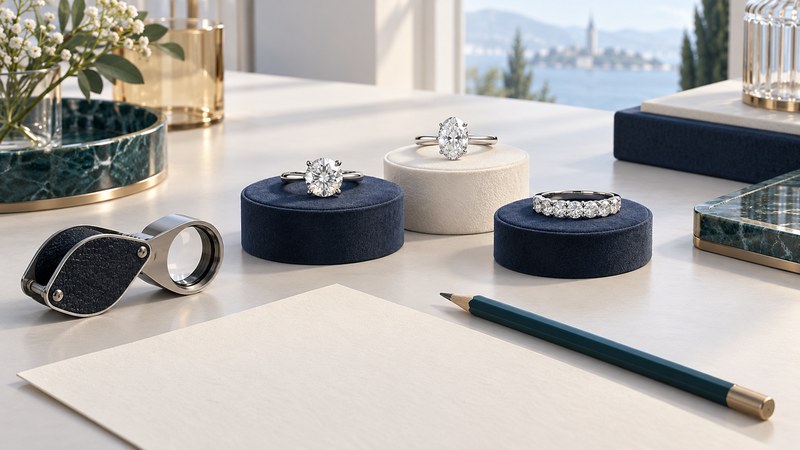
Choose a diamond wedding ring by comparing the complete ring, its documentation and the way it feels on your hand. Decide what you want to spend, identify the stones precisely, and get the setting and service terms in writing before ordering.
Start with a clear description
Write a short brief: a solitaire, a diamond-set wedding band, or a ring worn alongside another ring; preferred appearance; everyday activities; and a comfortable total spending limit. Bring the other ring to a fitting if the two will be worn together. For metal composition and plain-band choices, use the separate platinum wedding bands guide.
Keep three categories distinct. A natural diamond forms in nature. A laboratory-grown diamond is manufactured and has diamond's essential material properties. A diamond simulant, such as cubic zirconia or moissanite, is a different material chosen for a similar appearance. Ask the seller to identify the material and origin of both the main stone and smaller stones. The FTC's gemstone buying guide explains these distinctions and why clear labeling matters.
Ask about treatments and any resulting care requirements. Keep that answer with the receipt. Describe a preference for origin, appearance or price in your own terms; broad claims about environmental or ethical benefits need specific evidence about the offered product.
Compare like-for-like offers
Use the same questions for each seller. A large headline carat number may describe the combined weight of many stones. Record the center-stone weight separately from the ring's total diamond weight. Ask for dimensions as well as weight so you can compare the actual outline on your hand.
| Part of the offer | Get in writing | Use it to decide |
|---|---|---|
| Stones | Material, natural or laboratory-grown origin, treatments, individual and total weights | Whether the description matches your priorities |
| Report | Issuing laboratory, report type, date, number and which stone it describes | Which characteristics were assessed and on what scale |
| Setting | Metal and alloy, ring size, setting style and finished dimensions | How the complete ring fits and sits beside another ring |
| Complete price | Stone, setting, sizing, engraving, tax and delivery | Whether the finished order fits your total limit |
| After purchase | Return window, custom-order exclusions, repair and resizing terms | What happens if the fit or finished result needs attention |
Read the actual report
Ask for the document before paying. For a natural diamond, look at the reported carat weight, color, clarity and any applicable cut grade, together with dimensions and comments. Shape describes the outline; a cut grade assesses aspects of workmanship and optical performance under the laboratory's system. Ask the laboratory's guide to explain the particular report, including characteristics it does not grade.
Report formats vary by product and date. As checked October 8, 2026, GIA's Laboratory-Grown Diamond Quality Assessment uses overall Premium or Standard classifications for eligible loose colorless to near-colorless laboratory-grown diamonds of at least 0.15 carat. Read the applicable service description when comparing this with another laboratory or an older document.
For a GIA document, enter its number in GIA Report Check and compare the returned details. An online record confirms information in the laboratory's database; connecting that record to the physical stone requires matching identifying details. Ask a qualified independent jeweler or gemologist for help if that connection is uncertain. A report for one center stone also leaves the rest of the ring to be described by the seller.
GIA's report limitations distinguish its laboratory findings from a valuation, appraisal or guarantee. Arrange a separate appraisal if needed for your intended purpose, and ask an insurer what documentation it accepts before commissioning one.
Test the ring as you will wear it
Try the finished style or a representative sample in the intended size. Open and close your hand, hold a bag handle and try it beside your other ring. Notice height above the finger, pressure between fingers and whether exposed details catch on clothing. Ask the jeweler to explain how the setting holds each stone and how the design affects future resizing.
View shortlisted rings in ordinary indoor light as well as display lighting. Decide which appearance you enjoy within your limit. Ask for written cleaning, inspection and activity guidance for the exact stones and setting; treatments and construction affect appropriate care.
Keep one complete order record
Before a deposit, confirm the final specification, total price, delivery date, return conditions and who handles a sizing problem. At collection, compare the ring and paperwork with that specification and raise discrepancies promptly. Save photographs, receipt, report and service instructions together.
Download the ring comparison worksheet. Fill one copy per offer, mark unanswered questions, and resolve them before choosing.