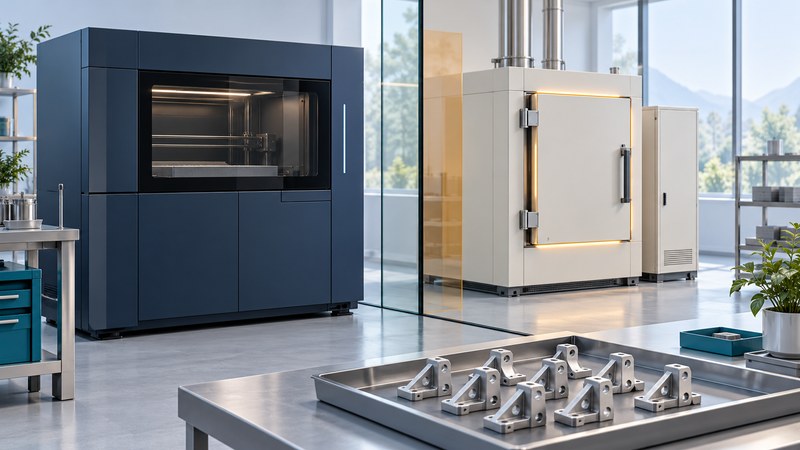
Evaluate a Desktop Metal Production System by its exact model, material route and supported configuration. The meaningful output is accepted parts after all required processing and inspection. Dated launch claims and printer-only rates provide context; a purchase or production plan needs a current, complete workflow.
Read the product history with dates
The Production System name spans different stages of development. In a December 2020 company announcement, Desktop Metal introduced the P-1 for process development and described the P-50 as the larger production platform. Treat the capabilities and delivery statements in that release as statements from that period.
On July 28, 2025, Nano Dimension reported Desktop Metal's Chapter 11 filing. A company-hosted ARC recruiting document, available when checked October 4, 2026, identifies ARC Impact Acquisition Corporation as owner of the Desktop Metal brand and products. That undated document does not establish availability or support for every Production System model.
For an actual machine, request dated written confirmation of the selling or servicing entity, model and serial number, supported software, qualified materials, spare parts, furnace route and service region. Resolve any gap before committing the process to a production schedule.
Map the route to an accepted part
On narrow screens, scroll the table horizontally. Keyboard users can focus it and use the arrow keys.
| Stage | Measure | Question for the trial |
|---|---|---|
| Printing | Build occupancy, nesting, print time and interruptions | Does the actual geometry and powder fit the quoted configuration? |
| Green-part handling | Required cure, recovery and depowder steps for the material route | Can fragile features survive handling with repeatable labor and loss? |
| Thermal processing | Applicable debinding/sintering route, furnace load and full cycle | Do shrinkage, distortion and furnace capacity support the target? |
| Finishing and inspection | Machining, surface work, measurements and disposition | How many parts meet the drawing after all required operations? |
Use the approved material route to identify which steps apply. Track batches through queues as well as equipment cycles. A printer can finish its next build while the previous batch waits for a furnace, inspection or rework. Record calendar lead time separately from hands-on labor and machine hours.
Use accepted parts in the denominator
State whether the cost boundary includes powder losses and reuse controls, binder, labor, energy, consumables, finishing, inspection, maintenance and allocated equipment cost. Show rework separately and reconcile it before final yield. Compare alternative processes using the same drawing, quantity, acceptance rule and cost boundary.
Ask for a representative production trial
Select parts that include difficult walls, holes, unsupported features and dimensional requirements from the intended family. Agree on material condition, inspection method, sampling and rejection rules before the run. Keep build location, thermal batch and inspection results linked to each part.
Require evidence for accepted output over a stated elapsed period, including downtime and queues, before treating a speed claim as capacity. Use CAD-to-metal preparation for the part brief and preserve the supplier's current support commitments alongside the trial record.
Use the working record
Download the editable working record. It includes the task-specific fields, instructions, fictional example and source references needed to preserve the evidence behind a decision. Complete it with the people responsible for the actual process.