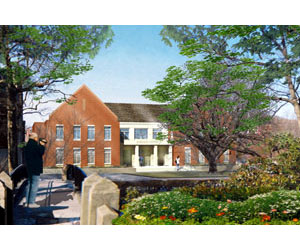
In 2003, Worcester Polytechnic Institute (WPI) deployed a Nortel Networks infrastructure to bring voice, data, remote access, and wireless connectivity into a single converged IP network. The original project connected WPI's main campus in Worcester, Massachusetts, with branch campuses in Waltham and Southborough, and it reflected the campus-network priorities of the time: multi-gigabit backbone capacity, survivable IP telephony, quality of service, secure VPN access, manageable wiring-closet switching, and a wireless LAN that could eventually support broad mobility.
The details now read like a snapshot of an important transition. Universities, hospitals, government offices, and enterprises were moving away from separate voice, data, and wireless systems toward one packet network. IP telephony was no longer just a lab experiment. Wireless was becoming a normal access method. Security had to move from perimeter-only thinking to authentication, tunneling, policy, and threat detection. The converged network was the architectural answer.
The Original WPI Design
The WPI deployment used Nortel Networks Passport 8600 Intelligent Routing Switches in the backbone and core, BayStack switches for desktop connectivity, Succession Multimedia Communication Server 5100 and Meridian systems for IP telephony and unified messaging, Business Communications Manager and Remote Office 9150 for survivable remote voice, Optivity Telephony Manager for administration, WLAN Security Switch 2250 and Access Point 2220 for wireless evaluation, and Contivity IP Services Gateways for VPN and secure remote access.
That equipment mix shows how broad convergence already was in 2003. It was not only a faster LAN. It was a combined architecture for switching, routing, telephony, wireless access, remote work, security, and operations. WPI's network team wanted performance, security, scalability, reliability, and simpler upgrades without creating barriers for faculty, students, researchers, and remote users.
What Convergence Meant Then
Early converged networks were built around several practical ideas:
- One cabling and switching plant: voice phones, desktop computers, servers, and wireless access points could all use Ethernet and IP instead of separate networks.
- Quality of service: latency-sensitive voice and video needed priority over bulk data and best-effort traffic.
- Centralized management: adds, moves, and changes for users, phones, ports, and mailboxes had to become less manual.
- Survivability: branch sites and campus buildings still needed calling and network access when a WAN path or central system failed.
- Secure remote access: VPN gateways extended internal resources to remote users while preserving authentication and encryption.
- Wireless mobility: WLANs were moving from convenience overlay to campus-wide access layer.
These goals are still recognizable, but the implementation has changed dramatically.
What Changed Since 2003
Nortel itself is no longer the vendor anchor it was when the WPI announcement was written. After Nortel entered bankruptcy protection, Avaya was selected in 2009 to acquire Nortel Enterprise Solutions. Many organizations that had Nortel voice and data systems eventually migrated to Avaya, Cisco, Extreme, Aruba, Juniper, cloud communications platforms, or a mix of specialized campus, security, and collaboration services.
The technology center of gravity also moved. IP telephony shifted from proprietary PBX migration projects toward SIP trunks, session border controllers, unified communications, Microsoft Teams and Zoom calling integrations, contact-center platforms, and mobile-first collaboration. Wireless advanced from early 802.11 deployments to Wi-Fi 6, Wi-Fi 6E, and Wi-Fi 7, with 6 GHz spectrum, multi-link operation, higher channel widths, denser AP designs, and identity-aware access controls. Network security expanded into zero trust, NAC, endpoint posture, segmentation, SASE, secure web gateways, and cloud-delivered policy.
Modern Campus Convergence
A current converged campus network is less about placing every service on one monolithic vendor stack and more about making several layers work coherently:
- Wired access: multi-gigabit Ethernet, PoE and PoE++, resilient uplinks, access control, and support for phones, cameras, sensors, APs, building systems, and user devices.
- Wireless access: Wi-Fi 6E or Wi-Fi 7 planning, RF design, roaming, client density, 6 GHz policy, guest access, and location-aware services.
- Voice and collaboration: SIP, emergency calling, analog survivability where needed, softphones, mobile clients, meeting-room systems, and cloud telephony integration.
- Segmentation: separate policy zones for students, staff, research systems, facilities, payment systems, labs, guests, IoT, and administrative applications.
- Security: identity-based access, certificate onboarding, device posture, threat detection, encrypted traffic visibility, firewalling, and remote-access policy.
- Operations: automation, telemetry, log retention, packet capture, configuration versioning, lifecycle management, and service-level reporting.
The best modern designs also assume that users are not always on campus. A student may move between dorm Wi-Fi, classroom networks, cellular, home broadband, cloud applications, and collaboration tools in the same day. A converged network must therefore extend policy and experience across physical locations rather than only inside the campus core.
Voice Over IP Lessons
Voice remains the classic convergence workload because it exposes weaknesses quickly. A data application may tolerate momentary delay; a phone call makes jitter, packet loss, bad QoS markings, failed DHCP options, DNS problems, and poor WAN paths obvious. SIP, RTP, emergency-location handling, call admission, survivable routing, and SBC policy all deserve careful design.
For campuses, the voice plan should include desk phones where they still make sense, softphones for flexible users, paging and alerting, elevator and emergency phones, analog adapters for legacy endpoints, E911 compliance, and a documented failover model. Convergence is successful when voice is just another well-managed application, not when it is treated casually because it now rides on IP.
Wireless Is Now The Primary Edge
In 2003, wireless was often described as an extension of the wired network. In 2026, wireless is the primary edge for many users. That makes RF design, AP placement, roaming behavior, spectrum strategy, authentication, device onboarding, and capacity planning central to the entire network architecture. Wi-Fi CERTIFIED 7, introduced by the Wi-Fi Alliance in 2024, adds capabilities aimed at higher throughput, deterministic latency, and improved reliability, but it still depends on good wireless network management.
A campus network should not upgrade wireless only by swapping APs. It should also validate switch PoE budgets, uplink capacity, DHCP scope sizing, RADIUS resilience, certificate workflows, guest isolation, monitoring coverage, and the impact of 6 GHz-capable clients alongside older 2.4 GHz and 5 GHz devices.
Design Guidance
The WPI project remains useful because it treated convergence as an institutional infrastructure project, not a gadget refresh. A modern refresh should do the same:
- Inventory applications and endpoints before choosing switch or wireless hardware.
- Define QoS policy for voice, video, control traffic, backups, research data, and best-effort Internet use.
- Segment by risk and role, not only by building or VLAN habit.
- Design remote access and cloud access as first-class paths.
- Keep emergency calling, physical security, and facilities systems in scope.
- Test failover with real services, including voice calls and wireless roaming.
- Plan lifecycle management for certificates, firmware, optics, APs, phones, and management platforms.
The language of converged networking has changed, but the architectural lesson has held up. A campus network is most valuable when it lets people move among devices, buildings, services, and locations without forcing them to understand the underlying transport. The infrastructure has to be fast, resilient, secure, observable, and flexible enough to keep absorbing the next wave of applications.