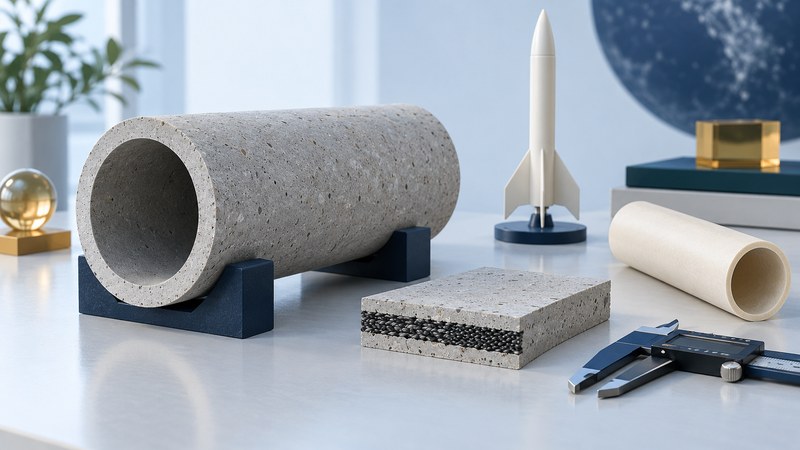
A concrete rocket is an intriguing materials question: can a cement-based composite form part of a lightweight airframe? The useful lesson is how to evaluate the complete structure, including reinforcement and joints, against the loads it must carry.
The UAH project as a starting point
In 2002, the Journal of Light Construction reported on a small concrete rocket built by University of Alabama in Huntsville students and quoted faculty adviser John Gilbert about possible aerospace uses for their lightweight composite research. The report connects the idea to the university’s concrete-canoe work. It is a contemporary account of an experimental project and the ambitions around it.
A stronger claim—such as a world first, superiority to aerospace composites, or a particular flight record—needs the corresponding technical or historical evidence. The surviving reporting supports a useful case study in asking better questions. It does not establish a general replacement for conventional flight structures.
Start by separating airframe from propulsion. The airframe carries loads and holds other systems in position. Fuel and oxidizer belong to the propulsion system. Calling an airframe “concrete” says something about a structural material, rather than identifying the source of thrust.
Describe what the material must do
NASA’s rocket structural-system introduction explains the need to transmit flight loads while keeping structural weight low. The distribution of that weight also matters to stability and control. A material sample therefore answers only part of the vehicle question.
Concrete performs differently in compression and tension. The Concrete Society’s reinforcement explanation describes how combining materials helps carry tensile loads. For a specialized composite, the type, orientation, bond, and amount of reinforcement all affect behavior. Properties measured for one mixture or specimen cannot simply be assigned to another.
On a narrow screen, scroll the table sideways. Keyboard users can focus the table region and use the arrow keys.
| Property | Plain-language question | Evidence to look for |
|---|---|---|
| Density | How much mass occupies a given volume? | Measured mass and volume, with moisture condition stated. |
| Stiffness | How much does the part deform under a load? | Load and displacement data for a stated shape and support arrangement. |
| Strength | At what load or stress does a defined failure occur? | Test method, dimensions, loading direction, and failure criterion. |
| Damage tolerance | How does damage affect continued load carrying? | Inspection and tests that address cracks, impacts, or other relevant damage. |
A rigid part can fail abruptly; a flexible part can remain intact over a larger deformation. “Strong,” “stiff,” and “tough” therefore describe different aspects of performance. A credible comparison names the property and the test behind it.
Compare finished parts, not just density
A fair comparison first defines the same job for both parts, then includes every element needed to do it. If one candidate must be thicker, its volume also changes. Include those geometry and assembly differences before drawing a conclusion from density.
Read a demonstration as evidence
A flight demonstration can show that a particular assembly operated under particular conditions. Broader claims require more information: the vehicle identity, materials, geometry, loading, inspection results, and repetitions. The record should connect every measurement to the same specimen or vehicle.
Keep a proposed larger prototype separate from an already-tested small one. Likewise, do not transfer a height, altitude, or recovery result from a nearby account of another team rocket. Photographs, dated project records, and test reports can resolve those distinctions; a shared university name cannot.
NASA’s research on refractory concrete in tension and compression illustrates the value of measuring separate mechanical properties for a specific application. That work concerns launch-pad flame-deflector material, not the UAH airframe, and its values should remain attached to that use.
Use a materials claim worksheet
Download the plain-text materials claim worksheet to evaluate an article, exhibit, or research abstract. It is a reading exercise.
- Write the claim exactly enough to identify what is being compared.
- Name the complete part, its intended task, and the material system.
- Separate measured properties from predicted performance and future proposals.
- Record the source, date, units, test conditions, and number of specimens.
- State the narrow conclusion supported by the evidence, followed by the next unanswered question.
The concrete-rocket story becomes more interesting with this discipline: an unusual idea leads to measurable questions about how materials, geometry, reinforcement, and evidence work together.