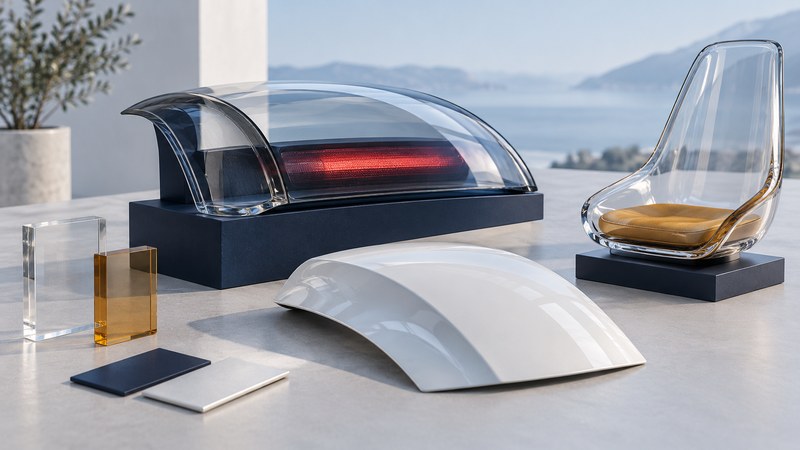
A transparent panel, an illuminated surface and a coating that recovers from damage describe different behaviors. zaZen offers a useful exercise in keeping those claims separate, even when they appear together in one striking concept car.
What the 2006 material story actually described
Rinspeed described a Makrolon polycarbonate canopy, a holographic effect for the third brake light, transparent seat shells with Technogel cushioning, and a self-healing polyurethane clearcoat over the crystalline white body finish. It separately described switchable transparency in three-dimensional forms as ongoing research. The coating claim concerns the body finish; it should not automatically be assigned to the canopy. See the English zaZen press text (PDF).
This distinction changes how the story should be read. The source supports an account of a concept and its materials program. It does not establish that the car’s entire canopy could switch dark at the touch of a button, or supply a quantified scratch-recovery result.
Turn each feature into a separate evidence question
The questions below are a reading framework, not results from tests on zaZen. Each row asks for evidence matched to the particular behavior being discussed.
On a narrow screen, scroll the table sideways. Keyboard users can focus the table region and use the arrow keys.
| Claim category | What to record | Evidence that would resolve the question |
|---|---|---|
| Canopy transparency | Which component, viewing angle and lighting condition? | Optical measurements and observations through the actual shaped part. |
| Rear brake-light effect | Where does the light appear, and under what conditions? | An operating demonstration with a defined viewing position and ambient light. |
| Transparency switching research | What changes between states, and what commands the change? | A documented state transition on the specific component. |
| Body clearcoat recovery | Which layer is damaged, and how is recovery defined? | Before/after measurements with damage method, time and conditions stated. |
For instance, a clear canopy seen in a photograph establishes an appearance at that moment. A switching claim asks an additional question: can the same part move between specified states? One image cannot answer that by itself.
Write a question that could be tested
Identify the specimen
Start with the exact part and layer. A bulk plastic, an adhesive, a clearcoat and a finished assembly are different specimens. Record shape and thickness if a source supplies them; otherwise leave those fields open. Results from a flat coupon would need explanation before being applied to a curved vehicle component.
Define the outcome
Replace a broad adjective with an observable result. For transparency, ask what is transmitted and how distortion is assessed. For a luminous effect, ask about visibility from specified positions. For recovery, define the initial damage and the remaining mark after a stated interval. These questions make the boundary of a claim easier to see.
Keep the mechanism honest
The launch description’s reference to a holographic effect does not justify drawing an invented optical path or naming an undocumented projector. A useful explanatory sketch can label the visible surface and the observed effect while leaving internal implementation unresolved.
Likewise, a material name does not establish a service life. A long-term assessment would need exposure conditions, cleaning or abrasion procedures, measured changes and an acceptance criterion. This is a proposed evidence checklist, not a suggestion that zaZen failed those checks.
Use an evidence ladder
Classify each statement as an intention, a described feature, an observed demonstration or a measured result. A project can contain statements at several levels. Keeping those levels visible helps a reader appreciate an experimental design without silently converting research ambitions into delivered functions.
Make a claim-by-claim record
Download the zaZen materials claim record. It includes spaces for component, source wording, evidence level and the next testable question. For the vehicle’s overall proportions, layout and integration roles, use the companion Rinspeed zaZen design guide.
Explore Autos: vehicle guides, technology and design · Cars: buying, maintenance and ownership