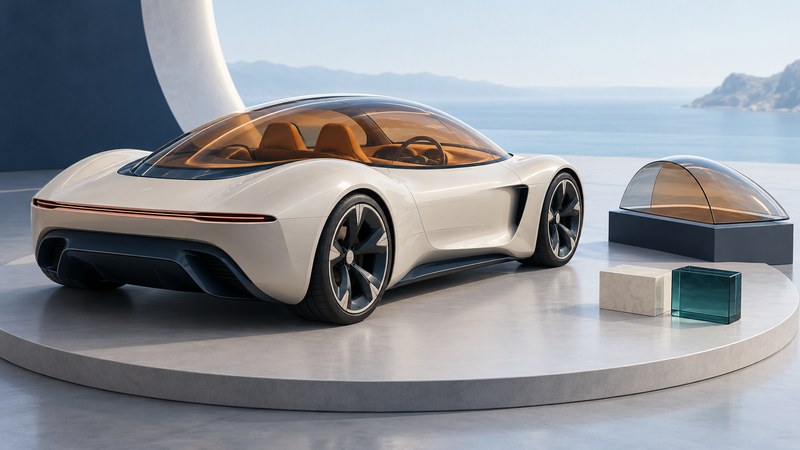
Rinspeed zaZen connects a transparent upper body, a visible cabin and a sculpted sports-car form. Read it first as a whole-vehicle design proposal: what experience does the combination suggest, and which documents explain how the parts were brought together?
A connected design, presented in 2006
Rinspeed announced zaZen for the 2006 Geneva show with Bayer MaterialScience as a partner. Its clear Makrolon polycarbonate canopy extended toward the beltline above an orange cabin. Esoro handled overall project integration, engineering and manufacture. These roles and materials are described in Rinspeed’s zaZen archive.
As a design reading, the clear upper volume makes the cabin part of the exterior composition. A viewer can consider the seats, surrounding surfaces and roof as one arrangement. That interpretation is different from a measured claim about visibility, comfort or cabin temperature; those outcomes need their own evidence.
Anchor the form in a documented package
Rinspeed’s technical data sheet (PDF) lists the following configuration. It identifies the engine family as Porsche 997 Carrera S; this should not be expanded into a claim that every part of the finished concept was an unchanged production Porsche.
On a narrow screen, scroll the table sideways. Keyboard users can focus the table region and use the arrow keys.
| Documented item | Published data | Question it helps frame |
|---|---|---|
| Occupancy | Two Recaro seats | How do the seats sit within the clear upper volume? |
| Dimensions | 4,477 mm long; 1,910 mm wide; 1,284 mm high | How do height and width affect the visual proportions? |
| Wheelbase | 2,350 mm | Where are the cabin and body ends relative to the axles? |
| Powertrain layout | Rear-wheel drive; six-speed manual | Which packaging decisions should a technical drawing explain? |
| Construction | Steel chassis; composite body | Which visible surfaces are body panels, and which are structural? |
A dimensions table is a starting point for reading proportions. It does not reveal seating posture, eye position or the internal clearance around a mechanism. When comparing concept drawings, use the same view and scale so that camera perspective does not become an accidental design conclusion.
Review the concept in three passes
1. Form and experience
Sketch the boundary between opaque body and clear canopy. Mark where the cabin becomes visible from outside. Then describe the intended experience in your own words: openness, enclosure, display or privacy. Keep those words separate from claims that require user testing.
2. Interfaces between parts
Trace the canopy-to-body junction and the relationship between seats, controls and glazing. Useful engineering questions concern sealing, access, reflections and the management of sunlight. Asking these questions does not establish a defect; it identifies the information a whole-vehicle assessment would need.
3. Delivery and evidence
Distinguish the concept’s organizing idea, the engineering work that integrates components and the supplier contribution behind a particular material. A named material alone cannot explain the complete vehicle. Equally, a finished show car does not provide all the evidence needed to judge long-term operation.
A strong comparison with another concept therefore uses a repeated set of headings: design intention, occupant arrangement, body architecture, component interfaces and evidence available. This produces a more useful comparison than a collection of promotional superlatives.
Keep design and materials questions connected
Download the zaZen whole-vehicle design record to capture those three passes. Use the companion zaZen materials and optics guide for the clear canopy, lighting effect, surface coating and the boundary between demonstrated features and continuing research. Together the two records connect the visible proposal with the evidence behind its component claims.
Explore Autos: vehicle guides, technology and design · Cars: buying, maintenance and ownership