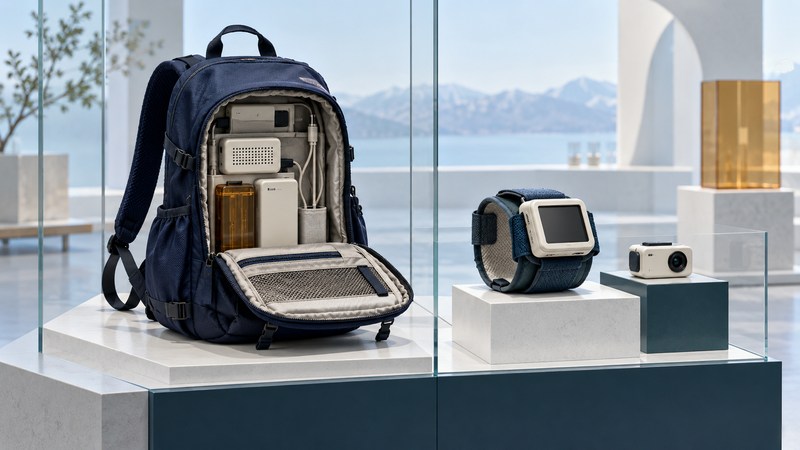
Commander Pack and CommanderGauntlet belong to the early-2000s effort to carry computing, communications and field interfaces as one wearable system. Their lasting interest lies in integration: where to put the electronics, how to reach the controls, and how to keep power and network connections usable while a person moves.
On a narrow screen, swipe tables sideways or focus them and use the arrow keys.
Start with the surviving documentary record
The USPTO Official Gazette of June 7, 2005 (PDF) includes a COMMANDERPACK entry, serial 78-258,210, filed by Douglas G. Linman on June 4, 2003. Its goods description identifies an integrated kit including a tablet computer, communications, GPS, power and other equipment in a transportable case. The entry records a claimed first-use date of May 2, 2003.
The April 19, 2005 Gazette (PDF) lists NetworkAnatomy’s CommanderGauntlet, serial 78-312,844, filed October 13, 2003. It describes communications and computing components, lighting, a miniature camera and microphone integrated into a wearable glove. The entries are on printed pages TM 313 and TM 414 respectively; the PDFs are about 29 MB and 27 MB. Search for the serial numbers if the page link is not honored.
These records establish a documented product concept and the applicant’s description. They are not laboratory performance reports. Dimensions, runtime, waterproofing, deployment history and current serviceability require other evidence. The distinction is essential when interpreting an ambitious wearable system from a short announcement.
Map the system by function
- Body-carried electronics and power
- Wearable controls, display, camera and audio interface
- Selected radio, cellular or satellite connection
- Remote people, applications or information systems
This map explains the idea without asserting a particular internal wiring arrangement. Moving the display to the forearm can make information easier to reach, while batteries and heavier electronics can remain elsewhere. But the arrangement introduces connectors, wireless links, controls and failure modes between the wearer and the equipment.
| Function | Benefit sought | Evidence needed |
|---|---|---|
| Wearable display and controls | Access information while carrying equipment | Reach, readability, control accuracy and task tests |
| Shared power | Support multiple electronics from a carried supply | Usable energy, conversion losses, peak load and runtime tests |
| Several communications paths | Provide alternative ways to reach a remote endpoint | Service coverage, subscriptions, routing and failover behavior |
| Camera and audio | Capture and transmit information | Usable quality, latency, data rate and power under load |
| Protective packaging | Keep equipment usable in its environment | Exact test methods, conditions, results and configuration |
Make the power question concrete
A radio may consume very different power while transmitting and while waiting. A screen’s brightness and a computer’s workload also change the average. That makes the task profile part of the measurement: document what the wearer actually did during a runtime test.
Several links still need an integration plan
Radio, cellular and satellite describe different paths with different endpoint, antenna and service requirements. Putting their hardware in one pack leaves important questions about how a user selects a path, whether data is retained during an outage, and how a remote recipient knows it arrived. A shared power failure can affect every path at once.
For an illustrative evaluation, follow one message from capture to receipt: a form is entered, saved locally, queued, transmitted and acknowledged. Record what happens when connectivity disappears between any two steps. A successful camera demonstration and a successful voice call do not alone establish that the complete information workflow is reliable.
Read ambitious wearable claims with an evidence table
When studying a surviving unit, brochure or demonstration, separate what is visible, what a primary document states, what a test establishes and what remains unknown. Photograph and identify the exact components before assuming that two similarly named configurations are identical. Avoid applying a protective rating from one enclosure to the assembled system.
The historical contribution is a systems question that remains recognizable: how can a person carry computing, power, sensors and several communications tools without the interfaces overwhelming the task? Commander Pack and Gauntlet make that question tangible. Their documented concept is worth explaining even where independent performance evidence is incomplete.