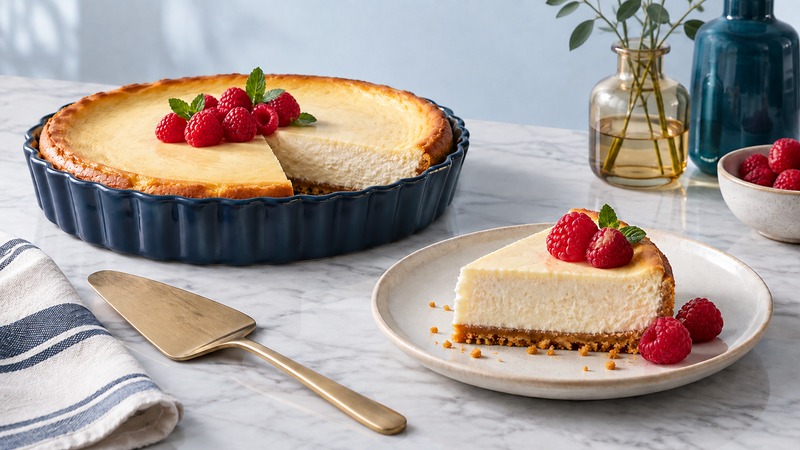
A smooth cheesecake begins before baking: soften the cream cheese, mix gently and use the specified pan. This version makes one shallow 9-inch cheesecake in a pie plate, with a crumb crust and a simple vanilla filling. Plan to bake it the day before serving.
Specify the pan and ingredients
Use a pie pan at least 9 inches across its inside top and at least 1¼ inches deep. Have a mixing bowl, mixer, spatula, baking sheet and digital food thermometer.
Crust: 150 g graham-cracker crumbs, 28 g confectioners’ sugar, 85 g melted butter and ⅛ teaspoon table salt. Filling: two 8 oz blocks cream cheese (about 452–454 g total), softened; 133 g granulated sugar; 2 large eggs; and 1 teaspoon vanilla.
These quantities come from King Arthur Baking’s Easy Cheesecake. Heat the oven to 350°F (177°C). Combine crust ingredients and press into the base and sides. Mix cheese and sugar smoothly on medium-low; blend in eggs and vanilla. Fill the crust and set the pan on a baking sheet.
Bake gently and check the filling
Bake 20 minutes, shield the crust edge with foil, then bake approximately ten minutes more. The source targets 165–170°F measured one inch inward from the filling’s edge; the center remains slightly mobile. Cool on a rack, then refrigerate.
Use the measurement location specified for this shallow recipe. Check the center also reaches 160°F, consistent with FDA guidance for egg dishes. If it is cooler, continue baking briefly and recheck. Insert the probe without contacting the pan. Foil shields the crumb edge while the filling finishes.
Yenra has not kitchen-tested this recipe or the added center check. Its pan and temperature details are deliberately specific; a deeper springform cheesecake needs a recipe designed for its different thickness.
Give cooling its own place in the schedule
Allow the hot pan to cool on a rack away from a draft, then refrigerate promptly and within two hours of leaving the oven. Cover once cool enough to avoid trapping heavy condensation. For a predictable plan, refrigerate overnight before cutting; the next-day texture is easier to assess than a warm slice.
At serving time, cut with a clean thin knife. Dip it in hot water, wipe dry and cut straight down; clean and dry between slices. Keep the pan supported on a stable surface. Slice only the amount needed, returning the rest to the refrigerator.
For eight wedges, each is one-eighth of the measured batch. If you cut twelve, each is two-thirds the size of an eighth. Neither cut changes the total ingredients, and toppings add to the portion.
Understand cracks, lumps and a soft crust
King Arthur’s cheesecake troubleshooting identifies overbaking, vigorous mixing and sudden cooling as causes of cracking. Mix softened cheese until smooth before adding eggs; once combined, stop rather than whipping in more air. Check temperature before the whole center looks rigid.
Lumps: look at how soft the cream cheese was before mixing. Cracks: record the final temperature and mixing speed. Loose warm slice: allow the planned refrigeration time before judging the formula. Soft crumb base: measure butter accurately and keep liquid toppings separate until serving.
This pie-pan method uses no water bath. Adding one changes the heating conditions. For another style, follow a complete recipe for that pan and method.
Serve chilled and store promptly
Refrigerate at 40°F or below and use within 3–4 days, following FDA’s cooked egg-dish guidance. Freeze tightly wrapped portions for longer storage and thaw in the refrigerator. Keep total serving time at room temperature within two hours, or one hour above 90°F.
The cake contains milk, eggs and usually wheat in the graham crackers. Check package labels. Serve berries or a spoonful of cranberry sauce alongside. A layer-cake decorating project uses a different assembly and storage plan.