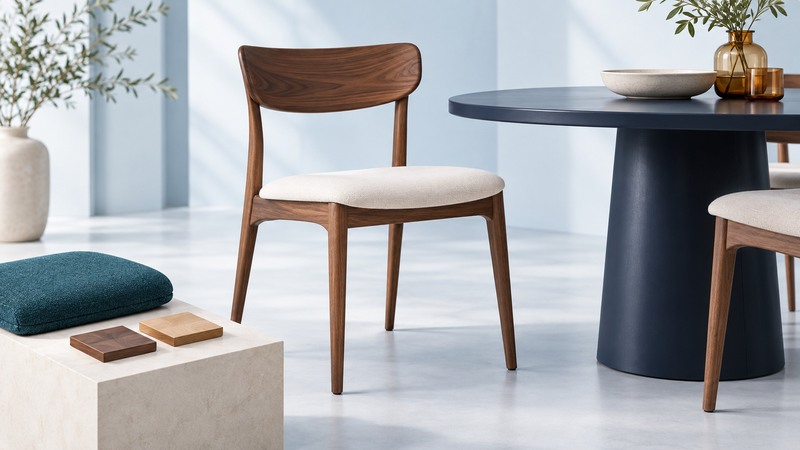
A good wooden chair fits both its user and its setting. Begin with the activity—dining, reading, occasional seating, or shared institutional use—then test the actual chair with the actual table height. Wood species and attractive upholstery are useful details within that larger decision.
Test the seat before comparing finishes
Bring the table measurements, a tape measure, and notes about who will use the chair. Record seat height, usable seat width and depth, overall width, arm height, and the chair’s full footprint. For an upholstered seat, the occupied height may differ from the catalog dimension; compare it by sitting normally.
- Sit with your usual footwear and rest against the back. Notice whether your feet are comfortably supported and whether the seat edge presses behind your knees. Try the positions you actually use during a meal or conversation.
- Move the chair toward the table. Check room for thighs beneath the apron or support structure, and whether arms slide underneath without striking it.
- Stand up and sit down again using the support you normally need. Check whether arms help or obstruct the movement.
- Leave the chair pulled out and occupied while another person walks behind it. Test the narrowest passage, especially with a mobility aid if one will be used.
A brief showroom sit can reveal a poor fit, but sustained comfort needs a longer trial. Ask about a sample chair, showroom appointment, or written return terms before ordering a full set. For a new arrangement, use the steps in planning a room before buying furniture.
Inspect the complete assembly
Look underneath with the seller’s permission. Identify where seat rails meet legs, how the seat attaches, and whether fasteners remain accessible. Ask which joints are glued, mechanically fastened, or designed to be taken apart. A visible joint style is only part of the construction: dimensions, workmanship, adhesives, and the complete design matter too.
On a small screen, scroll the table sideways. Keyboard users can focus it and use the arrow keys.
| Part | What you can check | What to request |
|---|---|---|
| Frame and joints | Cracks, open glue lines, missing hardware, uneven feet, or movement during ordinary use. | The assembly instructions, intended use, and written capacity for the exact model. |
| Seat and back | How the seat is fixed; whether the back supports you where you need it. | Availability of replacement seats, backs, cushions, and fastening hardware. |
| Feet and glides | Contact with the floor and suitability for your flooring. | Compatible replacements and care instructions for the floor/chair combination. |
| Finish | Feel edges and examine the sample under your room’s light. | Finish name, cleaning instructions, and the process for repairing a scratch. |
Do not test strength by rocking onto two legs or applying improvised loads. If a used chair has loose structural joints or cracks, set it aside for assessment before use. A seller’s rating needs to apply to the whole chair and its intended environment.
One construction example is the Eustis Joint, described by its manufacturer in this PDF, which uses steel rods bonded inside wooden joints with epoxy. That explains a reinforcement method. A joint demonstration alone does not establish the load rating or comfort of every chair using it. Ask for model-specific documentation.
Choose upholstery for the real cleaning routine
Take a fabric sample home and compare it beside the table, floor, and existing textiles in daylight and evening light. Consider crumb removal, likely spills, pet contact, and whether a textured weave catches things you regularly wear. Decide who will clean the chairs and what equipment they have.
Write down the fabric or leather code as well as the chair model. A removable cover may still require specialist cleaning; removability and washability are different specifications. Request the textile supplier’s cleaning instructions and confirm that the method is also suitable near the wooden frame.
For commercial orders, establish who approves the upholstery, who supplies it, and which suitability requirements it must meet. Eustis Chair’s FAQ explains the trade terms COM (customer’s own material) and COL (customer’s own leather), and points customers to its care guide. Use the actual supplier’s terms when comparing quotes.
Make one useful comparison
Compare the full cost of the combination you will receive: chair, selected upholstery, delivery, assembly, glides, and any return charges. For a set, confirm whether later chairs can be ordered in the same finish and whether natural variation is acceptable. Keep a photograph or approved sample of the finish.
Use the editable chair comparison worksheet (plain text) to record two candidates and the reason for your final choice. An unresolved clearance or repair question should remain visible instead of disappearing into an overall score.
Keep the chair usable
Save the assembly sheet, finish and fabric identifiers, receipt, and parts contact. Follow the maker’s cleaning and fastening instructions; use the specified method and interval rather than applying a generic polish or tightening routine. Check feet and glides when the chair starts marking the floor or sitting unevenly.
Wood responds to changes in moisture. The USDA Forest Products Laboratory’s Wood Handbook explains moisture relations and dimensional change; a coating can slow moisture exchange but does not eliminate wood movement. Keep the maker’s environmental guidance with the care record, and investigate recurrent joint movement or splitting rather than disguising it with finish.