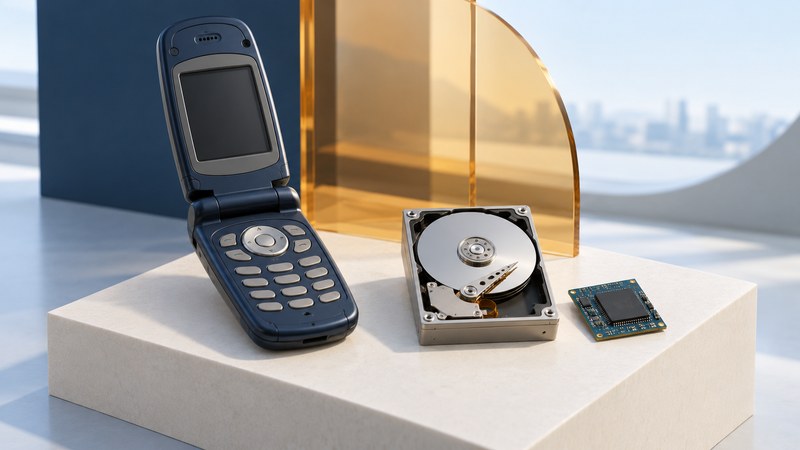
The Samsung SPH-V5400 put a miniature 1.5 GB hard disk inside a phone in 2004. It captures a moment when music, photographs, and video were turning a handset into a portable media library, and manufacturers were exploring how much storage a pocket device could carry. Its rotating drive is the central historical feature.
Separate the demonstration from the launch record
Samsung's 2004 annual report places the SPH-V5400 demonstration in September. A later Samsung Korean launch announcement dated December 3, 2004 describes the 1.5 GB, one-inch-class drive and the product being released. These are different milestones, so September's exhibition record should not be treated as a universal retail-availability date.
The December release also describes a 2.2-inch QVGA display, a megapixel camera, music playback, and electronic-book functionality. Samsung promoted the device as an industry first. Attribute that priority claim to the company; the primary records establish what Samsung announced, without providing a complete survey of every earlier prototype.
The feature combination explains the design question: how could a phone carry substantially more personal media while remaining portable? The capacity figure becomes meaningful when connected to file sizes and the physical storage system.
A small rotating disk is still a mechanical system
A hard disk records data magnetically on a rotating platter and uses a moving head assembly to read and write it. Flash stores data electronically without that spinning mechanism. Kingston's explanation of HDD and solid-state storage describes this basic distinction and the mechanical sensitivity to shock and vibration. Its PC comparisons explain the mechanism; they are not measurements of the V5400.
The advertised one-inch class identifies the miniature drive category, not the diagonal of the handset display or the dimensions of every part of its enclosure. The disk needs a spindle, head mechanism, control electronics, and packaging. Those components have to share the phone with its battery, radio, display, camera, and controls.
The broader industry was exploring even smaller drives. Toshiba's January 2004 announcement described a 0.85-inch disk with planned capacities of 2–4 GB for compact devices, including phones. That separate project provides period context; it does not identify the supplier or drive fitted to Samsung's V5400.
Translate 1.5 GB into an explicit assumption
File counts depend on compression, duration, resolution, reserved space, and other content already stored. Samsung's launch examples advertised up to 300 MP3 files or 1,000 photographs. Read those as separate illustrative maxima from the manufacturer, rather than a promise that both libraries fit together.
For a real collection, total the actual file sizes and compare them with the device's reported usable capacity. Keep decimal GB separate from binary GiB: 1.5 billion bytes is about 1.40 GiB. A smaller displayed number may reflect the unit convention as well as reserved space.
Compare the complete design, not capacity alone
| Design question | Miniature hard disk | Flash-based storage |
|---|---|---|
| Physical packaging | Accommodates platter, spindle, head assembly, and enclosure. | Uses electronic packages without rotating storage components. |
| Access and energy | Drive operation includes mechanical motion; assess the actual duty cycle. | Controller and memory activity still consume energy; measure the whole device. |
| Handling | Mechanical shock and vibration are relevant design considerations. | Removes the rotating mechanism; the assembled phone still has physical limits. |
| Historical economics | Offered a route to a larger media library in a small device. | Increasing density and changing cost altered the design choice over time. |
These are engineering questions, not a reconstructed bill of materials or a battery-life ranking. Exact shock ratings, power draw, reliability, and access latency require the actual drive and handset documentation. Evidence for another miniature drive cannot supply those missing specifications.
A Toshiba retrospective on HDD development describes small drives used in portable media devices and the subsequent displacement by flash. The V5400 is useful because it makes that transition tangible: multimedia ambitions, storage density, mechanical packaging, and component economics met inside one handset.
Read a surviving handset as a historical object
For a collection record, document the full model, regional variant, firmware, visible condition, accessories, and source of each specification. Separate a photograph of the device, a manufacturer announcement, and a successful operation observed today. Each answers a different question.
A phone powering on establishes less than successful access to its stored files. Preserve valuable data through an appropriate documented process before experimentation; this history is not a disassembly or recovery guide. Its most useful comparison with a current phone is architectural: both carry personal media, but their storage implementations belong to different design contexts.
For today's capacity planning and the distinction between working memory and storage, continue with the phone memory guide. For another historical handset built around a distinctive physical design, see BlackBerry on the Siemens SK65.