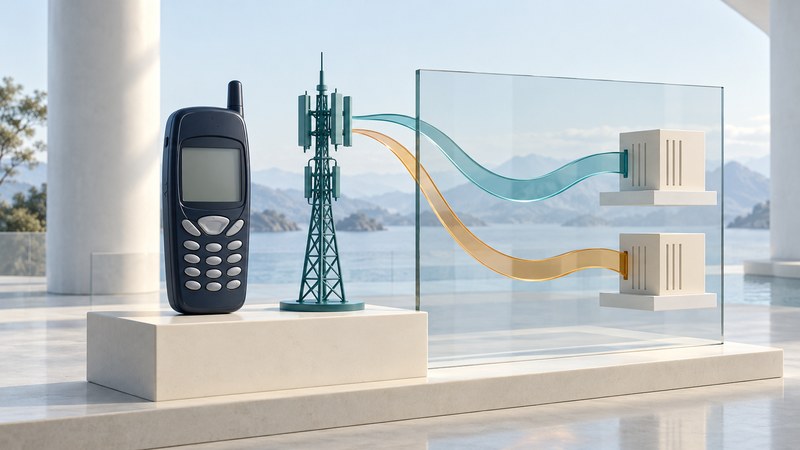
CDMA2000 1X is a cellular radio technology associated with voice and packet-data service on earlier mobile networks. Understanding an old phone requires three separate checks: which radio technologies it supports, which services the operator still provides, and whether that operator accepts the exact device. A familiar brand name or a working screen answers none of those service questions.
Place 1X in its technology family
CDMA describes code-division multiple access, a way of sharing radio resources. CDMA2000 names a particular standards family. 1X, also encountered as 1xRTT, identifies its single-carrier radio transmission technology. EV-DO identifies the family's data-optimized evolution.
| Name | How to read it | Question for a handset record |
|---|---|---|
| CDMA2000 1X | A radio technology used for voice and packet data. | Which bands and operator service did this variant support? |
| EV-DO | A data-optimized member of the CDMA2000 family. | Which revision and which data service were implemented? |
| WCDMA / UMTS | A different 3G standards family, associated with the GSM evolution path. | Does the device explicitly support it? |
| LTE with operator-supported voice | A later radio and service combination requiring its own device support. | Does the exact model meet the operator's voice and activation requirements? |
The ITU's 2003 report on the evolution to 3G includes CDMA2000 1X among IMT-2000 technologies. Qualcomm's 3G overview distinguishes CDMA2000/EV-DO from WCDMA/HSPA. Both families involve CDMA techniques; a shared acronym does not establish device interoperability.
Keep voice and data capabilities separate
Many CDMA2000-era devices combined 1X voice with EV-DO data. A feature list should identify each supported technology rather than compressing everything into “3G.” Qualcomm's 2003 EV-DO announcement explicitly describes the technology as optimized for data. The speed and features of a particular implementation still depend on its revision, device, and network.
Service retirement adds another layer. Verizon's CDMA retirement notice identifies its end-of-2022 retirement program and confirms decommissioning in early January 2023. It covers 1XRTT/CDMA devices and also explains the consequences for older LTE devices lacking the required HD Voice support. This is an operator-specific history, not a worldwide shutdown date.
For a current decision, consult the intended operator's device eligibility and service information. Separate “the radio supports this band” from “the provider will activate this model” and “the needed voice or data service is available.”
Build a record for the exact handset
- Identify the variant. Record the model number, regional or carrier suffix, and software version from the device and its documentation. Keep serial and subscriber identifiers private.
- List radio support. Copy technologies and bands from a matching manual or specification. Mark unknown entries rather than inferring them from the logo.
- Name the intended task. Ordinary calling, messaging, internet access, and inspecting locally stored material have different dependencies.
- Check the operator. Record the country, provider, date checked, exact eligibility result, and source. An old coverage map supplies historical context only.
- Keep the conclusion narrow. Label a feature confirmed, unsupported, or unverified, with the evidence behind that label.
Download the handset compatibility record for a blank version and a fictional example. It is an inspection aid, not an activation procedure.
Work through a fictional collector's question
For choosing a currently supported everyday phone, continue with tasks, compatibility, and support. For the application layer on older handsets, see how BREW applications were delivered.