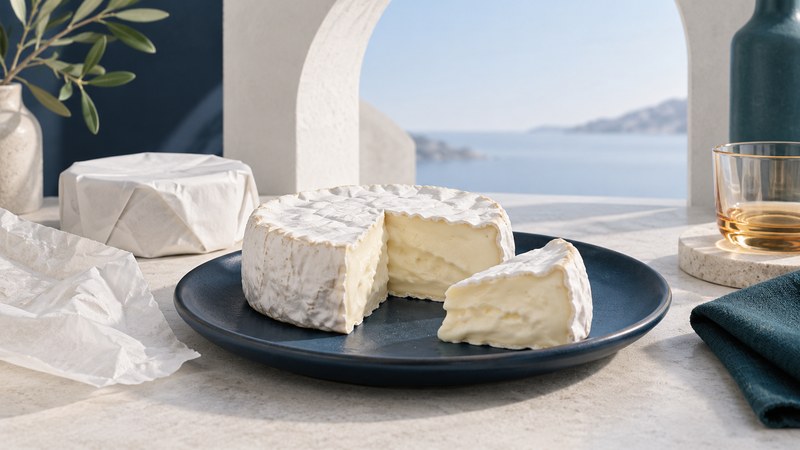
Camembert’s familiar white rind develops as part of cheesemaking. The useful distinction is between that intended rind and unexpected growth on a stored cheese. Start with the exact product, its label and its storage history; use official handling guidance when something has changed.
What the bloomy rind does
Président’s explanation of edible bloomy rinds describes the rind as an edible part of Brie and the closely related Camembert. Its texture and flavor contribute to the bite. USDA guidance on molds and cheese also identifies white surface molds on these cheeses as part of production, alongside the molds deliberately introduced inside blue cheeses.
For a sound cheese handled according to its label, eating the intended rind is a preference. A small wedge lets you compare rind and center together. Removing rind for a recipe changes the dish’s flavor and texture; follow that recipe’s directions. Removing a suspicious surface from a soft cheese does not make the rest safe.
Use the right handling rule
On a narrow screen, focus the table and use the arrow keys to scroll.
| Situation | Action | Why the distinction matters |
|---|---|---|
| Normal rind on a properly stored Camembert | Follow the product’s instructions; the intended rind is edible | Manufacturing molds are part of this cheese style |
| Unexpected mold on Camembert or Brie | Discard the soft cheese | USDA distinguishes unwanted growth from the manufacturing rind |
| Unwanted mold on sliced, shredded or crumbled cheese | Discard it | Contamination can extend beyond a visible spot |
| A small mold spot on a hard block without manufacturing mold | USDA allows cutting at least 1 inch around and below the spot; keep the knife clear and rewrap | This hard-block rule does not apply to Camembert |
The table summarizes USDA’s cheese-specific guidance linked above. Soft blue cheeses and mixed cheese preparations require attention to their actual form, too. When you cannot identify the product or determine whether a change is expected, keep it out of the meal and contact the producer or discard it. Do not taste suspect cheese or sniff a moldy item closely.
Keep the information that makes a decision possible
- Save the wrapper: retain the cheese name, milk treatment, date, lot details and storage directions.
- Record opening: note when you first cut the cheese and follow any use-after-opening instruction.
- Control storage: cover the cut portion and keep the refrigerator at 40°F (4°C) or below, following FDA refrigerator guidance.
- Check changes in context: a producer can describe the normal rind for its product. Color alone cannot identify a microorganism or prove safety.
Example: a new green patch on an opened Camembert is a different situation from its usual white rind. The soft-cheese discard guidance applies to unexpected mold; shaving off the patch borrows the wrong rule. A familiar-looking wheel left without required refrigeration also needs a time-and-temperature assessment.
Separate serving preference from food safety
FDA serving and time limits advises discarding perishable food after more than two hours without temperature control, or one hour when the surroundings exceed 90°F. Count preparation and serving time together. Put out a modest portion and keep the reserve refrigerated so a long gathering does not require a whole wheel to sit out.
For people who are pregnant, 65 or older, or have weakened immunity, use CDC’s safer food choices when selecting cheese. The guidance includes pasteurized hard cheeses among safer choices and advises avoiding unheated raw-milk cheeses. A normal rind and a pleasant aroma cannot establish that a cheese meets a guest’s needs.
For label choices, ripeness preferences and sourced baking directions, continue to Camembert: Buying, Ripeness and Serving. For the different role of blue veining, see the blue-cheese introduction.