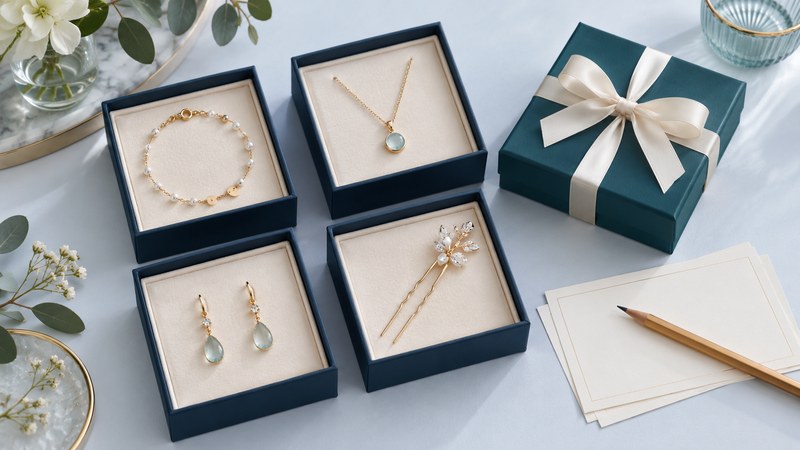
Choose bridesmaid jewelry by agreeing a simple visual brief and letting each person choose something comfortable within it. Separate any requested wedding-day accessory from a thank-you gift, and settle who pays before anyone orders.
Keep the shared brief small
Choose one or two features that matter to the overall look: a metal color, a modest scale, or a pearl-like accent. Describe them with a reference photograph and plain language. Leave room for an existing necklace, different earring styles, a bracelet or no jewelry. A shared brief can work across different outfits without asking everyone to wear the same item.
Ask privately about practical preferences: whether the person wants earrings, a necklace or neither; which fastenings they already use comfortably; preferred length or weight; and materials they already know they wish to avoid. “I’d prefer my own earrings” is a complete answer. Someone can decline a style without explaining a piercing, skin issue or personal reason.
Use precise material descriptions when buying. The FTC’s jewelry shopping guidance explains why metal markings and descriptions matter. Ask about the parts that touch skin as well as the ornament. Broad comfort or “hypoallergenic” marketing should not replace the wearer’s preferences and the seller’s actual composition details.
Original message to the group
“The idea is small, warm-metal accessories, with pieces you already own very welcome. A necklace, bracelet, earrings or no jewelry all work. If you’d like one of the options I’m buying, send me your choice privately by Sunday. I’ll cover it, and wearing it afterward is entirely up to you.”
Change the payment sentence to match the real arrangement. If attendants are being asked to spend money, state the full proposed cost and get individual agreement before placing an order.
Offer choices that solve different needs
| Choice | Useful when | Confirm privately |
|---|---|---|
| Wear an existing piece | The person already has a comfortable accessory they enjoy. | Whether they want to use it and whether its owner permits any borrowing. |
| Choose from a small set | The group wants a similar scale or color with different forms. | Exact item, dimensions, fastening, materials and who pays. |
| Use a different accessory | A bracelet, hair accessory or another detail better suits the wearer. | Whether it works with the outfit and hairstyle and feels comfortable in a trial. |
| Wear no jewelry | The person prefers the outfit as it is. | A simple acknowledgment, with no explanation required. |
For earrings, ask the wearer which fastening they want before selecting anything. Clip-on styles also deserve a comfort trial. For necklaces, check length against the actual neckline; for bracelets, check closure and whether the piece catches sleeves. Use seller-permitted trials and keep packaging until the decision is settled.
Make the thank-you gift personal
A gift can reflect a person’s own taste and may be given separately from the wedding outfit. If the item is specifically required for the day, explain that purpose and the payment arrangement clearly. A note naming something you appreciate about the person gives the gift meaning even when each attendant receives a different piece.
Use a comparable spending allowance if that helps you plan, while allowing different forms or a non-jewelry gift. Share only the information needed to coordinate delivery. Private preferences belong with the person placing the order, rather than in a group spreadsheet.
Check the whole order before paying
- Confirm the exact items. Record seller, product reference, finish, dimensions, quantity and any engraving. Ask for material details and care instructions. See Wedding Jewelry for pearl, gemstone and heirloom questions.
- Calculate the total. Include tax, delivery, gift packaging and adjustments. In a fictional example, four pieces at $24 cost $96; adding $8 shipping and $6 wrapping makes $110 before any tax. Replace every amount with the actual quote.
- Read the conditions. Check the return window and exclusions for earrings, personalized items or opened packaging. Get the terms in writing and decide how an uncomfortable or late item will be handled.
- Allow a decision point. Set a delivery date early enough for inspection and the agreed trial. Use an existing piece or no jewelry as the fallback if the order cannot be made workable in time.
At handover, check the contents and fastenings together. Include the care information and a gift receipt when appropriate. Carry each piece in its own suitable pouch or box. For borrowed jewelry, agree the return date and person responsible; for gifts, let recipients take their pieces home.
Download the private preference form and order checklist (TXT). Keep individual answers private; copy only item and delivery details into a shared task list. For broader responsibilities and costs, use the bridesmaids guide.