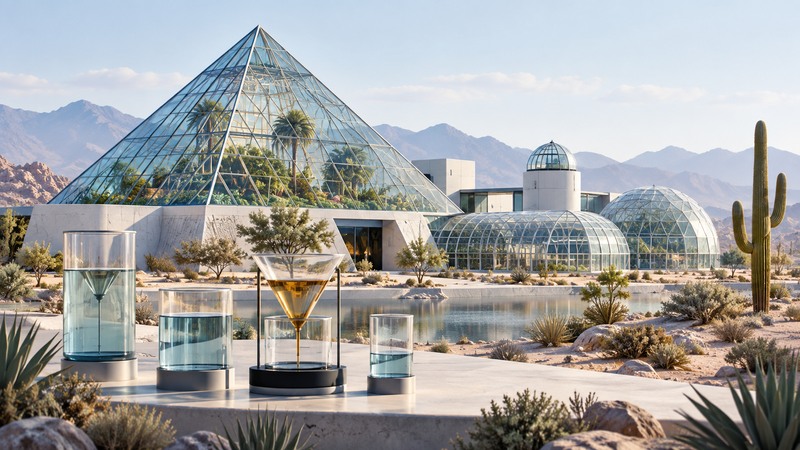
Biosphere 2 in Oracle, Arizona, is a research facility where scientists investigate interactions among water, soil, vegetation and the atmosphere. Its value is the ability to study complex systems while measuring and controlling selected conditions.
For a visit, class project or research story, ask three questions: which system was studied, what changed, and how was the response measured? Those questions connect the impressive enclosure to the scientific evidence produced inside it.
Place the facility’s history in context
The facility’s official history describes its early closed-system missions and later research use. The University of Arizona assumed ownership in July 2011. Research questions and operating configurations have changed over the facility’s history, so attach a date and experiment name to any specific claim.
The current Biosphere 2 overview introduces systems including rainforest, ocean, desert, mangrove and the Landscape Evolution Observatory. These provide different ways to study environmental processes. A result from one enclosure has a defined experimental setting and needs further evidence when applied to a wider ecosystem.
Read the design before the result
On a narrow screen, scroll the table sideways. Keyboard users can focus it and use the arrow keys.
| Part of the study | What to identify | Why it matters |
|---|---|---|
| System boundary | Enclosure, soil volume, organisms and exchanges with surroundings. | Defines what is being measured. |
| Intervention | A changed rainfall, temperature or other specified condition. | Identifies the proposed cause. |
| Comparison | Replicates, control conditions or a documented baseline. | Helps separate the intervention from other variation. |
| Measurements | Sensors, samples, units, calibration and time interval. | Connects the observation to the reported quantity. |
| Inference | The process or model the result supports. | Sets the scope of the conclusion. |
Ask what was held constant and what still varied. A controlled facility can make a mechanism easier to examine while retaining complexity within soil, water and living communities. Measurement uncertainty, missing pathways and time lags still require attention.
Use LEO as a concrete example
The Landscape Evolution Observatory description identifies three experimental landscapes in adjacent bays, initially filled with crushed basalt. Sensors and sampling devices track water, carbon and energy processes as landscapes develop.
The system lets researchers connect an input such as rainfall with storage, drainage and exchanges with the atmosphere. Its controlled geometry and instrumentation support testing models of landscape behavior. Applying those models to natural catchments also requires checking the soils, vegetation, climate and scale of the destination.
Connect a research story to its evidence
Find the experiment’s methods, measured outcomes and publication date. Distinguish measured gas concentration from a calculated carbon flux: concentration describes an amount per volume or fraction, while flux describes transfer over time. Converting one into the other needs information about the system and exchanges.
Look for replication and the range of conditions tested. A response over one experiment’s duration supports a conclusion within that setting; longer-term ecosystem forecasts require models and additional observations. Keep press summaries connected to the underlying study when using precise numerical claims.
Take one research question on a visit
Use Biosphere 2’s visit information for current admission, route and accessibility details. Choose one system to investigate: what enters, what leaves, what is stored and what researchers can change.
Sketch those relationships in the worksheet, note which measurements are visible and record questions for interpretation staff. Keep the historical missions and current experiments distinct in your notes. For a related practical example, the desalination guide follows inputs and outputs through a water-treatment system.
Biosphere experiment reading sheet
Biosphere experiment reading sheet — plain-text download. Save a copy and fill it in with your own information. It includes instructions, example assumptions and source references.