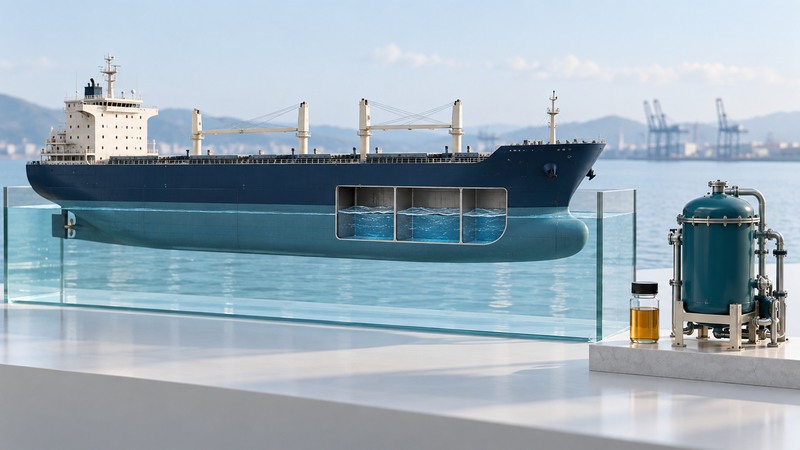
Ships use ballast water to help manage stability, trim and other loading needs. Water taken aboard in one place may carry organisms that are released elsewhere. Understanding the environmental issue means following uptake, storage, management and discharge as one connected route.
This guide helps students, port-community readers and project reviewers assess explanations and equipment claims. Vessel operation requires ship-specific procedures and applicable authority instructions. Start a review with the route, vessel, system and receiving jurisdiction identified.
Trace the transfer pathway
The IMO overview of ballast-water management explains the risk of moving aquatic organisms and pathogens between regions. Survival during transport and conditions at the destination influence the risk of establishment.
On a vessel diagram, locate water intake, ballast tanks, treatment equipment, sampling points and discharge. Include sediment management in the questions. Ask which parts of the route a claimed treatment actually covers and where performance is evaluated.
Record the operating context: source-water conditions, intended flows, time available and destination. A product description becomes much more informative when the reviewer can connect it to that context.
Separate exchange from discharge performance
IMO’s implementation explanation distinguishes the D-1 exchange standard from D-2 discharge performance. D-1 concerns a specified volumetric exchange efficiency. D-2 uses concentrations of viable organisms by size class and limits for indicator microbes.
On a narrow screen, scroll the table sideways. Keyboard users can focus it and use the arrow keys.
| Term | What to identify | Useful review question |
|---|---|---|
| Exchange | Water replaced under the applicable method. | Which requirement and operating conditions apply? |
| Discharge performance | Organism category, concentration, method and units. | Where and how was the discharge sampled? |
| Type approval | Authority, exact system and approval conditions. | Does the certificate cover this configuration? |
| Operating evidence | Relevant records, alarms, maintenance and sampling. | Was this installation operated within its documented conditions? |
For example, IMO describes D-2 limits below 10 viable organisms per cubic meter for organisms at least 50 micrometers in minimum dimension, and below 10 per milliliter for the smaller 10-to-under-50-micrometer class. Microbial criteria add further requirements. Keep the full standard and applicable guidance attached to a technical assessment.
Make a percentage claim show its denominator
Ask for absolute inlet and outlet values as well as reduction percentages. Compare compatible units: one cubic meter contains one million milliliters. Values for different organism classes remain separate even after unit conversion.
Read sample volume and detection or reporting limits. A result reported below a laboratory limit has a specific analytical meaning; retain that qualifier in a chart or summary.
Match approval to the actual installation
Type approval addresses a defined system and its assessed conditions. Match the certificate to the installed configuration and consult its limitations. Then seek evidence about operation, maintenance and relevant monitoring on the vessel.
For US questions, start with the Coast Guard’s current ballast-water FAQ entry point. Use its current linked guidance and applicable regulations to resolve vessel-specific requirements. Flag-state and destination requirements need explicit checks; an approval under one regime should not be assumed to settle every jurisdiction.
Request the relevant management plan, system documentation and the records appropriate to the review. Direct operational problems to the vessel’s responsible personnel and applicable authority. A general article cannot select a safe response for an unfamiliar ship or treatment system.
Write a finding that another reader can audit
A concise review should state the claim, the vessel and route covered, the exact supporting documents and what those documents demonstrate. Separate an equipment approval from evidence of a particular discharge.
For an unresolved claim, name the missing item: a certificate condition, a sampling method, a dated operating record or confirmation from the relevant authority. This turns uncertainty into a specific next check.
The wastewater-treatment guide explains a related reporting principle: a parameter, its units and the sampling period must stay together when interpreting treatment performance.
Ballast-water evidence review record
Ballast-water evidence review record — plain-text download. Save a copy and fill it in with your own information. It includes instructions, example assumptions and source references.