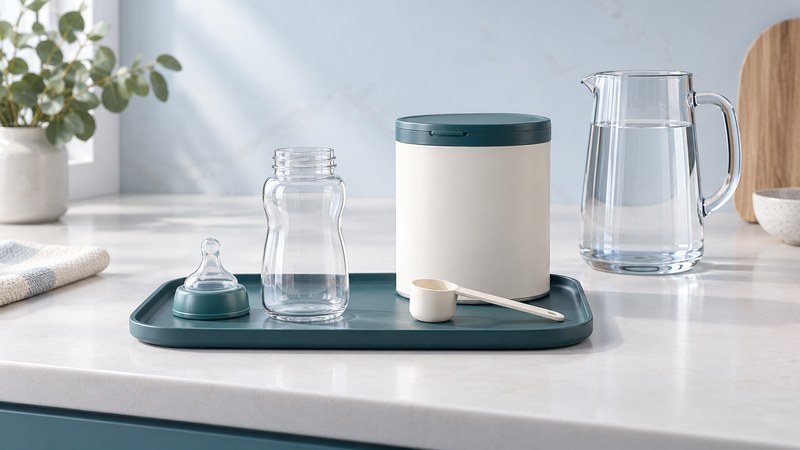
Safe formula feeding starts with the right product for your baby, the exact mixing instructions on its container, and careful handling of every bottle. This guide helps you distinguish formula forms, plan preparation, and keep track of the time limits that protect a feed.
The guidance here is for the United States. Follow a clinician's specific plan for premature infants, allergies, growth concerns, and prescribed metabolic or specialty formulas.
Choose for the baby's needs and your care routine
Choose a commercial product labeled infant formula with iron unless your clinician directs otherwise. Toddler drinks are unsuitable substitutes for babies under 12 months. CDC states that no single formula brand is best; suitability and safe preparation matter. See CDC guidance on choosing infant formula.
Before buying, check the use-by date and packaging condition. Think through who will prepare feeds, whether clean water and refrigeration will be available, and which form you can reliably use. For ongoing vomiting, rash, poor growth, or feeding difficulty, discuss the problem with the clinician before repeated product changes. Write down the exact product name when a particular formula is recommended.
Three forms require different handling
On a small screen, scroll the table horizontally. Keyboard users can focus the table region and use the arrow keys.
| Form | Preparation | Planning question |
|---|---|---|
| Ready-to-feed liquid | Use as supplied; do not add water. | Do you have a suitable feeding container and a way to follow the label's after-opening storage instructions? |
| Liquid concentrate | Add the amount of water specified on its label. | Can every caregiver distinguish this from ready-to-feed liquid? |
| Powder | Measure water first, then add the specified powder using that product's scoop. | Can you carry out the mixing and hygiene steps consistently? |
The FDA formula-handling guide explains the forms. Powder is not sterile; commercially manufactured liquid forms are sterile before opening. All forms require careful handling after opening. Never use a homemade formula recipe or change the water-to-formula ratio to stretch a container.
Prepare one feed with the label beside you
- Clean the work area and your hands. Use clean feeding equipment. Keep dirty items separate from clean parts.
- Read the current container. Confirm the product, form, mixing directions, use-by date, and after-opening instructions. A remembered recipe from another brand may differ.
- For powder, measure safe water first. Add the exact amount of powder specified, using the supplied scoop. Follow any extra preparation precautions below.
- Mix and check temperature. Formula can be served without warming. If warmed, test a few drops on your wrist; it should feel warm, not hot. Never microwave a feed.
- Feed promptly or refrigerate promptly. Mark preparation time so another caregiver can make a clear decision about use or disposal.
Follow CDC preparation and storage guidance. Keep the scoop and powder dry. For washing, air-drying, and additional sanitizing, use the CDC feeding-equipment instructions.
Plan extra precautions for a higher-risk baby
Babies younger than 2 months, babies born prematurely, and babies with weakened immunity need extra protection against Cronobacter. Ask about ready-to-feed liquid. If using powder, CDC advises boiling the water, waiting about five minutes, then mixing while it is still very hot—around 158°F (70°C)—before cooling the prepared feed to a safe feeding temperature. This addresses germs that may be in the powder. See CDC Cronobacter prevention guidance.
For prescribed specialty formula, resolve preparation with the clinical team. FDA notes that some metabolic products have heat restrictions. Match the product's instructions with the baby's risk plan rather than applying a general method automatically.
If the water supply is disrupted, follow local public-health advice and seek a reliable water or ready-to-feed supply. Boiling cannot remove harmful chemical contamination. Bottled water also should not be assumed sterile. The linked CDC and FDA guides explain these distinctions.
Track preparation time and feeding time separately
Scroll horizontally on small screens, or focus the region and use the arrow keys.
| Situation | Action |
|---|---|
| Prepared, with feeding not yet started | Use within 2 hours of preparation; refrigerate promptly if keeping it for later. |
| Feeding has started | Use within 1 hour of the start, while also observing the preparation limit. Discard what remains after the feed. |
| Prepared and promptly refrigerated before feeding | Use within 24 hours of preparation. Follow the product's directions if they require an earlier discard. |
An opened can of powder has a separate label-defined storage period. Record the opening date and keep it tightly closed in a cool, dry place. Opened liquid containers also have their own directions. A bottle's timer and a container's storage instructions answer different questions.
Make handoffs clear
Show the next caregiver the product and its label, your baby's specific plan, and the recorded times. Hold the baby for the feed, allow pauses, and stop at fullness cues. Avoid propping bottles or adding cereal. See CDC bottle-feeding guidance.
A useful handoff says: “This is ready-to-feed liquid; this bottle has not been offered; here is the opening time and the label's discard instruction.” That is more actionable than “There is milk in the fridge.”
Check the exact container when there is a recall
Use the FDA recall database and the manufacturer's notice. Match product name, lot code, package size, and any dates specified. Keep the identifying packaging and follow the affected product's instructions. If an infant becomes ill after a feed, contact the care team promptly and retain the product details for reporting.
For the wider care routine, see newborn care. When your baby is developmentally ready, our starting-solids guide explains the next feeding stage.
Continue exploring
Explore baby care, feeding, and safety. Sources are linked beside the guidance they support. Updated October 11, 2026.