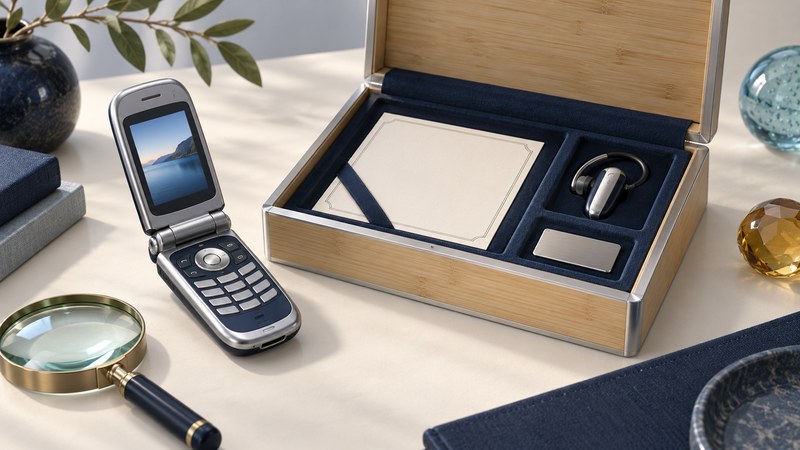
An Aston Martin-branded Motorola V600 combines two histories: the technology of an early camera phone and the presentation of a branded collectible. Understanding one does not establish the other. A useful description identifies the underlying handset, records the edition-related pieces, and shows how the paperwork connects to the particular object.
Begin with the ordinary V600's capabilities
Motorola's V600 user manual documents a clamshell handset with an integrated camera, picture messaging, video-clip playback, Bluetooth connections, and changeable covers. Its display, camera, and communications functions belong to the base model. The existence of those features does not authenticate an Aston Martin edition.
The manual distinguishes features that depend on a network, SIM, or subscription. That distinction remains useful when describing an old phone: a camera opening locally, a Bluetooth accessory connecting, and a cellular call completing are three different tests. Record which one occurred and under what conditions.
The cover-changing instructions are also relevant to identification. If exterior parts can be changed, the appearance of an exterior part cannot by itself establish the history of the entire handset. A collection record should connect the phone, covers, packaging, and documents rather than letting one photograph stand in for all four.
Use edition evidence at the level it actually supports
A useful surviving record is Bonhams' May 9, 2015 catalogue entry, lot 51, reproduced on Classic Driver. The seller's description identifies an Aston Martin DB9 Motorola V600 set with a certificate, Bluetooth hands-free kit, charger, software, instructions, and a metal-and-wood presentation box.
That catalogue is evidence of how one offered set was described. It does not establish the contents of every original package or certify another phone. Its text also gives 713/1000 for the phone and 973/1000 for the box and certificate. It does not explain the discrepancy. The responsible response is to retain both readings and seek clarification, not silently correct one or infer a counterfeit.
Similarly, a denominator of 1,000 on an edition marking is not a manufacturing audit or a count of surviving examples. A certificate can provide valuable context, but its relevance depends on an identifiable connection to the object. A loose document and a matching-looking handset need more explanation than a claim that they belong together.
Precise launch-day, total-production, and certificate-signatory claims require original edition documentation. Without that evidence, leave those fields unresolved. A narrower, well-supported description is more useful than an elaborate story built from repeated sales copy.
Build a provenance record in separate fields
| Field | What to record | What it cannot prove alone |
|---|---|---|
| Handset identity | Model label, private device identifier, and clear photographs. | That the exterior or accessories have always accompanied it. |
| Edition markings | Location, wording, finish, and each visible number. | A continuous ownership history. |
| Box and paperwork | Every number as written, document date, issuer, and physical condition. | That every item was supplied together originally. |
| Accessories | Individual model labels and whether each was tested. | Factory package completeness without a package specification. |
| Ownership trail | Dated receipts, prior descriptions, and photographs linked to this set. | The accuracy of a claim merely repeated from an earlier listing. |
| Changes and condition | Known replacement parts, additions, repairs, and untested functions. | Future reliability or a monetary value. |
Keep full identifiers in the private record and obscure them in public photographs. Transcribe an uncertain character with a question mark rather than guessing. If an old receipt identifies only a model, record that limitation; it may establish a purchase without identifying this exact handset.
Documenting a replacement is not a reason to discard the object's history. It makes that history more intelligible. A replacement battery, later-added headset, or restored cover should have its own note rather than being hidden inside a single “all original” label.
Turn a sales description into answerable questions
A useful resulting note might say: “V600 handset with Aston Martin-marked covers and presentation box; certificate present; relationship between the recorded numbers unresolved; local camera demonstrated; cellular service untested.” That leaves a future reader with specific evidence and specific gaps.
Do not treat a familiar ringtone, screen image, or successful startup as a substitute for provenance. Those observations describe the phone's current presentation. Provenance concerns the documented history of this object and how its parts came together. Keep technical function, edition identity, completeness, and condition as separate conclusions.