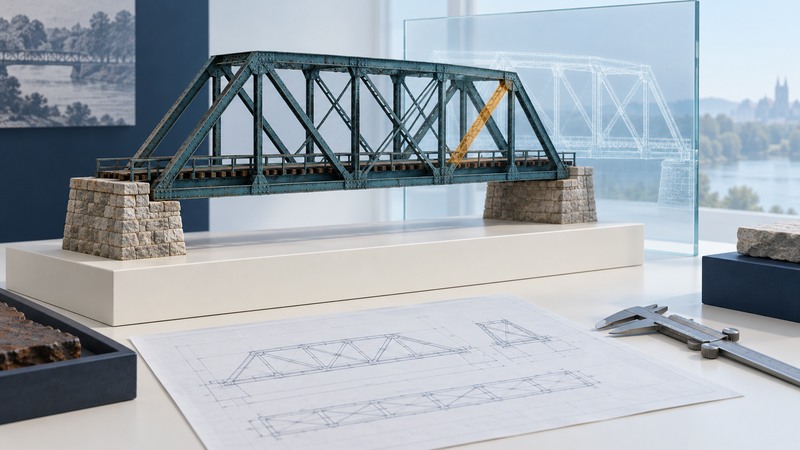
Industrial archaeology studies how people produced goods, moved materials and organized work through the physical traces they left behind. A bridge, mill, machine or abandoned railway can be read alongside drawings, photographs and records to reconstruct both a technical system and the lives connected to it.
Read the whole system
A machine makes more sense when its surroundings are visible. Ask what powered it, what entered it, what left it and who operated or maintained it. For a mill, follow water or another source of power through the building; for a railway, connect track, bridges, yards and the businesses served. Repairs, blocked openings, replacement parts and changes in layout can reveal several periods of use.
Begin with a bounded question: How did this crossing connect a factory to a railway? is manageable. Record the site's name, location, operating period and the date of each piece of evidence. A survey made decades after construction describes a later state of the place. Keep the construction date, alteration dates and recording date separate in your notes.
Find photographs, drawings and written history together
The Historic American Engineering Record (HAER), established in 1969, documents engineering and industrial heritage. Its records at the Library of Congress can combine large-format photographs, measured or interpretive drawings, and historical descriptions. This combination is especially useful for understanding a structure that has changed or disappeared.
The National Park Service's documentation standards and guidelines explain the importance of accurate records and identified sources. For a reader, the practical lesson is to retain the record number, drawing title, sheet number and date with every observation. A cropped image detached from its caption can lose exactly the information needed to interpret it.
Worked example: the Bollman bridge at Savage
The Library of Congress record for the Baltimore & Ohio Railroad's Bollman Truss Bridge brings together documentation of the crossing over the Little Patuxent River at Savage, Maryland. Its engineering record is HAER MD-1. Open the photographs, drawings and written data as complementary sources.
The written historical and descriptive data (PDF) gives two dates: fabrication in 1869 and erection at this location in 1887. It explains that the bridge was moved from mainline service to a spur serving the Savage mill. The crossing therefore has a history of reuse as well as original construction.
The report describes wrought-iron diagonal members carrying tension and cast-iron vertical members carrying compression. In ordinary terms, tension pulls a member apart; compression pushes its ends together. The arrangement connected the support of the bridge deck to its end posts. Read the engineering description beside the drawings to understand that relationship, while keeping a historical explanation separate from a present-day structural assessment.
| Question | Evidence to record | Supported conclusion or next step |
|---|---|---|
| When was it built? | Written data, opening record sheet: fabricated 1869; erected on site 1887. | Use both dates, with their different meanings. |
| Why this location? | Historical narrative connects the crossing to the mill spur and changes in its alignment. | Study the bridge as part of a railway and factory landscape. |
| What are the members made of? | The descriptive report identifies wrought-iron tension members and cast-iron compression members. | Cite the technical record; confirm the particular component being discussed. |
| What changed later? | Compare the dates of photographs, drawings and addenda. | Identify differences, then seek a dated repair or alteration record before assigning a cause. |
This approach produces a more informative caption than a single construction year: the object was fabricated for one use, moved for another and documented much later.
Make a digital reconstruction traceable
Computer-aided design can help compare dimensions, explore how parts fit and communicate a possible earlier arrangement. Its value increases when the evidence remains visible. Use a simple status system in the model and its accompanying notes:
- Measured: taken from a recorded survey or a documented field measurement. Include units, source and measurement date.
- Documented: shown or described in a historical source. Identify whether the source records a proposal, a completed installation or a later alteration.
- Inferred: supplied to fill a gap. State the reasoning and preserve plausible alternatives when the evidence permits several arrangements.
For example, a missing bracket inferred from a symmetrical partner should carry that note even if the model looks seamless. Check scale against a stated dimension; copying the apparent size of a photograph introduces perspective errors. Save a version of the model that can be reviewed alongside its evidence log. Attractive rendering is a communication layer over the research.
Connect machinery to working lives
The next questions concern people: who designed and financed the system, who built and repaired it, what skills operators needed, and how work shaped the surrounding community. Payrolls, company correspondence, maps, newspapers and oral histories may address different parts of that story. A technical survey may be detailed about structure while leaving wages, hazards or workers' experiences largely unexplored.
Use the Computer History Museum guide for an example of pairing an object with an oral history. For a landscape where labor, settlement and freedom intersect, the Great Dismal Swamp guide shows how material evidence and testimony can be read together.
Try a study you can finish
- Choose one documented structure and one question about its function or change over time.
- Save its catalog reference and list the available photographs, drawings and written data.
- Make a one-page evidence log using the bridge example above.
- Sketch the relationship you can support, labeling the uncertain parts.
- Write a short explanation that links the object to its use and identifies the next source needed.
When visiting a site, use authorized public access and leave objects and building fabric in place. Recording visible evidence and its context preserves more research value than removing an unexplained fragment.
Explore more documents, places and interpretations in Yenra History.