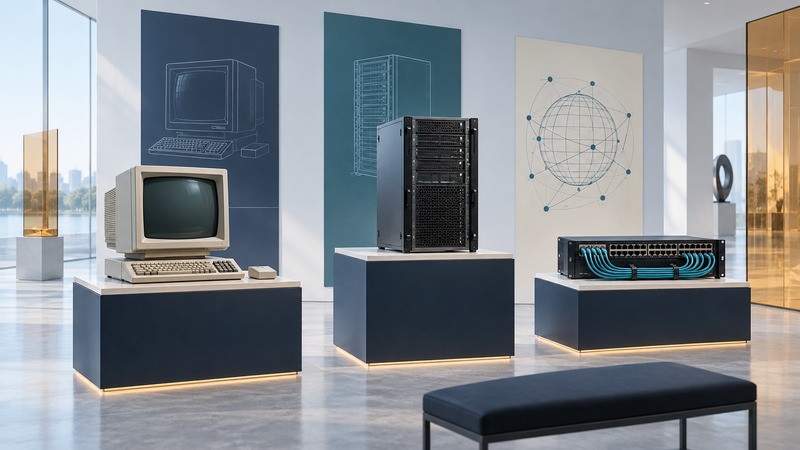
Andy Bechtolsheim's engineering career connects three kinds of systems: the networked workstation, the server, and the network that lets many computers work together. Following those connections gives a more useful account of his work than treating each company name as a separate achievement.
The workstation as a complete engineering tool
The Computer History Museum's 1982 timeline traces Sun Microsystems to Bechtolsheim's Stanford workstation project. It places Ethernet networking, high-resolution graphics, and UNIX together in the workstation model. Sun's early team joined hardware design with software and business development; the museum names Vinod Khosla, Scott McNealy, and Bill Joy alongside Bechtolsheim in that account.
A workstation put interactive computing at an engineer's desk while keeping that desk connected to shared resources. A graphical display made local interaction useful; a network connection made shared files and services reachable. The engineering question was how these parts worked together as a usable machine.
In his 2015 oral history, recorded by the Computer History Museum, Bechtolsheim describes building around available components and software, including Motorola processors, UNIX, and Ethernet. He also discusses the engineering market's needs and the importance of an accessible system architecture. This is a participant's retrospective account, valuable for design reasoning as well as chronology.
From individual computers to the network between them
Cisco's September 3, 1996 Granite Systems announcement described a team headed by Bechtolsheim developing multilayer Gigabit Ethernet switching technology. The stated problem was network-backbone congestion as users, applications, and servers grew. Cisco separately documented completion of the acquisition on September 27.
That connection is instructive: improving a workstation or server can increase the demand placed on the network. Useful system performance depends on whether data can move between the places where work happens. Switching technology addresses that communication problem, with its own hardware, software, and operational requirements.
A timeline with the type of event identified
Scroll the table horizontally. Keyboard users can focus it and use the arrow keys.
| Date | Event | How to interpret it |
|---|---|---|
| 1982 | Sun formed around the workstation project | A product and company-building milestone, involving a team |
| September 1996 | Cisco announced and completed its Granite acquisition | Two distinct transaction dates for a switching-technology company |
| April 12, 2004 | Sun acquired Kealia | The completed transaction date in Sun's filing |
| 2004 | Arista began, according to Bechtolsheim's oral history | A founding date, distinct from later products and revenue |
Sun's 2004 quarterly filing records the Kealia acquisition on April 12 and describes its work as designing advanced computer systems. That completed date is useful when comparing contemporary announcements with later biographies. Arista's management biography describes Bechtolsheim's previous role as Sun's co-founder and chief system architect, including server, storage, and network architecture.
Arista and the system around the switch
In the 2015 interview, Bechtolsheim explains Arista's focus on large data-center networks and emphasizes the software work behind the networking hardware. Read those comments in their 2015 setting: they explain a design and business perspective at that time.
As checked on September 16, 2026, Arista's management page lists him as co-founder and chief architect, responsible for advanced AI, silicon, and optics initiatives. Roles and responsibilities are time-sensitive; the linked company biography is the place to check for later changes.
The recurring engineering pattern is integration. A workstation joins local interaction to network services. A server combines processing, memory, storage, and input/output. A switch joins many machines while its software manages behavior over time. This is an interpretation of the documented career, rather than a claim that one person independently created every component.
Separate engineering, company roles, and investment
The oral history also describes Bechtolsheim's early Google investment and explicitly credits Google's founders and team for building the company. Financing, product design, management, and founding are distinct contributions. A careful biography says which contribution a source establishes.
When researching a milestone, pair the participant's explanation with a dated institutional record. Use the interview to understand why a design choice seemed promising; use a product record or filing to establish what was released or completed. Keep later interpretations separate from what people could know at the time.
For the technical ideas behind this career, see High-Speed Cluster Interconnects, Network Clients, and the IBM eServer p690 retrospective for another approach to large-system computing.