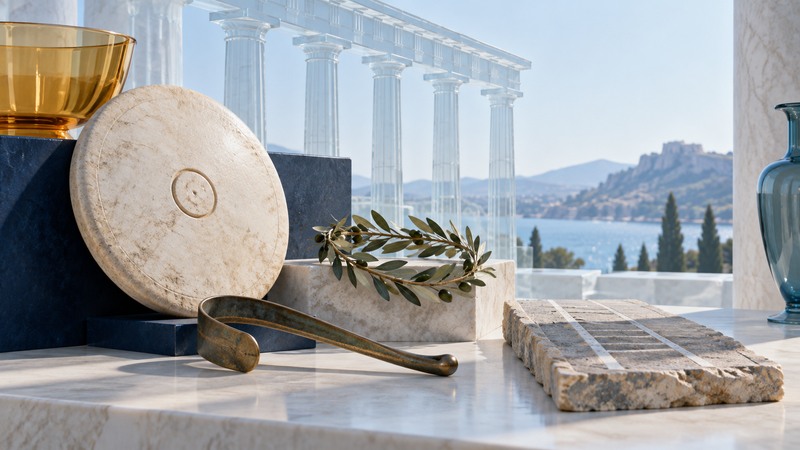
The ancient Olympics were a recurring religious and athletic festival at Olympia in western Greece. To understand them, connect the contests with the sanctuary, the communities that sent competitors and the evidence that survives. A vase painting, a victory inscription and a later written account each answer different questions.
Place the Games in their own world
Olympia’s festival honored Zeus. It belonged to a wider network of Greek athletic festivals, alongside competitions at Delphi, Nemea and the Isthmus of Corinth. Religious observance, athletic achievement and civic prestige met in the same gathering. The Metropolitan Museum of Art’s account of Greek athletics explains that setting through surviving objects and historical accounts.
The traditional starting date is 776 BCE. Treat that as the conventional beginning of the recorded Olympic chronology, rather than an archaeological date for the first person to race there. UNESCO’s Olympia entry summarizes the long history of the sanctuary and dates the ancient Games conventionally from 776 BCE to 393 CE. Those endpoints organize a history spanning many generations; practices and buildings changed within it.
A productive question is “Which period are we describing?” A scene set in the fifth century BCE and one set under Roman rule can both belong to ancient Olympia while depicting different surroundings and participants. Avoid combining every known event and monument into a single timeless festival.
Recognize the main kinds of contest
Running, combat, a five-part pentathlon and equestrian contests all formed part of the ancient programme over time. The Met’s overview provides the event families below. Ancient names identify related activities, but a modern sport’s detailed rules should not be projected backward.
| Event family | What it involved | Question to ask of an image or account |
|---|---|---|
| Footraces | Races of different lengths; some contests involved armor. | Does the source identify a particular race, date or festival? |
| Pentathlon | Running, jumping, discus, javelin and wrestling. | Is one component shown, or is the whole contest being described? |
| Combat | Wrestling, boxing and pankration, which combined fighting techniques. | Which contest is identified, and what evidence establishes the permitted actions? |
| Equestrian events | Horse and chariot racing. | Does “victor” refer to the owner of the entry or the person riding or driving? |
Swipe the table sideways, or focus it and use the arrow keys.
An object can reveal equipment or posture without preserving the full rules. A discus image, for example, can help identify the activity; it cannot by itself establish the precise sequence used to decide a pentathlon winner. For a school report, keep “visible on the object” separate from “explained by its museum label.”
Distinguish participation, ownership and honors
The main athletic contests were organized for male competitors, with categories that included men and boys. Girls’ races in honor of Hera belonged to a separate festival at Olympia. The Met’s discussion of the Hera games makes that distinction useful: “sport at Olympia” is a broader subject than the male Olympic contests.
Participation also has several meanings. Competing bodily, owning a racing team, attending as a spectator and holding a religious office are different roles. Kyniska of Sparta is an important example of victory through ownership in chariot racing; the Olympic Studies Centre’s Women in Ancient Greece resource discusses her victory inscription. Her recognition should be described with that role attached.
Use the same care with claims about spectators. Identify the author, period and category of people being discussed before generalizing a restriction to every woman throughout the festival’s history. Eligibility rules and social access deserve more precise language than “everyone could compete.”
Build an explanation from evidence
| Evidence | Useful for | Limit to keep visible |
|---|---|---|
| Buildings and excavated objects | Materials, dimensions, locations and sequences of construction. | Missing upper structures and uncertain identifications require interpretation. |
| Inscriptions | Names, dedications, honors and claims attached to particular monuments. | A commemorative claim serves the person or community paying for it. |
| Vase paintings and sculpture | How artists represented bodies, equipment and athletic ideals. | Art selects and stylizes; it is not a continuous recording of a contest. |
| Written accounts | Descriptions, traditions and arguments from an identifiable author. | Ask how long after the event the author wrote and what sources were available. |
Swipe the table sideways, or focus it and use the arrow keys.
Finish by comparing the object’s date with the period of the Games you are studying. A digital reconstruction can help you imagine space and movement, while the evidence record tells you how firmly each detail is supported. The separate Olympia guide shows how to read those reconstructions.