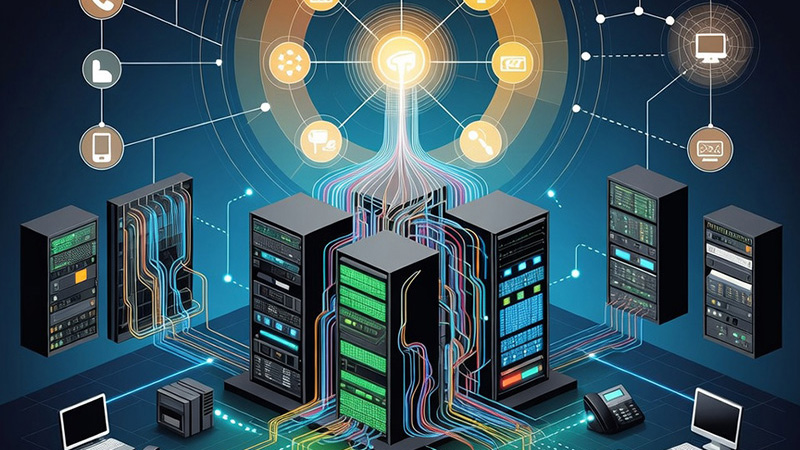
In 2003, Virtela Communications announced that Beacon Global Services Corporation had implemented an end-to-end voice and data call center network using multiple IP backbones between the United States and India. The original deployment linked New York and Hyderabad call center operations, carried voice, video, collaboration, web chat, co-browsing, email, fax, and application traffic over a private managed network, and promised 99.999 percent service reliability through multi-carrier routing and network operations centers in Denver and Mumbai.
That announcement captured an important moment in contact center networking. Offshore and distributed customer-service operations were growing quickly, voice over IP was becoming practical for production call centers, and enterprises wanted private IP networks that could cost less than dedicated international private lines while still delivering predictable voice quality. The advanced call center network was not only about cheaper transport; it was about making voice, data, and customer interaction tools behave like one service.
The Original Architecture
Virtela's model was carrier-neutral and managed. Instead of relying on a single telecom provider for every route, it used partnerships with many carriers and software-driven path selection to move enterprise traffic over the best available route. Beacon expected large savings compared with a private-line design, while also gaining monitoring visibility, rerouting, and managed support.
The design emphasized capabilities that remain central to contact centers:
- Voice quality: low latency, low jitter, low packet loss, and enough bandwidth for simultaneous agent calls.
- Application performance: reliable access to CRM, booking, billing, knowledge-base, and workforce systems.
- Redundancy: multiple carriers, route diversity, and operations teams watching for route degradation.
- Multimedia interaction: voice, chat, email, co-browsing, collaboration, and video on a common network foundation.
- Operational visibility: monitoring tools that let administrators see route behavior rather than wait for users to complain.
From Call Center To Contact Center
The vocabulary has changed. A call center was once primarily a voice operation with some email and web support around it. A contact center now manages conversations across phone, chat, SMS, messaging apps, email, video, social channels, mobile apps, and self-service portals. Customers expect context to follow them between channels, and supervisors expect analytics that connect customer experience, agent performance, compliance, and business outcomes.
That shift changes the network requirements. Voice paths still matter, but so do browser-based agent desktops, WebRTC media, cloud APIs, identity providers, screen recording, workforce optimization, real-time transcription, sentiment analysis, payment handling, and secure access from home agents. The network has become the delivery path for the entire customer-service platform.
What Changed Since 2003
Virtela later became part of a larger global networking story. NTT Communications completed its acquisition of Virtela in January 2014, describing Virtela as a managed and cloud-based network services provider whose capabilities would support hybrid MPLS and Internet networks, cloud access, network functions virtualization, firewalling, WAN acceleration, and SSL remote access from the network cloud.
That direction anticipated how enterprise WANs would evolve. Modern contact centers often use a mix of MPLS, dedicated Internet access, broadband, 4G and 5G backup, SD-WAN overlays, cloud interconnects, and SASE services. The goal is similar to the 2003 design: keep real-time conversations stable while giving the business flexible locations, lower cost, and better visibility. The implementation, however, now reaches into cloud platforms, identity systems, endpoint security, and AI governance.
Modern Building Blocks
A current advanced contact center network usually combines these components:
- CCaaS platform: cloud contact center software for routing, IVR, agent desktops, recording, analytics, and omnichannel queues.
- UCaaS and SIP trunks: enterprise calling, session border controllers, number management, emergency calling, and carrier interconnects.
- WebRTC: browser-based audio, video, and data sessions for agents and customers without a traditional desk phone.
- SD-WAN: application-aware path selection across MPLS, Internet, and wireless links, with policies for voice and agent desktop traffic.
- SASE and zero trust: identity-aware access, secure web gateways, ZTNA, CASB, firewall-as-a-service, and policy enforcement for remote agents.
- Observability: synthetic tests, packet captures, MOS estimates, route monitoring, API telemetry, and end-user experience scoring.
- AI services: virtual agents, agent assist, summarization, quality scoring, intent detection, knowledge retrieval, and workforce analytics.
Voice Quality Still Decides The Experience
Contact centers are unforgiving voice networks. A small amount of latency, jitter, packet loss, echo, clipping, or one-way audio can damage both customer satisfaction and agent productivity. SIP handles session setup, while RTP carries real-time media; both need clean firewall traversal, NAT handling, DNS, certificates, SBC policy, codec planning, and monitoring.
For global operations, the media path matters as much as the signaling path. Routing a call from a customer to a distant cloud region, then to an agent in another country, then back through a recording or analytics service can add delay. Good designs place media anchors, SBCs, cloud regions, and carrier handoffs deliberately. The cheapest route is rarely the best route for live conversation.
Security And Compliance
Advanced contact centers hold sensitive information: payment cards, health details, travel records, account data, call recordings, transcripts, authentication answers, and customer behavioral data. That makes network design part of the compliance program. Remote agents, unmanaged home networks, cloud recording storage, AI analysis, and third-party integrations all expand the risk surface.
Security planning should include strong identity, least-privilege access, segmentation, encrypted transport, endpoint posture checks, logging, data retention policy, DLP controls, secure payment capture, role-based recording access, and vendor-risk review. Zero trust is useful here when treated as an architecture: verify users and devices continuously, minimize implicit trust, and enforce policy as close to the resource as practical.
AI In The Contact Center
AI is now part of many contact center designs. It can route contacts, suggest next actions, summarize calls, score quality, detect intent, retrieve knowledge-base answers, and power customer-facing virtual agents. Those features can improve service, but they also introduce risks: hallucinated guidance, biased scoring, accidental disclosure, weak auditability, model drift, prompt injection, and over-automation of sensitive interactions.
Useful AI governance for contact centers is practical rather than abstract. Keep humans responsible for critical decisions, test models on real call types, log prompts and outputs where appropriate, protect training and transcript data, disclose automation when required, and measure whether the system improves actual customer outcomes. NIST's AI Risk Management Framework is a helpful reference for building that discipline.
Design Guidance
For a modern refresh, evaluate the network and platform together:
- Map every media, signaling, API, identity, recording, analytics, and CRM path used by an agent session.
- Choose cloud regions and carrier handoffs based on latency and resilience, not only contract price.
- Use application-aware SD-WAN policy for voice, video, screen sharing, agent desktop, and background application traffic.
- Test failover during live-like call loads, including recording, transcription, and supervisor monitoring.
- Protect remote agents with identity-aware access, managed endpoints, and clear home-network requirements.
- Monitor customer experience end to end, not just circuit uptime.
- Document compliance boundaries for recordings, transcripts, payment data, and AI-generated summaries.
The 2003 Virtela and Beacon project was advanced because it treated call center networking as a managed global service with voice quality, cost, redundancy, and visibility engineered together. In 2026, the same principle still holds. The best contact center network is the one that makes every customer interaction dependable, secure, measurable, and easy for agents to handle, no matter where the customer, agent, carrier, or application happens to be.