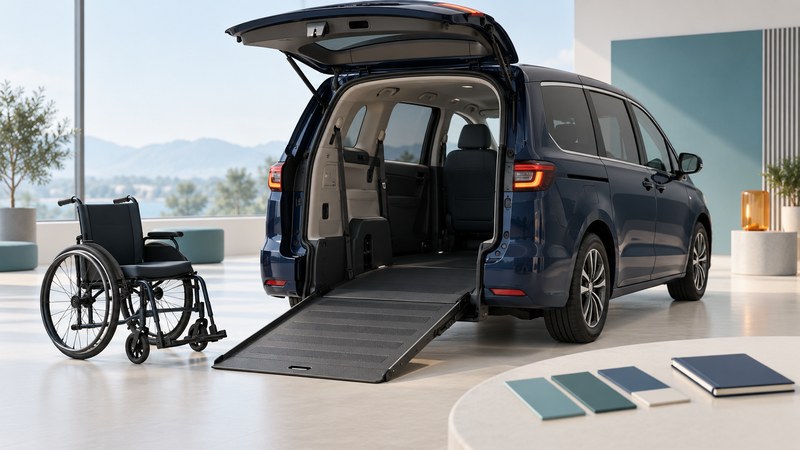
Begin with the journeys a vehicle must support and the way each person will enter, sit, travel and leave. A driver who transfers to the original seat, a passenger who remains in a wheelchair and a driver using adapted controls can need very different arrangements. The useful comparison is the complete vehicle and conversion in daily use, supported by a qualified assessment and demonstration.
Write the access requirements before choosing a model
List who drives, who travels, the seating positions needed, the wheelchair or scooter involved, regular luggage, typical journey length and parking conditions. Describe transfers and assistance as they actually occur, including fatigue and variation across the day. Bring the intended equipment and the people who will use the vehicle to an arranged assessment or demonstration.
Keep driving controls, entry and seating, and equipment transport as separate questions. Hand controls address operation of the vehicle; a hoist may address loading an unoccupied mobility device; a wheelchair-accessible conversion addresses a different set of needs. A feature name alone does not establish suitability for a person or a particular wheelchair.
Use assessment and current regional guidance
In the United States, NHTSA's adapted-vehicle guidance describes evaluation, vehicle selection, qualified modification and training. Discuss driving needs with a suitable driver rehabilitation professional before committing to controls or a conversion. Confirm licensing, insurance and any medical reporting requirements with the appropriate authorities for your circumstances.
In the United Kingdom, Driving Mobility's assessment service information provides a route to specialist assessment. The Motability Scheme's WAV information and current vehicle finder can help eligible users explore available options. Check eligibility, lease terms, support and costs directly; they depend on the current scheme and your situation.
Ask the assessor or converter to explain which findings support a proposed arrangement and what remains to be demonstrated. Obtain written specifications for the actual conversion, including equipment compatibility and any applicable limits. Arrange training in the installed equipment rather than learning a safety-critical procedure from a generic article.
Compare the whole journey
| Area | What to establish | Evidence to keep |
|---|---|---|
| Entry and exit | Can the intended person and equipment use the opening in realistic parking space? | Demonstration notes and measured clearances with units |
| Travel position | Does the arrangement provide suitable space, posture, view and communication? | Assessor findings and exact seating layout |
| Equipment compatibility | Is the wheelchair and proposed transport arrangement suitable and approved by the relevant manufacturers? | Model-specific instructions and supplier confirmation |
| Driving | Can the driver operate the assessed controls and other essential functions? | Assessment, installation and training records |
| Everyday use | Where do luggage and mobility equipment go, and what happens at regular destinations? | A trial of the intended loading and parking arrangement |
| Support | Who services the conversion and what assistance is available during a fault? | Written maintenance, warranty and recovery terms |
Wheelchair securement and occupant restraint need the correct compatible equipment and professional instruction. Have the converter demonstrate the approved arrangement and emergency procedures. Do not improvise attachment points or infer a load rating from an illustration.
Test the arrangement you intend to buy
Arrange an appropriate demonstration and, for a driver, a test drive under the conditions recommended by the assessment team. Check entry, exit and the full passenger arrangement as well as how the vehicle drives. Confirm that the demonstration vehicle matches the proposed conversion; even similar base vehicles can have different layouts.
Use the vehicle comparison notes to record questions, observations and unresolved items for each vehicle. Mark every measurement with its units and source. Leave unknowns open until an appropriate professional or supplier has resolved them.
Plan for ownership and changing needs
Request a written breakdown of the vehicle, conversion, adaptations, maintenance and support costs. Establish who handles a fault in the base vehicle and who handles a fault in the conversion. Discuss recovery arrangements that accommodate the people and equipment traveling in it. Keep manuals, service contacts and training records available.
Revisit suitability when a wheelchair, seating system, driver's ability or passenger arrangement changes. The aim is a vehicle that works for the actual person and journeys, with support that continues after delivery.