Three-dimensional manufacturing has matured from rapid prototyping into a broad group of production processes. Polymer powder-bed systems make thousands of customized parts without molds. Metal lasers build flight hardware with internal cooling channels that cannot be machined conventionally. Dental laboratories print patient-specific models, surgical guides and restorations. Directed-energy systems repair turbine components and add features to existing forgings. Large robotic extruders deposit building materials, tooling and fiber-reinforced polymers at architectural scale.
“3D printing” and “additive manufacturing” are often used interchangeably, but modern production requires much more than the print step. A successful part begins with design rules and controlled feedstock, proceeds through build preparation and a qualified machine process, then passes through depowdering, support removal, heat treatment, infiltration, sintering, machining, surface finishing and inspection as required. For critical hardware, the digital record connecting those stages is part of the product.
Additive manufacturing does not replace casting, molding, forging or machining universally. It excels when geometric complexity, customization, part consolidation, low volume, rapid iteration or local production creates enough value to offset slower build rates, expensive feedstock and substantial post-processing.
The seven established additive-manufacturing categories
ISO/ASTM 52900 organizes additive manufacturing into seven process categories. Commercial names can obscure these fundamentals, so the underlying method is the best place to begin.
| Process family | How material is added | Typical materials | Strong applications |
|---|---|---|---|
| Material extrusion | Material is pushed through a nozzle and deposited along a programmed path | Thermoplastics, filled polymers, pastes, concrete and bound metal or ceramic feedstocks | Fixtures, tooling, prototypes, large composite forms and low-volume parts |
| Vat photopolymerization | Light selectively cures liquid resin in a vat | Photopolymer resins with ceramic or other fillers where needed | Dental, jewelry, models, microfluidics, smooth prototypes and investment-casting patterns |
| Powder bed fusion | Thermal energy fuses selected regions of a powder layer | Polymers, metals and selected ceramics | Production polymer parts, aerospace hardware, implants and complex metal components |
| Binder jetting | Liquid binder selectively joins powder, usually followed by curing and densification | Metals, ceramics, sand and other particulate materials | Sand molds and cores, metal production, ceramics and full-color models |
| Material jetting | Droplets of build material are deposited and cured or solidified | Photopolymers, waxes, nanoparticle inks and biological materials | Multimaterial models, casting patterns, dental work and printed electronics |
| Directed energy deposition | Powder or wire is fed into a focused heat source as material is deposited | Metals, with emerging ceramic and composite variants | Repair, cladding, large structures, feature addition and composition gradients |
| Sheet lamination | Sheets or foils are bonded and cut layer by layer | Paper, polymers, metals and composite tape | Models, embedded components, laminated tooling and low-temperature metal structures |
Material extrusion: from desktop filament to industrial cells
Material extrusion is the most familiar form of 3D printing. A drive system feeds thermoplastic filament into a heated nozzle, or a screw extruder melts pellets. The nozzle traces each layer while the platform or robot positions the part. Common polymers include PLA, ABS, PETG, nylon, polycarbonate, thermoplastic polyurethane and high-temperature materials such as PEI and PEEK.
The method is accessible and material-efficient, but deposited roads create direction-dependent properties. Strength across layer interfaces is often lower than along the extruded path. Temperature history, chamber control, moisture, bead geometry and voids determine performance. Industrial systems use heated chambers, controlled drying, closed-loop extrusion and validated toolpaths to improve bonding and repeatability.
Pellet extrusion and large-format additive manufacturing
Pellet-fed extruders process material faster and at lower feedstock cost than filament systems. Gantry machines and robots deposit broad beads to make molds, trimming fixtures, autoclave tools, boat patterns and architectural forms. Short carbon or glass fiber reduces thermal expansion and increases stiffness, although the material remains anisotropic and abrasive.
Large-format parts are commonly printed near net shape and then CNC machined. This hybrid route can replace massive blocks of foam, polymer or tooling board. The economics come from rapid material placement and reduced waste, not from achieving final surface tolerance directly from the nozzle.
Continuous-fiber reinforcement
Some extrusion systems place continuous carbon, glass or aramid fiber within a thermoplastic matrix. Fiber paths can reinforce load directions more efficiently than chopped-fiber fill. Design and slicing become structural tasks: fiber turning radius, anchoring, overlap, void content and access determine whether theoretical strength appears in the part.
Vat photopolymerization: precision through controlled light
Stereolithography scans a laser across liquid resin. Digital light processing exposes an entire layer with a projected image, while masked stereolithography uses an LCD or related mask over a light source. In each case, photons initiate polymerization where the part is defined.
These processes produce fine detail and smooth surfaces. They are deeply established in dental models, surgical guides, hearing products, jewelry patterns and visual prototypes. Engineering resins target toughness, heat resistance, flame behavior, elasticity or biocompatibility for specified uses.
A printed photopolymer is not complete when it leaves the vat. Washing removes uncured resin; post-curing finishes the reaction; supports are removed; dimensional change must be controlled. Resin age, temperature, light dose, oxygen inhibition and cure depth affect properties. Unreacted chemistry requires gloves, ventilation and appropriate waste handling.
Continuous and high-speed photopolymer printing
Continuous liquid-interface approaches manage oxygen or another inhibited region near the window so the part can move without mechanically separating every layer. Other high-speed systems improve projection, resin flow, thermal control and peeling. These methods reduce layer-cycle overhead, but large cross-sections still demand resin replenishment and careful heat management.
Ceramic-loaded resins
A photopolymer can carry ceramic particles. After printing, the organic binder is removed and the ceramic is sintered. Alumina, zirconia, silica and technical ceramics become microfluidic devices, dental restorations, insulators and casting cores. Shrinkage during debinding and sintering must be predicted from solids loading, geometry and furnace cycle.
Polymer powder bed fusion
Selective laser sintering uses a laser to fuse polymer powder while unfused material supports the part. Several components can be nested throughout the build volume without dedicated support structures, making SLS attractive for production batches and complex assemblies. Nylon 12 is the workhorse; nylon 11, thermoplastic elastomers, polypropylene and filled materials extend the range.
Thermal uniformity is central. The powder bed is held near its fusion range, and a narrow process window must avoid both incomplete bonding and distortion. Used powder experiences heat and may be refreshed with virgin material according to a controlled ratio. Cooling can take as long as printing because premature removal warps parts.
Infrared powder-bed systems that use patterned absorbers or inhibitors can expose larger areas in parallel rather than tracing each contour with one laser. These approaches improve throughput and enable voxel-level control of some surface or material effects, but they remain powder processes requiring cooling, unpacking and cleaning.
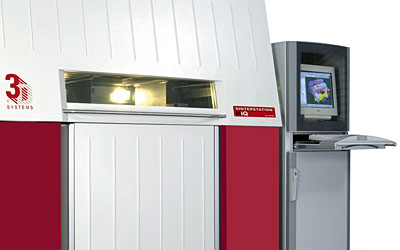
The Sinterstation HiQ upgrade described in the original 2004 article represented an important transition from prototyping toward repeatable end-use SLS production. Today's polymer powder-bed factories extend that objective with automated powder handling, fleet scheduling, process monitoring and application-specific qualification.
Metal laser powder bed fusion
Laser powder bed fusion spreads a thin metal-powder layer and selectively melts it with one or more lasers under inert gas. The process repeats until the component is complete. It can produce dense stainless steel, tool steel, aluminum, titanium, nickel superalloy, cobalt-chromium, copper and other qualified alloys.
LPBF enables internal cooling passages, lattice structures, organic topology-optimized forms and consolidation of assemblies into fewer components. Aerospace heat exchangers, rocket injectors, medical implants, motorsport hardware and conformally cooled mold inserts are established applications.
The same rapid melting that creates geometry also creates steep thermal gradients, residual stress and nonequilibrium microstructures. Orientation, support design, scan strategy, build-plate temperature, powder condition and gas flow affect porosity, cracking and distortion. Parts commonly receive stress relief, hot isostatic pressing, heat treatment, support removal, machining and surface finishing.
Multi-laser machines and larger build volumes
Production systems increasingly use several lasers to divide the build area and increase throughput. This creates calibration and overlap challenges: lasers must produce consistent melt pools, and seam regions must match the rest of the part. Larger chambers raise the value of each build but also increase powder inventory, recoating risk and the cost of a failed job.
Green and blue lasers for reflective metals
Copper reflects much of the near-infrared energy used by conventional fiber lasers. Green and blue wavelengths are absorbed more effectively, enabling stable printing of pure copper and copper alloys for heat exchangers, induction coils, radio-frequency components and electric-motor windings. High-power infrared systems and tailored parameters can also process copper, so wavelength is one part of a complete strategy.
Electron-beam powder bed fusion
Electron-beam powder bed fusion operates in vacuum and preheats the powder bed before selectively melting metal with an electron beam. It is especially associated with titanium implants and aerospace components. High build temperature reduces residual stress, while the vacuum suits reactive alloys. Surface roughness, powder removal and feature resolution differ from laser systems.
Binder jetting: separate shaping from densification
Binder jetting deposits droplets of binder into a powder bed. The unbound powder supports each layer, allowing dense nesting without printed supports. After curing and depowdering, the fragile “green” part is sintered, infiltrated or otherwise densified.
Sand binder jetting is an established foundry technology. It prints complex molds and cores directly from CAD, allowing internal cooling passages and eliminating pattern tooling for low-volume castings. Different binders and sands serve iron, aluminum and other casting systems.
Metal binder jetting aims at higher throughput than beam-based metal fusion because an inkjet head patterns broad areas quickly and several parts can fill the bed. The central challenge is sintering. Parts shrink substantially, and that shrinkage depends on feature thickness, packing, gravity, support fixtures and furnace uniformity. Software must compensate geometry, while debinding and sintering establish final density and properties.
Bound-metal extrusion follows a related route using filament or pellets containing metal powder and polymer binder. Printing equipment is simpler and avoids loose reactive powder during shaping, but debinding, sintering shrinkage and support strategy remain critical.
Material jetting and nanoparticle deposition
Material jetting places tiny droplets of photopolymer or wax and cures or cools them. Multiple print heads can combine colors, hardness levels and support material within one build. It is valuable for anatomical models, dental patterns, realistic product prototypes and investment-casting masters.
Properties may vary with orientation, ultraviolet exposure, time and moisture. Multimaterial visual models should not be assumed to have the same durability as molded engineering polymers. Support removal can limit small channels and delicate features.
Nanoparticle jetting deposits suspensions containing metal or ceramic particles, dries each layer and then sinters the part. Aerosol jet and inkjet systems print conductive, dielectric or functional inks onto planar and three-dimensional surfaces. Applications include antennas, sensors, heaters, interconnects and customized electronics.
Directed energy deposition
Directed energy deposition creates a melt pool with a laser, electron beam, plasma arc or electric arc while feeding metal powder or wire. A multi-axis machine moves the head or workpiece. DED deposits material faster than powder bed fusion and is not confined to a powder bed, but it generally produces coarser features and requires machining for precision surfaces.
Laser powder and wire DED
Laser DED repairs turbine blades, restores worn shafts, applies corrosion-resistant cladding and adds features to forgings. Multiple powder feeders can vary composition during the build, creating graded transitions or local wear-resistant material. Closed-loop height and melt-pool control help stabilize deposition as geometry and heat accumulation change.
Wire-arc additive manufacturing
Wire-arc additive manufacturing uses welding equipment and robotic or gantry motion to build large metal shapes at high deposition rates. It suits ship, aerospace, energy and heavy-industry components that would otherwise require large forgings or extensive machining. Interpass temperature, bead geometry, residual stress and distortion require careful path planning. The printed preform is normally machined to final tolerance.
Electron-beam wire deposition
Electron-beam wire systems build large reactive-metal parts in vacuum. They can achieve high deposition rates with efficient energy transfer and are attractive for titanium structures. Vacuum chamber size and capital cost constrain the work envelope.
Solid-state additive manufacturing
Not every additive process melts the feedstock. Cold spray accelerates metal particles in a high-velocity gas stream so they bond through severe plastic deformation on impact. It can restore dimensions, apply conductive coatings and build near-net structures while limiting thermal damage, oxidation and phase change.
Additive friction-stir deposition feeds rod or powder into a rotating tool and deposits material through frictional heating and plastic deformation below the melting point. Ultrasonic additive manufacturing bonds metal foils using pressure and high-frequency vibration. These methods can embed sensors or channels, join dissimilar materials and preserve wrought-like characteristics that fusion processes may alter.
Solid-state processes still produce interfaces, texture and residual stress that require characterization. Their strength is avoiding solidification defects, not eliminating qualification.
Sheet lamination
Sheet lamination bonds layers of paper, polymer, composite tape or metal foil and cuts each outline. Laminated-object manufacturing can create inexpensive visual models. Composite-sheet systems cut and consolidate reinforced thermoplastic layers. Ultrasonic foil bonding is a metal form of sheet lamination that can encapsulate fibers, sensors or cooling channels before final machining.
Material waste from cutting, accessible geometry and bond quality determine viability. The process can be fast because it adds an entire sheet at once, but internal voids and stair-stepped edges require control.
Volumetric and computed-light printing
Conventional vat systems form one layer at a time. Volumetric additive manufacturing projects changing light patterns through a rotating or stationary resin volume so the accumulated dose cures a three-dimensional object. Computed axial lithography borrows ideas from tomography: a set of projections reconstructs the desired dose distribution inside the material.
Because the part forms throughout a volume, printing can be extremely fast and avoids some layer interfaces and support requirements. Current challenges include resin transparency, scattering, dose threshold, heat, resolution, build size and removal of uncured material from enclosed spaces. The technology is promising for small complex polymer and biomedical structures but remains less mature than production vat photopolymerization.
Micro- and nanoscale printing
Two-photon polymerization focuses ultrafast laser pulses inside a photosensitive material. Polymerization occurs only where two photons are absorbed nearly simultaneously, confining the reaction to a tiny voxel. The process builds microlenses, metamaterials, micro-robots, cell scaffolds and research devices with submicron features.
High numerical aperture and serial writing constrain build volume and throughput. Parallel beams, faster scanning, adaptive optics and stitching are expanding capability, but two-photon systems remain precision microfabrication tools rather than general-purpose printers.
Bioprinting and living materials
Bioprinting places cells, hydrogels, growth factors or supporting materials in controlled three-dimensional arrangements. Extrusion handles viscous bioinks; inkjet ejects droplets; laser-assisted transfer places material without a nozzle; light-based systems cure cell-compatible hydrogels.
Printed tissues can serve research, drug screening, disease models and regenerative scaffolds. Simple tissues and nonliving implants are much closer to routine use than complete transplantable organs. Thick living constructs require vascular networks, nutrient transport, mechanical maturation and validated biological function. The FDA notes that tissue-engineered printed constructs remain a research area with regulatory considerations beyond those for ordinary printed devices.
Construction-scale additive manufacturing
Construction printers extrude cementitious material, clay or geopolymer mixtures through gantry or robotic systems. They can form walls, architectural elements, infrastructure components and stay-in-place formwork with reduced conventional formwork and novel geometry.
The printed bead must pump reliably, retain shape, bond to the previous layer and develop structural properties. Reinforcement is a central issue: deposited concrete is strong in compression but structures still need steel, fiber, post-tensioning or other systems for tensile loads. Building codes, foundations, utilities, roofs, weather protection and inspection remain conventional construction responsibilities.
Large-scale printing is most credible as one integrated construction method, not a machine that creates a complete building unattended.
Food, pharmaceuticals and energetic materials
Food printers extrude pastes, doughs, chocolate, proteins or structured ingredients for customized shape, texture and nutrition. Their value lies in personalization and automation rather than replacing efficient mass production of ordinary foods.
Pharmaceutical printing can control tablet geometry, porosity, dose and release profile. The first FDA-approved 3D-printed drug demonstrated regulatory feasibility, while research continues into personalized polypills and decentralized manufacture. Formulation uniformity, stability, cleaning, software control and release testing remain essential.
Additive methods also shape propellants, explosives and reactive materials under tightly controlled conditions. These specialized processes require safety systems and regulatory expertise far beyond ordinary polymer printing.
Design for additive manufacturing
Additive manufacturing creates value when design uses its capabilities. Simply printing a part designed for machining often preserves excess material and ignores build constraints.
- Part consolidation combines components, joints, seals and fasteners into a smaller assembly.
- Topology optimization removes low-value material while preserving load paths and manufacturing constraints.
- Lattices tune stiffness, energy absorption, heat transfer, permeability or bone ingrowth.
- Conformal channels follow mold surfaces, combustors or heat sources more closely than drilled passages.
- Mass customization changes geometry from part to part without new hard tooling.
- Functionally graded design varies density, composition or structure across a component where the process allows.
Every benefit has a manufacturing counterpart. Consolidated internal channels must be cleaned and inspected. A lattice may be impossible to depowder. A topology-optimized shape may require inaccessible supports. Design tools increasingly include build orientation, thermal simulation, support generation and machining allowance from the beginning.
Feedstock quality
Powder size, shape, chemistry, moisture, flow and contamination influence each layer. Metal powder can oxidize or absorb moisture, and fine reactive powder creates combustible-dust hazards. Reuse changes size distribution and chemistry, so sieving, blending and traceability must follow a qualified procedure.
Filament diameter, ovality, moisture and thermal history affect extrusion. Pellets need controlled drying and composition. Photopolymers age and respond to temperature and stray light. Wire chemistry, surface condition and feed consistency influence DED. Feedstock certificates are not enough if storage and handling are uncontrolled.
Post-processing is part of the process
| Post-process | Purpose | Where it is common |
|---|---|---|
| Depowdering and cleaning | Remove loose material from surfaces and internal passages | Powder bed fusion and binder jetting |
| Support removal | Separate anchors and heat-conducting structures | Metal LPBF, DED, vat and material extrusion |
| Wash and UV cure | Remove uncured resin and complete polymerization | Vat photopolymerization and material jetting |
| Debinding and sintering | Remove polymer binder and densify powder | Metal or ceramic binder jetting and bound-feedstock extrusion |
| Stress relief and heat treatment | Control residual stress, microstructure and mechanical properties | Fusion-based metal processes |
| Hot isostatic pressing | Close internal porosity using heat and gas pressure | Critical metal components and implants |
| Machining | Create threads, sealing surfaces and precise interfaces | Most production metal AM and large-format polymer tooling |
| Surface finishing | Reduce roughness, remove partially fused particles and improve fatigue or appearance | Metal, polymer and ceramic parts |
| Inspection and testing | Verify geometry, internal integrity and material performance | All qualified production processes |
Post-processing can dominate cost and lead time. Internal channels, delicate lattices and rough down-facing surfaces are particularly difficult. Automated depowdering, chemical smoothing, electrochemical polishing and robotic support removal are advancing because an unattended printer feeding a manual finishing bottleneck is not a scalable factory.
Monitoring, AI and closed-loop control
Metal systems observe melt-pool radiation, layer images, recoater behavior, acoustic signals, temperature and oxygen. Polymer systems monitor bed temperature, fusion, extrusion pressure or layer geometry. Machine learning can classify anomalies and relate signatures to known defects.
The hard problem is connecting a signal to final part quality. A bright melt-pool pixel does not automatically mean a rejectable pore. Sensors need calibration, timestamps, spatial registration and physics-based interpretation. NIST's additive measurement program identifies process variability, surface quality, material properties and qualification as continuing barriers.
Closed-loop systems adjust laser power, speed, wire feed, extrusion flow or path based on measured conditions. Pointwise and layerwise control can stabilize deposition, but any adaptive algorithm used on critical parts must itself be validated. In 2026, NIST convened an industry roadmap effort focused on in-situ structural and microstructural measurements that could support qualification rather than merely create more process data.
Inspection and qualification
Additive parts can contain lack-of-fusion pores, keyhole porosity, inclusions, cracks, delamination, trapped powder or dimensional distortion. Surface roughness and internal geometry challenge conventional gauges. Computed tomography reveals internal features but becomes less sensitive in thick, dense or large components. Ultrasound, radiography, thermography, optical scanning and destructive coupons each address part of the problem.
Qualification may cover the material, machine, process, facility, operator, software and exact part family. A parameter change, new powder source or different machine can require evidence that the validated state remains equivalent. Critical industries use witness coupons, build records, heat-treatment certification and statistical controls.
NIST's part-qualification work emphasizes why complex surfaces, internal defects, anisotropy, residual stress and post-processing make acceptance difficult. In-process monitoring can reduce uncertainty, but it does not yet eliminate post-build inspection and material testing.
Digital workflow and cybersecurity
The manufacturing chain includes CAD, medical imaging or scan data, mesh repair, build orientation, support design, slicing, parameter assignment, machine instructions and inspection results. File translation can lose units, tolerances, material assignments or surface definitions. Newer formats preserve richer product information than a basic triangle mesh.
A qualified digital thread records which design revision, software version, parameter set, machine state, feedstock lot and post-process cycle produced each part. Secure access, signatures, backups and change control matter because modifying a build file can alter internal geometry without leaving an obvious mark.
Distributed production does not mean sending an uncontrolled file to any available printer. Remote manufacturing requires an equivalent machine and process, calibrated inspection, authorized material, trained personnel and a quality system. The digital file is portable; manufacturing capability is not automatically portable.
Medical, aerospace and automotive production
Medical manufacturing uses porous titanium spinal cages, acetabular cups, cranial plates, dental restorations, surgical guides and patient-specific models. Controlled porosity can encourage bone attachment, while imaging-derived geometry improves fit. The FDA states that more than 100 additively manufactured devices have been cleared and that powder bed fusion is the most common process for medical devices.
The FDA manufacturing workflow emphasizes design, software, material control, post-processing, process validation and testing. The agency clears or approves finished devices for intended uses, not a material or printer for unrestricted medical use.
Aerospace applies metal AM to fuel nozzles, heat exchangers, brackets, rocket injectors, turbomachinery and satellite structures. Weight reduction, part consolidation and rapid design iteration justify qualification effort. Space propulsion is particularly suited because internal fluid passages and low production volume create high value.
Automotive manufacturers use AM heavily for development, casting cores, checking fixtures, assembly aids and motorsport. Production applications include low-volume structural parts, cooling components and customization. High-volume vehicle parts must compete with exceptionally efficient stamping, molding and casting, so additive wins only when it changes function, tooling or inventory economics.
Tooling and indirect manufacturing
Some of additive manufacturing's greatest production value is indirect. Printed jigs, drill guides, soft jaws, grippers and inspection fixtures can be delivered in days and redesigned by the people who use them. Lightweight ergonomic tooling reduces worker strain.
Conformal-cooled mold inserts shorten injection cycles and improve part quality. Printed sand cores enable cast passages that conventional core boxes cannot form. Investment-casting patterns replace wax tooling for low-volume or rapidly changing parts. Large polymer prints become machining patterns and composite molds.
These applications avoid demanding the printed material serve as the final product for decades while still exploiting tool-less geometry.
Economics and sustainability
Additive cost is driven by machine time, build utilization, feedstock, labor, post-processing, inspection, rejects and qualification. Complexity is relatively inexpensive once a build is running, but volume is not. A simple part made by the million usually belongs in a mold, die or high-speed machining line.
The strongest business cases include expensive conventional tooling, high buy-to-fly material waste, long spare-part lead time, valuable weight reduction, assembly consolidation or patient-specific geometry. Digital inventory can replace some stored parts, provided a qualified process remains available when needed.
Additive manufacturing is not automatically sustainable. Polymer supports and failed builds create waste. Metal powder production is energy intensive. Lasers, heaters, inert gas, furnaces and hot isostatic pressing consume energy. A lighter aircraft part may save far more energy during use than its manufacture requires, while a decorative print may not. Lifecycle assessment must compare the actual design and supply chain with a credible conventional alternative.
How to choose a process
| Decision | Questions to answer |
|---|---|
| Material | Does the process produce the required chemistry, microstructure, temperature resistance and biocompatibility? |
| Geometry | Can supports or powder be removed, and can critical internal features be inspected? |
| Size and resolution | Does the build envelope, feature size, wall thickness and tolerance fit the part? |
| Quantity | Will nesting, automation and machine rate compete at the intended annual volume? |
| Surface and tolerance | Which areas need machining, polishing, sealing or coating? |
| Properties | How do orientation, porosity, heat treatment and aging affect performance? |
| Qualification | Which standards, test coupons, records and change controls are required? |
| Complete cost | What do feedstock, print time, labor, post-processing, inspection and scrap cost together? |
Production-ready, scaling and emerging processes
| Maturity in 2026 | Representative processes and uses |
|---|---|
| Established production | Polymer SLS, industrial extrusion, vat photopolymerization, sand binder jetting, metal LPBF, dental printing and tooling |
| Scaling across more applications | Metal binder jetting, large-format composite extrusion, multi-laser LPBF, wire-arc AM, printed electronics and automated post-processing |
| Commercial in specialized niches | Cold spray repair, ceramic photopolymerization, continuous-fiber extrusion, nanoparticle jetting and point-of-care medical models |
| Emerging or research-intensive | Volumetric printing, transplantable bioprinted organs, widespread closed-loop qualification, molecular-scale printing and fully autonomous construction printing |
The latest process is the complete manufacturing chain
The decisive advances in 3D manufacturing are no longer limited to faster print heads. They include lower-cost and more consistent feedstocks, simulation that predicts distortion, multimaterial deposition, automated powder recovery, in-situ monitoring, machine-to-machine parameter transfer, robotic finishing and standards that make parts repeatable enough to purchase by specification.
The industry has also become more honest about what follows the build. A dense metal part may still need hot isostatic pressing and machining. A resin part needs washing and cure. A binder-jetted part is a fragile intermediate until it survives the furnace. A concrete wall still needs reinforcement, utilities and inspection. Manufacturing value comes from optimizing that chain rather than presenting the printer as a self-contained factory.
Today's additive processes can create end-use components of extraordinary complexity and quality. Their best use is selective: choose the material and physics that fit the product, design for the process, control every transformation after printing and qualify the result as rigorously as any conventionally manufactured part.