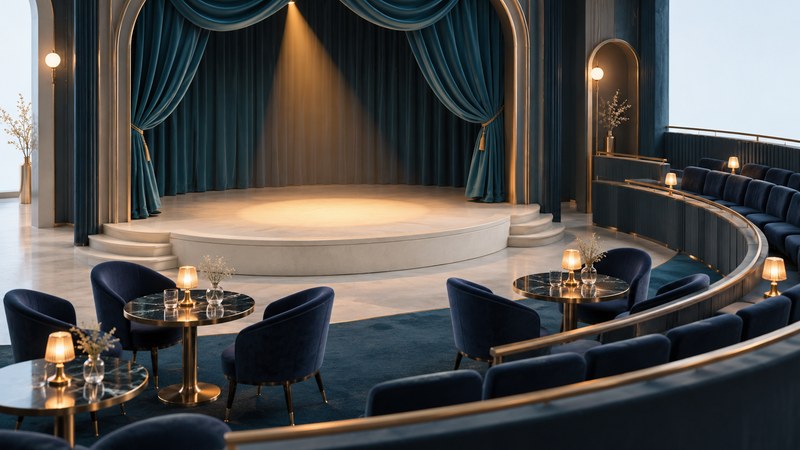
Zumanity was Cirque du Soleil’s adults-only cabaret at New York-New York in Las Vegas. Its importance lies in how it brought acrobatics into a more intimate theatrical setting, using comedy, movement and desire to explore the people on stage. The production closed in 2020.
Cirque identifies its run as 2003–2020 in its show history. Read Zumanity as a completed production with its own creative identity. Present-day entertainment at the resort has separate titles, creative teams and booking information.
A cabaret relationship with the audience
Cirque’s corporate history places Zumanity’s arrival in August 2003 and identifies it as an adults-only resident show at New York-New York. The company’s show archive describes a mix of burlesque and cabaret alongside acrobatics. That combination shifts the viewing question from the size of a spectacle to the relationship between performer and audience.
Cabaret can bring spectators close to a performer’s timing, expression and response. In that setting, an acrobatic movement can carry dramatic weight as an encounter between people, while a comic interruption can change the room’s mood. This is a way of understanding the form: technical skill and theatrical intimacy can work together rather than compete for attention.
The production’s adult framing was central to that experiment. Its themes concerned attraction, identity and human connection, with the audience asked to engage with vulnerability and play as well as physical achievement. Describing it only as a conventional circus show would leave out the choices that gave it a distinct place in Cirque’s Las Vegas work.
Comedy was part of the construction
A particularly useful first-person production record comes from Spymonkey’s account of its Zumanity work. The company says Cirque invited it and comedy director Cal McCrystal to create and perform comedy numbers in 2003. Its credits identify Dominic Champagne and René Richard Cyr as the show’s directors.
Spymonkey’s involvement ran from the August 2003 opening period to August 2005. That boundary matters: an account of the original comedy team describes a particular phase, not every version of a long-running production. Casts, numbers and the balance between them can evolve while a show keeps its title.
The collaboration helps explain the role of comedy in a cabaret. Humor can unsettle expectations, make an audience more conscious of its own reactions, or provide a change of pace between physically intense numbers. Those possibilities offer a richer interpretation than treating comedy as filler between acrobatics. They also invite a specific question when studying a recording: what changes in the audience’s relationship to the performers when the tone changes?
Separate the last performance from the closure announcement
Swipe sideways, or focus the table and use the arrow keys.
| Date | Event | What the date establishes |
|---|---|---|
| August 2003 | Opening period at New York-New York, documented by Cirque and Spymonkey. | The beginning of the resident production. |
| August 2005 | Spymonkey’s participation ended. | A change in one creative team’s involvement, not the end of the show. |
| March 14, 2020 | The final performance identified in Cirque’s later closure statement. | The last performance before the pandemic shutdown. |
| November 16, 2020 | Cast and crew were informed of permanent closure. | The decision that the production would not return. |
The last two dates come from Cirque’s closure statement reproduced by PLSN on November 19, 2020. The statement describes more than 7,700 performances and thanks the cast, crew and staff. Its November announcement followed the March final performance; using either date without its meaning can confuse a production timeline.
The closure sits within the broader interruption of live entertainment during the pandemic. Cirque’s corporate history documents the shutdown of its operations and the subsequent relaunch. Zumanity’s own outcome was permanent closure, as also indicated on its official production page.
Read the legacy through the performance choices
When looking at official excerpts, contemporary accounts or collaborators’ recollections, keep the date and source in view. A promotional trailer selects highlights, a contributor explains one part of the creative process, and a critic describes a particular performance. Together they can help explain the work without making any one account stand for its entire run.
- Watch the scale of the encounter. Consider how the room’s intimacy changes the significance of gesture, voice and eye contact.
- Listen for changes in tone. Ask how comedy and music prepare the audience for, or release it from, an acrobatic sequence.
- Keep versions distinct. Identify the year and performers when comparing clips or memories.
Zumanity’s useful legacy is this expanded idea of what a resident Cirque production could ask from an audience: attention to bodies as expressive people as well as admiration for physical skill. That is an interpretation of its documented cabaret format, not a claim that every spectator experienced it in the same way.
Check current entertainment under its own name
Cirque announced Mad Apple for New York-New York in 2022, with a May 26 premiere date. Its corporate history records the May opening. Mad Apple has a New York-inspired mixture of comedy, music and acrobatics, with its own creators; it is a distinct production.
For a present-day visit, use Mad Apple’s current official page for dates and policies. Its FAQ excludes guests under 18. Check the production you actually intend to attend rather than transferring Zumanity’s historical details to a new ticket.
For other planning needs, explore Blue Man Group at Luxor or the Las Vegas dining guide. Return to Las Vegas trip planning.