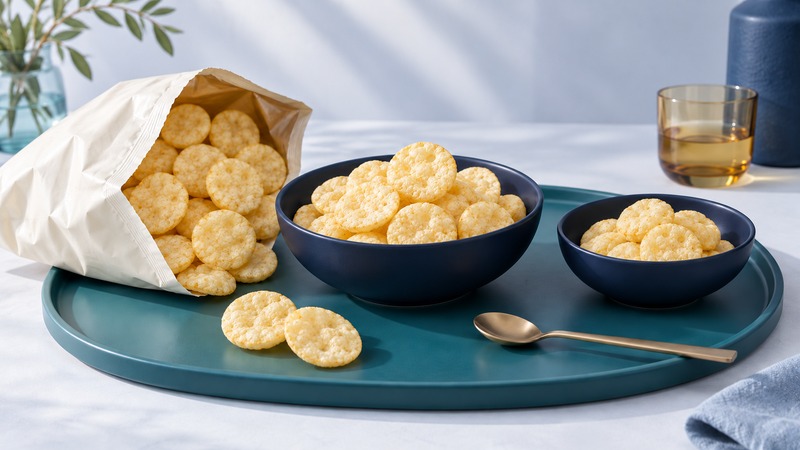
Start a snack comparison with the serving weight and the amount you expect to eat. “Popped” describes how a snack is made; the Nutrition Facts panel describes its measured nutritional profile. The example below uses a specific U.S. Sea Salt package displayed by Popchips in October 2026.
Identify the package before using its numbers
The manufacturer’s Sea Salt product page shows a 5-ounce bag with a 28 g serving. Its pictured back label lists 130 calories, 4.5 g total fat, 1 g saturated fat, 150 mg sodium, 20 g carbohydrate, 1 g fiber and 2 g protein per serving. Ingredients include potato, rice flour, avocado oil, potato starch, sea salt and salt. Formulations and markets change, so let the bag in your hand take precedence.

Popchips describes its process as using heat and pressure. This manufacturing description helps explain the puffed texture. Oil and seasoning still belong in the ingredient and nutrient comparison. Check other flavors separately, including their allergen statements; a plain flavor’s ingredients cannot stand in for the full range.
Scale the label to your portion
Focus the table and use the arrow keys to scroll sideways.
| Amount eaten | Calories | Total fat | Sodium |
|---|---|---|---|
| 14 g: half the labeled serving | 65 | 2.25 g | 75 mg |
| 28 g: one labeled serving | 130 | 4.5 g | 150 mg |
| 42 g: one and a half servings | 195 | 6.75 g | 225 mg |
Calculate portion grams ÷ serving grams, then multiply each listed nutrient by that factor. For 42 g, the factor is 42 ÷ 28 = 1.5. These results are estimates from rounded label values; the extra decimal places show the arithmetic, not laboratory precision.
The pictured bag lists five servings. Multiplying the panel by five gives approximately 650 calories for that labeled container. For a different bag size, check servings per container or divide its net weight by the serving weight. Counting an assumed number of chips is less reliable when pieces break or vary in size.
Make a fair comparison with another snack
The Sea Salt page’s fat comparison uses 4.5 g per 28 g against the manufacturer’s reference value of 10 g per 28 g for regular fried potato chips. The arithmetic is (10 − 4.5) ÷ 10 × 100 = 55% less fat. That explains the brand’s relative claim using its stated comparator. It does not describe every fried chip on sale or establish a 55% reduction in calories.
- Write down both exact products, flavors, country and label date.
- Convert each panel to the same weight: listed amount × 28 ÷ labeled serving grams gives an equivalent 28 g amount.
- Compare calories, saturated fat, sodium and any other nutrient relevant to your choice separately.
- Repeat the calculation for the portion you plan to eat. A larger portion can reverse an advantage seen at equal weights.
The FDA’s Nutrition Facts guide explains serving size and per-serving quantities. Use the printable snack-label comparison sheet to record two actual labels and calculate their portions. The worksheet includes this 42 g example and blank spaces for your own products.
Use the result to choose a snack
Decide which property matters for this occasion: crunch, saltiness, portability, price or a particular nutrient. Compare ingredients and portions alongside that preference. A lower-fat claim gives one useful number; the rest of the panel tells you what tradeoffs accompany it.
For example, if sodium is your comparison criterion, calculate milligrams in the amount you will eat rather than ranking products by total fat. If package size affects how much you eat, portion the snack into a bowl and close the bag before starting. Record the quantity that feels practical for you instead of treating the serving on the panel as a personal prescription.
For other ways to use a label, see white cranberry drink comparisons and food portions and everyday meals.