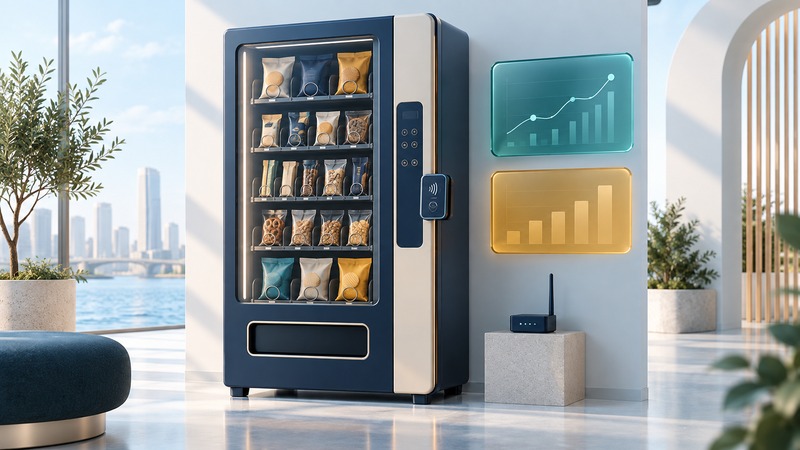
Wireless vending connects several jobs: accepting payment, confirming that a product was dispensed, and reporting sales or machine status to the operator. Plan those jobs separately, then verify that the chosen machine, reader, telemetry hardware and service work together.
For an operator adding connectivity to existing machines, start with an inventory of exact machine models, controller and reader versions, site locations, current payment arrangements and the person responsible for support. Have an authorized technician assess compatibility and installation using the equipment manuals.
Map the transaction and reporting paths
On a narrow screen, scroll the table sideways. Keyboard: focus the table and use the arrow keys.
| Stage | What you need to establish | Evidence to request |
|---|---|---|
| Payment request | Reader and payment provider support the intended payment method | Exact supported hardware, account and configured payment flow |
| Machine selection and vend | Controller and reader communicate the selection and result | Supported interface/version and documented success/failure behavior |
| Payment completion or reversal | Provider handles the reported outcome according to its configured process | Transaction record, exception policy and refund responsibility |
| Telemetry | Sales and health records reach the operator's system | Data fields, update timing and last successful communication |
| Replenishment | Reported stock aligns with physical loading and sales | Correct product/slot mapping and a physical reconciliation |
Cantaloupe's vending glossary explains MDB and DEX in the vending context. MDB connects a machine controller with supported payment peripherals; DEX is associated with audit-data exchange. A machine's support for one interface does not establish every reader or reporting feature you need. Request compatibility for the exact controller and firmware.
Separate payment approval from vend confirmation
A transaction can involve several reported states. Ask the provider to explain authorization, the machine's dispense result and final payment handling in the actual configuration. Include the outcome when the product sticks, the machine reports failure or the expected response times out.
Nayax's MDB attributes documentation describes a configurable wait for the machine's vend-success or vend-failure report. This is a concrete reason to verify machine-to-reader reporting. Its parameter behavior applies to that system; it does not establish another provider's refund timing or offline policy.
Use the supplier's approved test procedure or test mode with authorization. Keep the transaction identifier, machine identifier, time and observed physical result together. Never collect full card numbers in a maintenance worksheet. Agree in advance who investigates and resolves a disputed or incomplete transaction.
Evaluate connectivity at the installed position
Check the proposed cellular or wired/Wi-Fi arrangement at the actual machine location, including the effect of the enclosure and nearby structures. Record the supported carrier/service, last-seen status, reconnect behavior and who manages any SIM or network account. A phone working in the lobby provides limited evidence for a modem inside a cabinet farther away.
Cantaloupe's telemetry product information describes sending sales and machine-health information through cellular connectivity. Use the exact device's installation and service documents for placement and setup. Ask which reporting and payment functions share the connection and which continue during an interruption.
Fictional outage review: a machine's dashboard shows a last update at 10:15, while staff inspect it at 11:00. Treat displayed inventory as a record with a timestamp. Confirm local machine status and the provider's communication state before sending a replenishment order based on apparently current stock.
Validate a small pilot
Choose a few representative machines and sites. With the technician and service provider, verify one normal approved test purchase, the documented failed-vend test, communication recovery and the resulting records. Use only supported test procedures; do not create mechanical faults or interrupt a customer's transaction to simulate failure.
Reconcile a physical product count with the configured selections, loaded quantities and reported sales. Check cash sales as well as cashless sales if both must be included in inventory. Record how manual adjustments and refills enter the system. Telemetry is most useful when its product mapping and timestamps are dependable.
A pilot acceptance record should contain the exact hardware/software, site, test method, expected result, observed result, evidence location, owner and unresolved action. Expand deployment after required compatibility, transaction handling and reporting checks pass.
Assign ownership and ongoing costs
Compare equipment, installation, connectivity, software, payment processing and support terms over the same period. Have the provider explain contract termination, account transfer, data export and hardware reuse. Keep changing prices in a dated quote rather than assuming a universal per-machine rate.
Assign an owner for stale-machine alerts, customer refunds, device updates and network-service changes. Review supported cellular technologies and replacement plans with the provider before a service sunset affects the fleet. For a structured supplier comparison, adapt the WLAN vendor pilot method to the vending requirements above.