A wind turbine blade is both an aerodynamic surface and a load-bearing structure. Its shape captures energy from the wind, while its composite structure carries bending, twisting and repeated cyclic loads into the hub. Evaluating a blade requires evidence about the complete design, manufacturing quality and service history.
For project owners and readers of materials announcements, the key question is how a claimed improvement translates into reliable operation. A stronger material coupon addresses only part of that question.
Follow the load through the blade
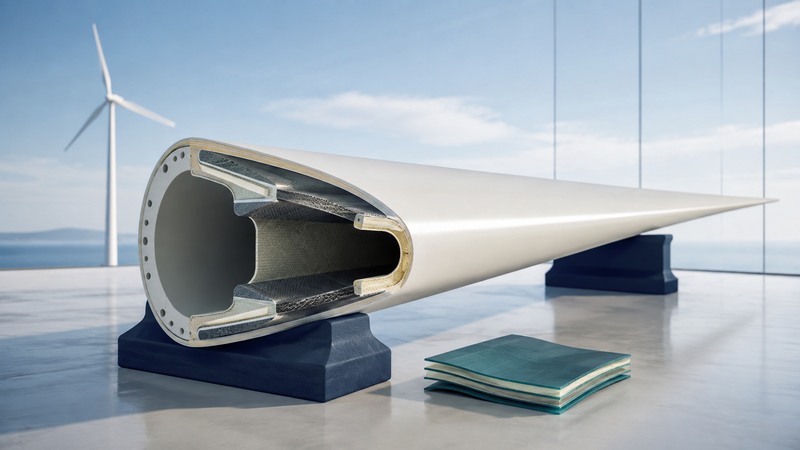
Many blades use glass-fiber composites, with carbon fiber used in selected designs or structural regions. Fibers provide directional reinforcement, resin binds the structure, and lightweight core materials help make stiff sandwich panels. Spar caps carry major bending loads; shear webs connect structural regions, while bonded joints transfer loads between parts.
Sandia’s 2013 carbon-design study for a 100-meter blade provides a research example of how material changes affect a blade design and its structural constraints. It is a reference design, not a universal description of every commercial blade. Exact construction varies by model.
On a narrow screen, scroll the table sideways. Keyboard users can focus the table region and use the arrow keys.
| Feature | Role or concern | Useful evidence |
|---|---|---|
| Aerodynamic shape and surface | Lift, drag and sensitivity to erosion or contamination | Design assumptions and performance under relevant surface conditions. |
| Spar caps, webs and shell | Strength, stiffness, buckling resistance and load transfer | Material properties, structural analysis and representative testing. |
| Bonds and manufacturing | Alignment, cure, voids and joint quality | Process controls, traceable inspections and acceptance criteria. |
| Root and protection systems | Connection to hub and exposure to lightning or weather | Exact-model design, inspection requirements and service records. |
Material changes also affect mass, stiffness, processing, repair compatibility and cost. Ask which part of the blade changes and which tests were repeated for the assembled design.
Separate strength from fatigue and field life
A static test examines response to an applied load case. Fatigue testing examines repeated loading. Real blades also experience combinations of turbulence, gravity, starts and stops, environmental exposure and other design conditions. Passing one test supports a particular assessment within those assumptions.
Sandia’s blade reliability and composites program combines material testing, structural work and inspection research. This progression helps connect small-specimen behavior with defects and loading in larger structures.
Fictional evidence comparison: supplier A reports a stronger coupon; supplier B provides a complete-blade test under a stated load program. The results answer different questions. Request how A’s material is incorporated into a blade and how B’s test represents the intended site. Neither item alone specifies remaining service life for an installed blade.
Use inspections to support an engineering decision
Record the blade model and serial identification, installation and repair history, inspection method, dates and defect locations. Compare observations consistently so the reviewer can distinguish a changing feature from a different camera angle or measurement method.
The Blade Reliability Collaborative studies issues including leading-edge erosion and manufacturing defects. Surface erosion can affect aerodynamics, while internal damage may need other inspection methods. A photograph should be interpreted within the limits of what it can reveal.
Qualified blade specialists and the turbine manufacturer should determine operating restrictions, repair design, acceptance checks and return to service. A cosmetic patch or an unreviewed material substitution can leave structural questions unresolved. Keep the engineering disposition with the inspection record.
Evaluate an actual end-of-service route
DOE’s recycling overview distinguishes the many metal components of a turbine from harder-to-process fiber-reinforced composites. A whole-turbine recycling percentage therefore needs a blade-specific explanation.
Options can include assessed life extension, reuse, mechanical processing, cement-related uses, and thermal or chemical processes that recover materials. Their availability and recovered-product quality vary. The DOE wind end-of-service guide explains project decommissioning and blade pathways.
For a real proposal, identify the receiving facility, accepted blade material, transport and segmentation plan, permits, residue destination and evidence of the recovered material’s use. Ask what fraction reaches each destination and which costs are contracted. A successful demonstration should be described at its demonstrated scale; a local disposal plan needs an available service and a traceable destination.
Use the wind-power project guide to connect component decisions with the wider project, site and energy assessment.