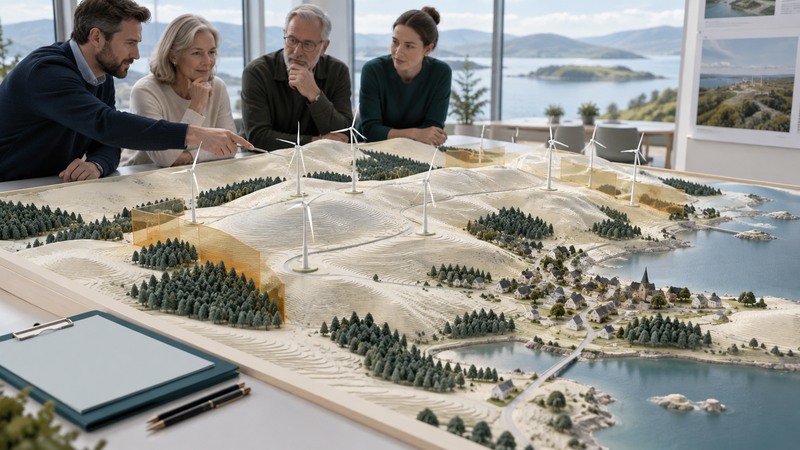
Review a wind-farm proposal by connecting each claim to a dated document, the site it describes and the party responsible for delivery. Start with the project stage and layout, then examine generation, community effects and obligations over the project’s life.
This guide is for residents, community organizations and project reviewers assembling informed questions. Use the current documents and authorities for the actual location; approval processes and land arrangements vary.
Establish what is proposed and what is decided
Obtain a dated map showing turbine locations, dimensions, access roads, cables, substations and nearby receptors such as homes. Record the developer, land interests, project capacity and alternatives still under consideration. Ask which changes would trigger another study or consultation.
The U.S. Department of Energy’s Large Community Wind Handbook separates feasibility, site assessment, interconnection, permitting and operation. Use those distinctions to organize a proposal review. A preliminary layout, a permit application and an operating authorization represent different stages.
On a narrow screen, scroll the table sideways. Keyboard users can focus the table region and use the arrow keys.
| Topic | Useful document | Question it should answer |
|---|---|---|
| Energy and grid | Wind-resource assessment, loss assumptions and interconnection status | What supports expected annual delivery, and what remains contingent? |
| People and place | Receptor map, sound/shadow studies and visualizations | Which locations and operating conditions were assessed? |
| Ecology and land | Seasonal surveys, construction footprint and mitigation plan | What site-specific impacts were identified and how will responses be checked? |
| Local commitments | Written benefit, access, complaint and reporting arrangements | Who receives each benefit, who carries each obligation and how is delivery tracked? |
| End of service | Removal/restoration plan, cost estimate and financial assurance where applicable | Who pays, what is removed and how will funding remain adequate? |
Read the energy estimate as a chain of assumptions
Nameplate MW describes capacity. Annual MWh describes energy over time. Ask for the wind data period and height, adjustment to the proposed turbines and losses from wakes, electrical equipment, maintenance and curtailment. Determine which losses are already included before applying additional deductions.
Request a range or uncertainty assessment as well as the central estimate. Identify whether grid constraints, connection works or a power-purchase arrangement remain unresolved. A technically promising resource still needs a route for delivering and using its electricity.
For an explanation of capacity, energy and wind variability, see the wind-power guide. Turbine technology questions can be pursued through the turbine-blade guide.
Turn broad assurances into local checks
For sound and shadow studies, ask which homes and other receptors were included, which turbine configuration was modeled and what operating assumptions were used. Request the applicable local criteria and the proposed response if monitoring or complaints reveal a problem.
DOE’s environment and wildlife overview explains that effects vary by place and species. A site review should identify survey coverage, sensitive periods, avoidance measures and operational responses. Ask how monitoring results lead to action and who is responsible for reporting them.
Keep construction impacts visible: road changes, drainage, access restrictions and restoration can affect people before electricity production begins. Separate employment estimates by construction and continuing operation, and ask how local participation is defined.
Use project history to ask better ownership questions
In a December 28, 2005 announcement about the Kumeyaay wind project, GE described 25 turbines and 50 MW on Campo tribal land in California. This is a dated project account, not a current ranking or description of every ownership arrangement.
The useful question for a new proposal is how the actual landholder, project owner, community and electricity purchaser participate. Ask for the relevant agreements or public summaries and distinguish ownership, lease payments, taxes and voluntary benefits. Each has a different recipient and basis.
Prepare a short evidence-based response
Fictional consultation question
“The April layout moves two turbines nearer the northern road, while the sound study uses the January layout. Please identify the study that evaluates the revised locations, its receptor list and the process for reviewing the result.”
This request identifies a document mismatch and a concrete way to resolve it. Use the same approach for an omitted survey season, unclear loss assumption or restoration plan without an assigned responsible party.
End with a concise register: claim, supporting document and revision, unresolved question, responsible party and requested response date. Track commitments into the relevant approval or agreement and ask how monitoring, complaints and end-of-service obligations will be maintained if ownership changes.
Wind proposal evidence review
Wind proposal evidence review — plain-text download. Save a copy and fill it in with your own information. The file includes instructions, assumptions and references so it can be used independently.