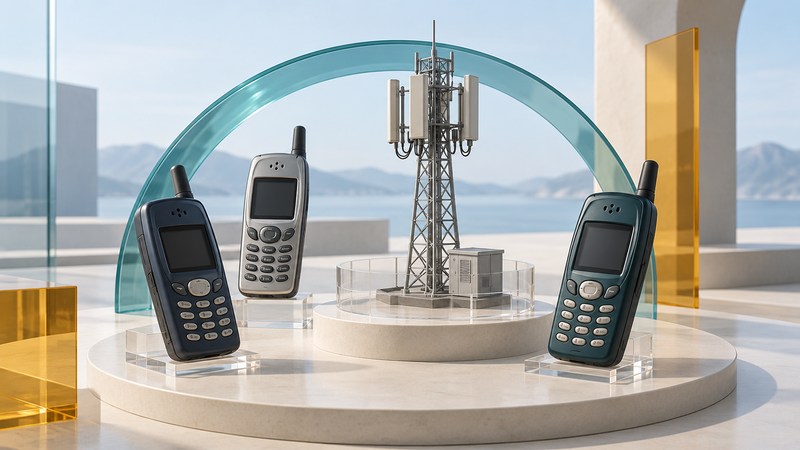
Motorola’s Integrated Digital Enhanced Network, or iDEN, combined cellular telephone and dispatch-style push-to-talk services in one network. Its historical appeal was a quick way to reach a colleague or talk group using a portable handset. Understanding that service model helps explain both its legacy and the limits of an old handset today.
On a narrow screen, swipe tables sideways or focus them and use the arrow keys.
Understand the dispatch conversation
A push-to-talk interaction gives a participant a turn to speak, then lets others respond. A talk group makes one transmission useful to a defined set of colleagues. In a networked service, the infrastructure manages access and delivers the conversation to the participating devices. A phone-like case with a side button describes the interface; it does not identify the radio technology or service behind it.
- A user requests a speaking turn
- The service manages the conversation and group membership
- Participating handsets receive the speaker
- The speaking turn is released for another participant
Motorola Solutions’ 2018 PTT technology history (PDF) places iDEN among land-mobile radio, broadband PTT and mission-critical PTT developments. It describes iDEN as combining telephone, two-way radio and data-related services. Those service roles explain its appeal more clearly than a list of handset features.
Keep the historical dates scoped
| Date | Milestone | Scope |
|---|---|---|
| 1993 | Motorola introduced iDEN, according to its PTT history | Technology introduction; commercial launches differ by operator |
| 2000s | Handset manuals documented telephone, private-call and other features | Exact functions depended on model and service |
| June 30, 2013 | Sprint’s U.S. Nextel platform reached shutdown | A particular operator and country, not a global retirement date |
| Later broadband PTT | Group-voice services use broadband networks and applications | A different platform with its own compatibility and provisioning |
Sprint’s 2013 year-end investor update defines the Nextel iDEN subscriber platform through June 30, 2013. Its 2013 annual filing discusses the June shutdown. Preserve that operator-specific scope when reading a handset listing or an international network history.
Separate the service from the button
| Term | What it identifies | What must be checked |
|---|---|---|
| iDEN | A particular network technology and equipment ecosystem | Exact handset, operator, band and supported service |
| Push-to-talk | A way to conduct a voice conversation | Underlying radio or broadband service and group behavior |
| Direct or off-network mode | A documented device-to-device function on some equipment | Model support, compatible peers and operating restrictions |
| Broadband PTT | An application/service over supported broadband connectivity | Device, account, application, coverage and interoperability |
A familiar brand name or a physical PTT key does not establish that two products can communicate. Interoperability needs a supported common service or a documented bridge. For a historical exhibit, describe the network and handset together so that the button’s purpose remains understandable.
Read an old handset as a documented artifact
The Motorola i355 user guide (PDF) documents MOTOtalk on printed page 21: direct communication between equipped phones when network service is unavailable, with availability qualified by the service provider. That is a model-specific function, separate from network calling. Check the matching regional version and supported peer equipment.
- Record the full model, variant, original carrier branding and label information.
- Locate the matching manufacturer manual and identify the function being claimed.
- For network service, obtain current confirmation from the relevant operator before purchasing service or accessories.
- For any direct mode, verify the exact supported peer equipment and applicable operating conditions.
- Check power, battery and charger compatibility from the manufacturer documentation; physical fit alone is insufficient.
A handset powering up establishes only that part of the hardware responds. A menu entry establishes that software exposes a function. Neither observation establishes present network registration or usable service. Keeping those levels of evidence separate avoids an expensive compatibility assumption.
What iDEN helps us understand
The enduring idea is communication organized around a working group: quick turn-taking, known participants and a device people can operate with little interaction. Later platforms can preserve that workflow while changing the network, software and management model. Evaluate continuity of the user’s task separately from compatibility of the equipment.
When comparing a later PTT service, ask who manages groups, which devices and coverage it needs, what happens during a network outage, and how any radio-system interconnection is documented. Those questions explain the migration more usefully than calling every new PTT product a replacement for every old radio.