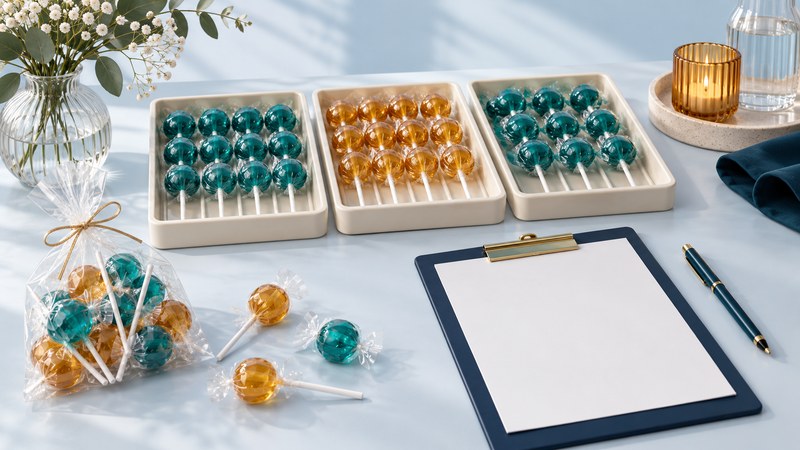
For an adult event, plan Dum Dums by usable piece count, then check the actual bag’s assortment and ingredients. Start by deciding whether hard candy fits the audience. An allergen statement and a choking-risk assessment answer different questions.
Settle audience and label requirements first
Spangler identifies Dum Dums as one of its brands, but choose the exact product before relying on a general brand description. Original Mix, larger pops, flat pops and single-flavor bags can differ in size, assortment and count.
Hard candy is unsuitable for infants and toddlers. The CDC’s choking guidance includes round or hard candy among foods to avoid for young children. A stick or individual wrapper does not remove the candy’s hard, round form. For a mixed-age event, arrange an appropriate alternative and keep hard candy out of young children’s reach.
For food allergies, read the exact package and manufacturer information and follow the event organizer’s requirements. Retain the outer bag. A broad marketing phrase such as “allergen free” needs its stated scope; it is not a promise covering every possible allergy or every setting.
Calculate the quantity before choosing a bag
Fictional adult-event example: plan one lollipop for each of 120 attendees and a 10% reserve. Required pieces = 120 × 1 × 1.10 = 132. A hypothetical 150-count bag leaves 18 after setting aside that reserve. The 10% allowance is a planning choice, not a manufacturer recommendation.
Count only people for whom the item is appropriate. Add staff or take-home portions explicitly rather than hiding them in a large allowance. If you plan several sessions, write each session’s quantity separately, then combine them before buying.
Swipe the table sideways, or focus it and use the arrow keys.
| Input | Example | Your check |
|---|---|---|
| Eligible attendees | 120 | Exclude people receiving an alternative. |
| Pieces per attendee | 1 | Define the distribution plan. |
| Reserve | 10% | Choose a buffer for the event. |
| Required pieces | 132 | Round any fractional result upward. |
| Pack count | 150, hypothetical | Use the actual package count. |
| Packs required | 1 | Round required pieces ÷ pack count upward. |
The plain-text quantity planner includes this example and blanks for your event, purchase cost and label checks.
Compare count, assortment and total cost
Spangler’s Dum Dums shop offers several formats. Its 600-count Original Mix listing is one current lookup example, checked October 2, 2026. Use the seller’s present package description and delivered price; the event example above does not describe that product.
Divide the full purchase cost by usable pieces. Include shipping and taxes in the numerator and account for any unusable or reserved pieces in your plan. If a listing gives only net weight, ask for the expected count and whether it is approximate. Weight alone cannot tell you exactly how many favors you can assemble.
An assorted bag also does not promise equal numbers of each flavor. For a color scheme or a specific flavor requirement, verify the assortment or choose a clearly identified single-flavor product. Allow time to count and inspect the delivered order before the event.
Prepare a simple distribution plan
- Inspect the outer bag and individual wrappers; set aside damaged pieces.
- Keep the original ingredient, allergen, date and lot information with the serving supplies.
- Count the planned portions into session batches, keeping the reserve separate.
- Provide the agreed alternative alongside the distribution plan, with its own packaging information.
- Store unopened surplus according to the package directions and record what remains for a future event.
A controlled handout makes the quantity estimate easier to use than an unlimited self-serve bowl. If the plan changes to self-service, treat the attendance calculation as a starting stock estimate and track consumption during the event.
For another quantity-planning method, see calculating packaged ice-cream portions.