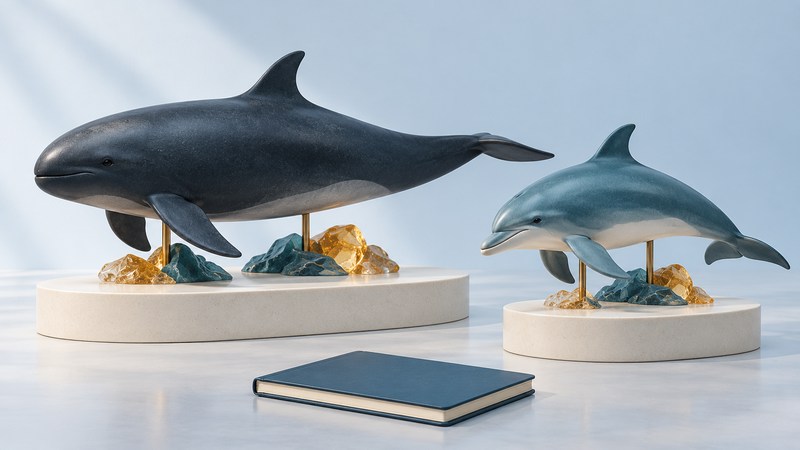
A wholphin is the common name used for a hybrid between a false killer whale and a bottlenose dolphin. Both parent species belong to the oceanic dolphin family, Delphinidae. The name is memorable, but understanding the animal requires separating common names, biological relationships and evidence about individual hybrids.
Identify the parent species
The false killer whale, Pseudorca crassidens, is a large, dark dolphin with a rounded head and no prominent projecting beak. Its common name reflects a resemblance between its skull and that of the killer whale. NOAA's false killer whale account places it within Delphinidae and describes its appearance and populations.
The common bottlenose dolphin, Tursiops truncatus, has the familiar projecting rostrum, or beak. NOAA's bottlenose dolphin account explains its biology and variation among populations. “Atlantic bottlenose dolphin” occurs in historical descriptions of the Sea Life Park animals; the species name helps keep the parentage precise.
Common names containing “whale” are also used for several members of the dolphin family. Therefore, the name wholphin should not be read as a cross between an oceanic dolphin and any whale species. The particular parents matter.
Read the Sea Life Park record as a dated history
Kekaimalu's parentage is documented in the operator's photograph caption uploaded in June 2008: a bottlenose dolphin mother and a false killer whale father. The photograph is labelled as taken in May 2005. Keeping the capture and upload dates separate helps establish what a historical image can tell us.
In April 2005, a Sea Life Park/Dolphin Discovery announcement described Kekaimalu and a female calf with further bottlenose-dolphin ancestry. These are historical records. An old statement about an animal's age, health or rarity should remain tied to its date rather than serving as a current visitor promise.
The important biological point is that a female hybrid produced offspring. That observation concerns this individual and pedigree. It does not establish that all hybrids of the same parent species, or hybrids of either sex, will be fertile.
Understand what an ancestry fraction means
For a first-generation hybrid with one parent from each species, the conventional pedigree expectation is one-half ancestry from each parental species. If that hybrid has offspring with a bottlenose dolphin, the expected pedigree contribution becomes three-quarters bottlenose dolphin and one-quarter false killer whale.
Recombination and inheritance make the relationship between ancestry and traits more complicated than dividing an animal into visible fractions. A body measurement or coat colour alone cannot establish the full pedigree. Researchers use documented parentage and genetic evidence to investigate such questions.
Keep species and evidence together
A comparative study of cetacean hybridisation examined documented crosses and factors associated with them. Reports can come from managed settings, wild observations and genetic investigations, which have different strengths and limits.
A 2018 study of common and Indo-Pacific bottlenose dolphin hybrids documented fertile first-generation hybrids and backcross offspring in managed care. Those parents were two species within Tursiops, a different pairing from a wholphin. The study illustrates why the exact cross and generation belong next to a fertility claim.
Distinguish producing a hybrid individual from establishing a new species. A documented birth addresses parentage and reproduction. Claims about a persistent population, reproductive isolation or long-term evolutionary effects require evidence at a different scale.
Check the next hybrid headline
Record the scientific names of both parents, whether the animal is a first-generation hybrid or a later cross, and how parentage was established. Note the observation date, setting and whether a claim concerns appearance, fertility or population history. These few details often resolve an otherwise confusing story.
For viewing wild cetaceans, use our dolphin-watching guide to find the rules for the place and species. A rare-animal story should lead to careful observation and better understanding, rather than an assumption that close contact is appropriate.