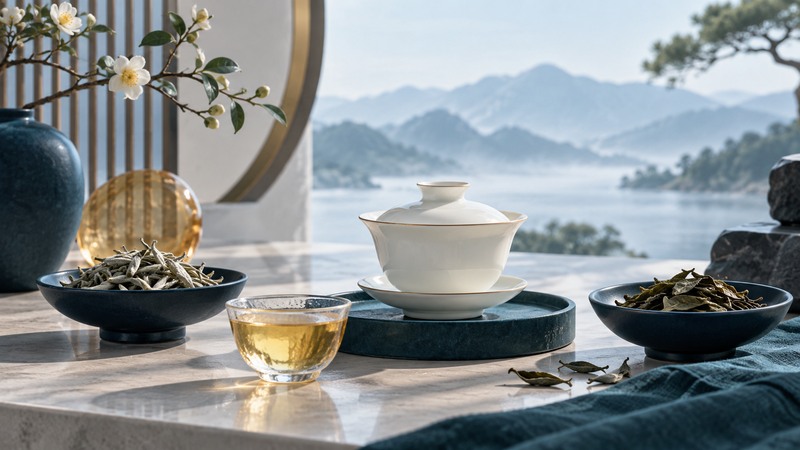
Choose white tea for the cup you want to make. Start with a small amount of a clearly identified tea, follow its brewing directions, and record leaf weight, water volume, temperature and time. Those four details make a pleasing result easier to repeat than descriptions such as “a little leaf” or “water just off the boil.”
Choose a style before a health promise
White teas come from Camellia sinensis and include bud-focused styles such as Silver Needle and styles with buds and leaves such as White Peony, also called Bai Mudan. Producer names and grades vary. Inspect the seller's description of origin, harvest, ingredients and preparation, then buy a sample if the flavor is unfamiliar. Harney & Sons' white-tea collection provides examples of these styles and a general brewing starting point.
For a first comparison, choose one plain bud-style tea and one plain leaf-and-bud tea. A peach or vanilla blend can be enjoyable, but added aromas make it harder to isolate the base tea's character. Check the full ingredient list so you know what you are tasting.
Dry leaves vary greatly in bulk. A fluffy spoonful of large leaves and a tightly packed spoonful of broken tea may weigh quite differently. A small kitchen scale removes that ambiguity. Keep the package closed and dry between uses, away from strong kitchen odors; follow any specific storage directions supplied with the tea.
Make one measured cup
Use a heat-safe pot or mug, a roomy infuser or fine strainer, a scale, a timer and a temperature-controlled kettle or thermometer. The following is an editorial starting formula for tasting, not a claim of kitchen-tested perfection. The tea's own instructions take priority.
- Weigh 2 g of plain white tea into the infuser.
- Add 200 mL of water at about 80°C / 176°F.
- Steep for 3 minutes, then remove or strain the leaves completely.
- Let a small sip cool to a comfortable temperature. Taste before adding milk or sweetener.
- Record the result: aroma, strength, sweetness and any drying sensation in the mouth.
The temperature and time sit near the producer's 175°F, 2–3 minute guidance. Different leaves, including some aged styles, may suit different preparation. Treat the starting cup as a baseline you can adjust.
Change one variable at a time
On narrow screens, scroll the table sideways. Keyboard: focus the table and use the arrow keys.
| What you notice | Try on the next cup | Keep fixed |
|---|---|---|
| Pleasant aroma but weak body | Increase leaf from 2 g to 2.5 g | Water, temperature and time |
| Harsh or very drying finish | Shorten the steep by 30 seconds | Leaf, water and temperature |
| Too concentrated overall | Reduce leaf or use a little more water | Change only the chosen variable |
| Good taste but difficult to reproduce | Weigh the leaf and time the steep | Use the same vessel and water |
These are tasting experiments, not universal rules. If you try a second infusion, keep it separate and record its time. Its flavor and caffeine extraction will differ from the first cup. Do not assume that a quick rinse or first steep removes all caffeine.
For a two-cup batch using the starting ratio, 4 g in 400 mL preserves the leaf-to-water ratio. Use a vessel large enough for the leaves to move freely. Doubling water and leaf does not require doubling the steep time.
Understand caffeine and antioxidant language
Tea color alone is a poor way to assign a caffeine number. A 2008 laboratory study of 20 commercial tea products found overlapping caffeine amounts among white, green and black teas, with steep time affecting extraction. Its measured range describes those samples and preparations, rather than every tea available today.
Similarly, a measurement of polyphenols or antioxidant activity describes a sample and a test. A claim about preventing disease needs relevant human evidence, including the actual product, amount and outcome. This guide makes no cancer-prevention or weight-loss promise for white tea. The green-tea evidence guide explains how to separate laboratory findings, observational associations and treatment trials.
Keep the cup you enjoyed
Write the tea name and batch, grams of leaf, milliliters of water, temperature, minutes and your next adjustment. The tea tasting record supplies a reusable format. Repeat the preferred version before buying a large quantity. For certification and packaging choices, see organic tea labels; for an herbal alternative, explore rooibos and honeybush.