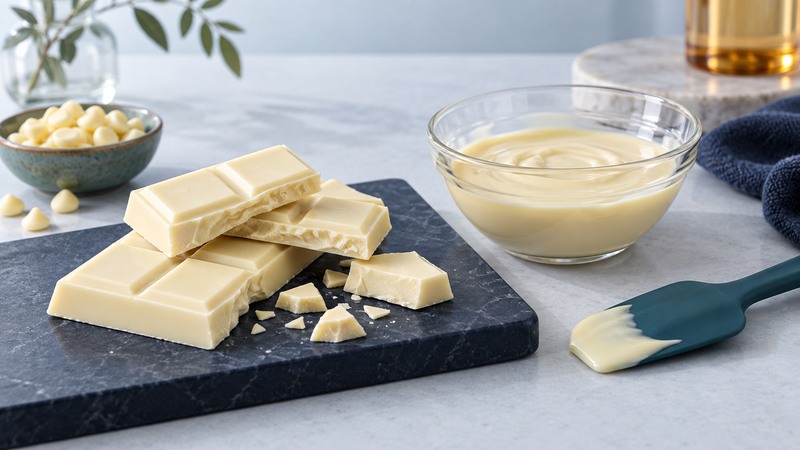
White chocolate combines cocoa butter, milk ingredients and sweetener. For baking or dipping, the first useful question is which product you have: a white chocolate bar, baking chips or a confectionery coating can behave differently despite looking similar.
Read the name and ingredients together
In the United States, the FDA standard-of-identity guide describes white chocolate as containing at least 20% cocoa butter, 14% total milk solids and 3.5% milkfat, with no more than 55% nutritive carbohydrate sweeteners. These are composition criteria, not a flavor ranking.
White chocolate contains cocoa butter without the nonfat cocoa components that give dark chocolate its brown color. A white coating may instead use other vegetable fats. Check the exact name and ingredients; some baking chips are white chocolate and others are a different formulation. Milk and any relevant allergen information deserve the same attention as the front label.
Scroll the table sideways. With a keyboard, focus it and use the arrow keys.
| Job | Useful product choice | Check before buying |
|---|---|---|
| Fold pieces into cookie dough | The chips or chopped bar specified by the recipe | Piece size and whether the recipe expects pieces to hold their form. |
| Make ganache or mousse | The recipe’s named white chocolate or stated composition | Amount and type of cream; a dark-chocolate formula needs redesign. |
| Make dipped treats with a simple setting step | A coating explicitly intended for dipping | Whether the package says tempering is unnecessary. |
| Make crisp molded pieces | Suitable cocoa-butter white chocolate | The manufacturer’s tempering curve and mold instructions. |
Melt gently and stir before adding more heat
Use a dry heatproof bowl and dry spatula. Chop a bar into small, similar pieces. In the microwave, Ghirardelli’s general melting guidance uses medium power and 30-second intervals with stirring between them. As melting progresses, stop heating while a few soft pieces remain and finish by stirring; follow the package if it gives different product-specific instructions.
For indirect heat, set the bowl over hot water and keep splashes and steam condensation out of the chocolate. Remove it from the heat as soon as it can be stirred smooth. More heat cannot improve chocolate that has scorched.
First melt only what your task requires. If you are making a decorative drizzle, test a small line on parchment and observe how it sets before coating the whole dessert. If the recipe adds cream, butter or another liquid, follow its sequence; that becomes a formulated mixture with a different purpose.
Use the curve for the actual chocolate
Tempering creates the cocoa-butter crystal structure needed for a good set. Merely melting a bar does not complete that process. As a specific example, Callebaut’s W2 white-chocolate curve gives melting at 45°C (113°F), cooling to 27°C (80.6°F), then working at 28–29°C (82.4–84.2°F). Those values belong to that product and method.
Read the complete manufacturer procedure, including how to seed or cool the chocolate, before attempting molds or a crisp shell. A temperature alone is an incomplete procedure. Use a suitable thermometer, stir consistently and test a thin smear on parchment. Keep the work within the product’s stated conditions instead of borrowing a dark-chocolate temperature range.
Decide whether the substitution changes structure
Replacing chocolate chunks in a cookie is a different experiment from replacing the main chocolate in mousse. In a cookie, you may mainly change sweetness and the pockets of melted chocolate. In a ganache, the chocolate is part of the structure that holds the filling together.
For a mousse or truffle recipe, use a version developed for white chocolate. Match its cream type and quantity as well as the chocolate. For an optional cookie mix-in, make a small trial with equal weights and compare after cooling. Write down the exact product so you can repeat a successful choice.
Water-based color or flavor additions can disrupt plain melted chocolate; choose products intended for that use and follow their directions. Keep unused chocolate tightly wrapped, away from heat, moisture and strong odors, following its storage label. Store cream-based fillings according to the finished recipe, since a stable bar and a dairy filling have different storage needs.