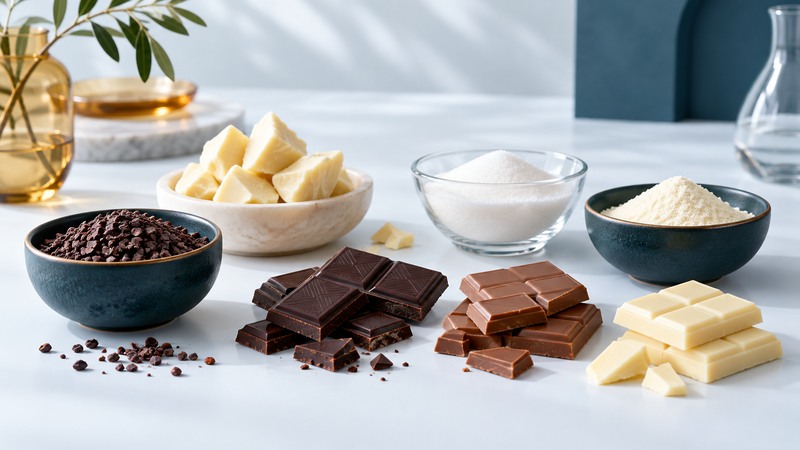
Chocolate’s flavor and behavior come from its cocoa components, sugar, milk where used, and smaller additions such as emulsifiers. Read the ingredient list alongside the cacao percentage: together they tell you more than either one alone.
Understand the building blocks
Scroll the table sideways. With a keyboard, focus it and use the arrow keys.
| Ingredient | What it contributes | How to interpret it |
|---|---|---|
| Cocoa mass, cocoa liquor or unsweetened chocolate | Ground cacao nibs, containing cocoa butter and nonfat cocoa material | Liquor here describes the cocoa paste, not an alcoholic ingredient. |
| Cocoa butter | Fat extracted from cacao | Helps determine melting and flow; counted among cacao ingredients. |
| Sugar | Sweetness and solid particles | Check the nutrition panel for amounts per serving. |
| Milk powder or other milk ingredients | Milk flavor, protein, sugar and sometimes milk fat | Check the exact ingredient and allergen information. |
| Lecithin | An emulsifier used to adjust flow | Its source may be soy or another ingredient; read the label. |
| Vanilla or other flavorings | Additional aroma | A short label can still contain flavoring; judge the product against your intended use. |
Ghirardelli’s ingredient glossary explains cocoa liquor, cocoa butter and chocolate types. Manufacturers use different formulations, so compare the actual products in front of you.
Read 70% as an ingredient proportion
Cacao percentage describes the combined cacao-derived ingredients. It can include cocoa mass, added cocoa butter and cocoa powder. It does not specify how much of that total is nonfat cocoa material. Lindt’s dark-chocolate explanation connects percentage to cocoa components.
Two hypothetical 70% bars
A 100 g bar could contain 60 g cocoa mass plus 10 g added cocoa butter. Another could contain 65 g cocoa mass plus 5 g added cocoa butter. Both total 70 g of cacao ingredients, but their balance differs. This arithmetic example illustrates label interpretation; it is not a manufacturing formula or a claim about a brand.
The remaining 30% may include sugar, milk ingredients, emulsifiers and flavorings. Use the nutrition panel to find the sugar amount. Percentage alone also leaves the bean origin, fermentation, roast and particle size unresolved. Those differences help explain why two bars with the same percentage can taste and melt differently.
Connect the process to the result
Fermentation and drying prepare the beans; roasting develops flavor, and cracking and winnowing separate nibs from shells. Grinding releases fat and produces cocoa mass. Refining reduces particle size, while conching further develops texture and flavor. Tempering controls cocoa-butter crystallization before molding. Ghirardelli’s manufacturing overview follows that sequence.
These stages answer different questions. A fine texture can come from refining even in a modestly priced bar. A glossy surface reflects setting and handling as well as ingredients. A farm name describes origin; it does not by itself tell you how the maker fermented, roasted or formulated the chocolate.
Match the product to your task
- For a recipe: start with its specified chocolate type and percentage range. Unsweetened chocolate changes the sugar balance; white chocolate changes the cocoa components.
- For dipping: check whether the product calls for tempering or is a ready-to-melt coating. Those workflows differ.
- For tasting: compare small pieces at the same temperature and write down sweetness, aroma, melt and aftertaste before reading marketing descriptions.
- For dietary needs: inspect the ingredients, allergen statement and current manufacturer information for that exact package.
Keep the wrapper if you are testing a recipe. Note the brand, product name, percentage and format—bar, chip or wafer—alongside your result. That record is more useful for repeating a successful batch than a note that simply says “dark chocolate.”
For nutrition, compare equal gram amounts first and your likely portions second. For ingredient sourcing, ask which origins and traceability model the maker can document. These are separate dimensions of the same buying decision.