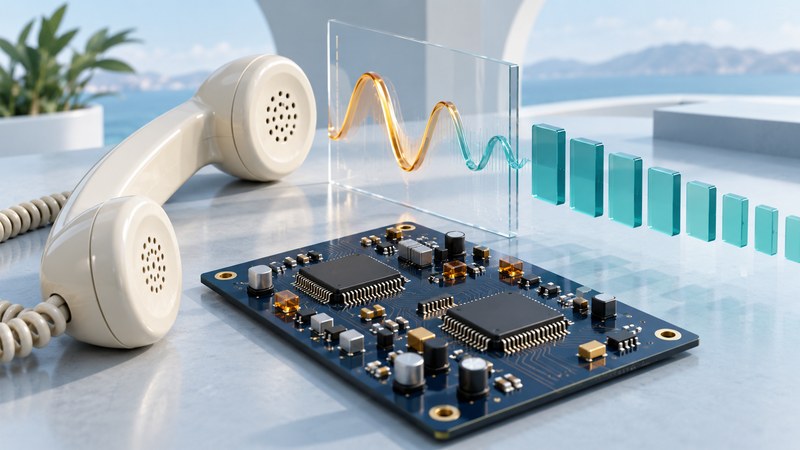
An analog telephone needs an electrical line interface before its speech can become IP packets. A subscriber line interface circuit, or SLIC, handles telephone-line functions; a codec handles conversion between analog audio and digital samples. A host processor and its software then connect those samples to a calling service.
This is a block-diagram and datasheet-reading guide for students and technical readers. It does not provide a wiring procedure for telephone-line voltages. Use the manufacturer's complete reference design and qualified engineering review for hardware work.
Follow the analog-to-packet path
- Analog telephone and two-wire line. The handset exchanges electrical voice signals with an FXS telephone port.
- Line interface. The SLIC performs supported line-driving and supervision functions, including feed and ringing. The complete circuit needs the specified supply and protection arrangements.
- Conversion and filtering. The codec converts incoming analog speech into digital samples and returning samples into analog speech.
- Host processing. Software handles the selected voice format, buffering, call signaling and media packet handling.
- Network interface. Packets travel through the device's access connection to the voice service.
These are functional blocks; package boundaries vary. Microchip's line-circuit overview distinguishes combined SLIC/codec families from SLIC-only products. MaxLinear's CPE telephony chipset overview likewise describes combined interfaces and different connections to host systems. Count required functions before counting chips.
Read “codec” in context
In a line-circuit datasheet, codec often refers to analog/digital conversion and associated signal processing. In a calling application, codec can refer to the speech coding format and its implementation. A hardware device may also implement particular coding functions, so the terms overlap.
For a specific example, the publicly hosted Le9642 datasheet, section 3.3, describes analog conversion, programmable filtering, PCM paths and G.711 A-law or μ-law coding, with a linear option. That establishes the functions of that documented part; it does not establish support for every codec a softphone can negotiate.
Swipe horizontally, or focus the table and use the arrow keys.
| Requirement | Find in the documentation | System consequence |
|---|---|---|
| Telephone ports | Channel count and FXS or FXO role | Determines which external equipment each port serves |
| Electrical interface | Feed, ringing, load, supply and protection requirements | Requires a complete supported circuit and applicable compliance review |
| Sample and control interfaces | PCM or other sample bus, clocking and control protocol | Must match the host's hardware and driver support |
| Signal processing | Bandwidth, coding formats, filters and gain controls | Defines what the line device handles and what remains on the host |
| Software and lifecycle | Driver/API, supported profiles, errata and product status | Affects integration, maintenance and replacement planning |
Resolve a missing block
Fictional gateway review
A team proposes a two-port analog gateway using a host SoC and a part labeled “SLIC.” The reviewer asks where analog conversion occurs and how samples reach the host. If the selected SLIC integrates a codec, the team documents that sample interface. If it is SLIC-only, the design must identify the separate conversion path. The outcome is an explicit functional map before pin-level design begins.
The same reasoning helps with a fault report. Ringing with no usable speech suggests checking different evidence from complete loss of line feed. Engineers should use the part's documented diagnostics and qualified procedures; end users should collect symptoms through the equipment's supported interface and contact the service provider.
Keep protocol responsibilities visible. SIP signaling and RTP media transport belong to the calling system. An analog line circuit supplies functions at the telephone boundary, while the host and network complete the service.
Build a function-to-part map
Download the line-circuit reading worksheet. Record a datasheet section for every claimed function and mark unresolved interfaces. Continue with VoIP SoC system design for processing, power and software boundaries, or cable voice equipment for a household-level view.