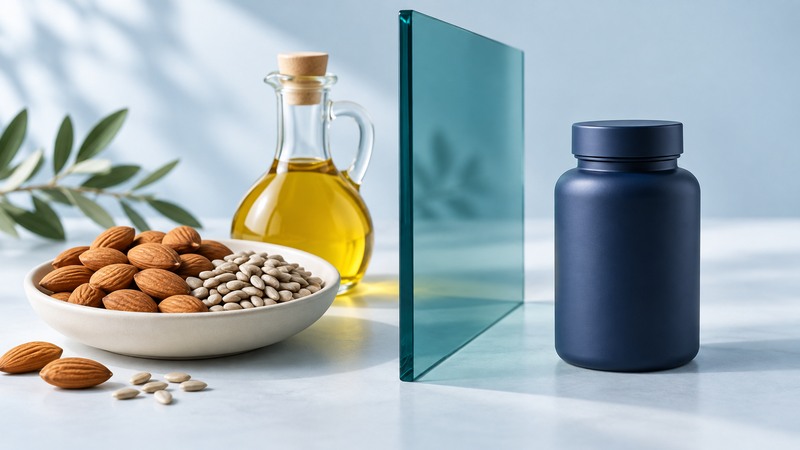
Vitamin E helps protect cell membranes and supports normal immune function. For everyday decisions, start with food intake and the amount on the label. A concentrated antioxidant supplement needs evidence for the particular benefit being claimed, plus a check for interactions.
Start with the nutritional need
The U.S. recommended daily allowance is 15 milligrams (mg) of alpha-tocopherol for adults, including pregnancy, and 19 mg during breastfeeding. These are total-intake reference values, covering food and supplements together. Vitamin E deficiency is uncommon in healthy people; problems absorbing fat can change the assessment. See NIH vitamin E nutrition guidance.
Use your usual meals as the starting point. Write down the nuts, seeds, oils and fortified foods you actually eat over several days. Keep portions realistic: a food that is rich per 100 grams may contribute less in the teaspoon or small handful you use. A single low-intake day is a prompt to inspect the pattern, not a diagnosis.
Make a practical food comparison
On a narrow screen, scroll the table sideways. Keyboard users can focus the table region and use the arrow keys.
| Food and portion | Approximate vitamin E |
|---|---|
| Dry-roasted sunflower seeds, 1 ounce | 7.4 mg |
| Dry-roasted almonds, 1 ounce | 6.8 mg |
| Sunflower oil, 1 tablespoon | 5.6 mg |
| Peanut butter, 2 tablespoons | 2.9 mg |
Values from the NIH food table are estimates; preparation and products vary. Choose foods that fit allergies, energy needs and the rest of the meal.
Read the amount and form together
Current U.S. labels use mg. Older labels and research may use international units (IU). Natural-source d-alpha-tocopherol and synthetic dl-alpha-tocopherol have different IU conversions: multiply natural IU by 0.67, or synthetic IU by 0.45, to obtain mg of alpha-tocopherol. The NIH conversion guidance explains the distinction.
- Photograph Supplement Facts and the ingredient list.
- Record how many capsules make one serving and how many you take.
- Add the vitamin E in your multivitamin, single-nutrient product and any eye-health formula.
- Ask what clinical purpose each product serves before making a change.
Match the health claim to human evidence
For community-dwelling, nonpregnant adults without a known nutritional deficiency, the USPSTF recommends against vitamin E supplements to prevent cardiovascular disease or cancer. An antioxidant mechanism alone cannot establish that taking a capsule prevents a heart attack.
A condition-specific formula is a separate question. Vitamin E is one component of studied AREDS formulations for selected people with age-related macular degeneration. Read the AREDS2 guide with your eye clinician before treating a stand-alone vitamin E bottle as an equivalent.
Bring high-dose products to a medication review
High supplemental intakes can increase bleeding risk, especially with anticoagulant or antiplatelet medicines. The adult upper limit is 1,000 mg daily of supplemental vitamin E; it is a safety ceiling, not a target or a guarantee that a smaller dose suits you. See NIH consumer safety advice.
Bring all bottles to the pharmacist or clinician, including products you use only occasionally. Ask: “What benefit are we expecting, what total amount am I taking, and does it affect my medicines or a planned procedure?” Continue prescribed treatment unless the prescriber advises a change. Record the answer and an agreed review date in your supplement inventory.
Continue reading
- Vitamins and heart-disease prevention
- Read labels and organize supplement use
- All vitamin and mineral guides
U.S. nutrition and clinical sources checked September 18, 2026. This educational guide supports a discussion with your care team; individual treatment plans depend on your health and medicines.