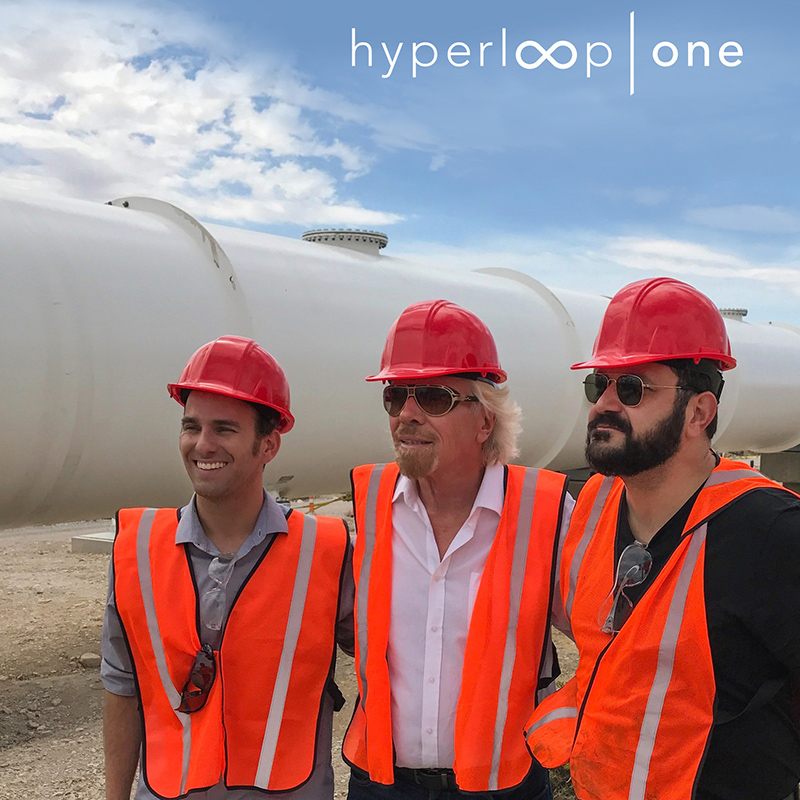
Virgin Hyperloop One was one of the most ambitious transportation ventures of its era. It proposed moving passengers and freight in magnetically levitated pods through low-pressure tubes, reducing aerodynamic drag enough to make very high speeds possible. The company did not achieve its ultimate goal: it ceased operations at the end of 2023 without opening a commercial route. Its decade of work nevertheless produced meaningful engineering milestones, including a full-scale integrated test system, a 240 mph pod run and the first hyperloop journey with people aboard.
That record is more useful than either the exuberant predictions of 2017 or a simple declaration that hyperloop failed. Hyperloop One showed that several core elements could work together. It also revealed how much more difficult it would be to turn a short controlled demonstration into safe, affordable infrastructure operating across hundreds of miles.
From an open concept to a working test system
The modern hyperloop discussion accelerated in 2013, when a team at Tesla and SpaceX published the Hyperloop Alpha paper and invited others to develop the idea. Hyperloop One was founded in 2014 as Hyperloop Technologies. It was independent of Elon Musk and his companies, despite building on the broadly circulated concept.
A hyperloop vehicle is intended to travel inside a tube from which most—not all—air has been removed. With much less aerodynamic resistance than a train encounters in the open atmosphere, an electrically propelled pod could theoretically travel at airline-like speeds. Hyperloop One's approach combined a low-pressure environment, a linear electric motor, electromagnetic levitation, guidance, braking, power electronics, controls and vacuum management.
The company first demonstrated its propulsion system in the open air in Nevada in May 2016. It then built DevLoop, a roughly 500-meter (1,640-foot) tube near Las Vegas, to test those components as a system. On May 12, 2017, a levitating test vehicle accelerated through the low-pressure tube and reached 70 mph in 5.3 seconds. It was a short run, but it was an important change in kind: the propulsion, levitation, tube, vacuum and control systems were operating together. Hyperloop One described it as the first full-system hyperloop test in a vacuum environment.
The Virgin partnership and faster tests
On October 12, 2017, Virgin Group announced an investment and strategic partnership. Richard Branson joined the board, and Hyperloop One became Virgin Hyperloop One. Virgin's consumer-transportation experience and recognizable name gave the project greater public visibility as the company explored passenger and freight corridors in India, the Middle East, Europe and North America.
The Nevada program continued to improve. The XP-1 pod reached 192 mph in the summer of 2017 and a peak of 240 mph (387 km/h) later that year. The 500-meter track forced the vehicle to accelerate and brake quickly, so it could not demonstrate the sustained cruising speed envisioned for a long route. Even so, the run showed controlled high-speed travel inside a large low-pressure tube and gave engineers real data about vehicle dynamics, thermal behavior, braking and system coordination.
| Date | Milestone | What it demonstrated |
|---|---|---|
| 2014 | Company founded | A dedicated engineering organization formed to commercialize the modern hyperloop concept. |
| May 2016 | Open-air propulsion test | The linear electric propulsion system accelerated a test sled in the Nevada desert. |
| May 2017 | First integrated DevLoop run | Levitation, propulsion, controls, vacuum infrastructure and the tube worked as one test system. |
| October 2017 | Virgin partnership | The company gained a global transportation brand and expanded its passenger ambitions. |
| December 2017 | 240 mph XP-1 test | The pod reached the program's highest publicly reported speed on the short DevLoop track. |
| November 2020 | First crewed hyperloop run | Two employees traveled safely in the XP-2 passenger pod through the low-pressure tube. |
| 2022 | Shift to freight | The company reduced staff, set aside near-term passenger service and later dropped the Virgin name. |
| December 2023 | Operations ended | The effort closed without a commercial construction contract; its testing record and technical work remained. |
The first passengers in a hyperloop pod
The company's most memorable achievement came on November 8, 2020. Co-founder and chief technology officer Josh Giegel and passenger-experience director Sara Luchian boarded the two-seat XP-2, named Pegasus, at DevLoop. The pod reached 107 mph (172 km/h) during a run of about 15 seconds.
That speed was modest compared with the 600-plus-mph vision, and slower than established high-speed rail. Speed, however, was not the test's main purpose. The crewed run demonstrated boarding procedures, restraints, communications, acceleration and braking with people inside a pod operating in a low-pressure environment. After more than 400 uncrewed tests, it answered a narrower but essential engineering question: could an integrated hyperloop prototype carry people through the tube? The successful passenger demonstration remains a first for the field.
Work beyond the test track
Hyperloop One's contribution was not limited to vehicle speed. Its engineers had to address seals, pumps, airlocks, switching concepts, emergency procedures, structural tolerances and the interaction between a fast vehicle and a confined tube. The company also brought infrastructure operators, governments and safety specialists into discussions that had initially been dominated by renderings and theoretical performance.
In the United States, hyperloop developers helped prompt a more formal regulatory conversation. The Department of Transportation's Non-Traditional and Emerging Transportation Technology Council published a hyperloop standards review in 2021, identifying existing standards that might apply and areas where new ones would be necessary. That did not certify Hyperloop One's system, but it moved the subject toward the patient work required of any new transport mode.
DP World, a major investor that ultimately held majority control, worked with the company on the Cargospeed concept for high-priority freight. Those studies encouraged logistics planners to examine where extremely fast, automated tube transport might offer value—especially between ports, distribution centers and inland terminals—even though no commercial Cargospeed line was built.
Why the commercial system did not follow
A successful prototype does not solve the economics of a network. A useful hyperloop corridor would require long, exceptionally straight rights of way; precisely built tubes and supports; large vacuum and power systems; terminals and airlocks; safe switching; and procedures for evacuation, pressure loss and equipment failure. Curves become demanding at high speed, while bridges, tunnels, land acquisition and urban approaches can dominate a project's cost and schedule.
DevLoop was an effective component-integration facility, but its short length could not validate sustained top-speed travel, route-scale vacuum operations, high-frequency dispatch, station throughput or commercial maintenance costs. The company announced route studies and agreements, but it did not secure a contract to construct and operate a full system. Hyperloop still had to compete for investment and public support with aviation, highways and increasingly capable high-speed rail—modes with established standards, supply chains and operating experience.
In early 2022, the company laid off roughly half its staff and redirected its immediate focus from passengers to freight. Virgin branding was later removed, returning the name to Hyperloop One. The pivot narrowed the problem but did not produce a commercial project in time.
The end of Hyperloop One
In December 2023, reports confirmed that Hyperloop One was selling its remaining physical assets and ending employment for its remaining workers on December 31. The Los Angeles-based company had raised more than $400 million since 2014, but it closed without a working commercial line or construction contract. Majority shareholder DP World was reported to retain the intellectual property. The shutdown ended this particular corporate effort, not every hyperloop research program worldwide.
The conclusion deserves clear-eyed respect. Hyperloop One did not deliver the new transportation network its leaders forecast, and its demonstrations should not be confused with a deployable public system. Yet the team built hardware at meaningful scale, operated a complex low-pressure test environment, pushed an integrated pod to 240 mph and accepted the responsibility of putting its own people aboard. According to the Reuters account of the closure, it completed the world's first passenger ride on a levitating hyperloop pod system.
Those accomplishments matter because ambitious engineering advances through tested evidence, including evidence about limits. Hyperloop One left later researchers a more concrete understanding of the technology, safety questions, infrastructure burden and commercial challenge than existed when the company began. Its grandest promise remained unrealized, but it helped move hyperloop from a white paper into the physical world—and established milestones that any future effort will have to exceed.