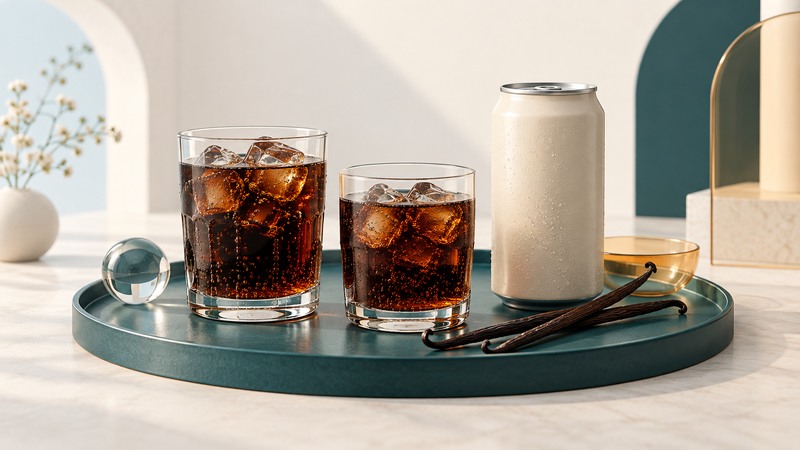
Vanilla Coke combines a familiar cola identity with a distinct flavor variant. A useful comparison begins by separating the product’s history, the exact version on your local shelf and your own taste preference. The label can establish composition; a small, consistent tasting can help you decide which flavor you prefer.
From the 2002 introduction to current variants
Coca-Cola’s U.S. flavors page dates the introduction of Coca-Cola Vanilla to 2002. As checked on September 18, 2026, that page lists both Coca-Cola Vanilla and Coca-Cola Zero Sugar Vanilla. These are distinct formulations, so keep the full product name in any comparison.
A manufacturer’s U.S. listing establishes the products described there. Local stock, packaging and formulas in other markets need a separate check. Read the package you are buying and use the manufacturer’s corresponding market site if the wording or quantities differ.
Compare the stated serving
The U.S. manufacturer listing gives the following values for a 12 fl oz serving. This is a dated transcription of selected fields, with the package label remaining the reference for a particular purchase.
On narrow screens, scroll the table sideways. Keyboard: focus the table and use the arrow keys.
| U.S. product | Calories | Total sugars | Sodium |
|---|---|---|---|
| Coca-Cola Vanilla | 150 kcal | 42 g | 35 mg |
| Coca-Cola Zero Sugar Vanilla | 0 kcal | 0 g | 40 mg |
Both ingredient lists include caffeine. Use the official product page and actual packaging for the full ingredients and nutrition information. Similar flavor names allow a sensory comparison, but the formulations and sweetening systems differ.
Start by copying the serving volume. If you drink a different amount, multiply each per-serving value by consumed volume divided by labeled volume. Using the regular product’s stated figures, 6 fl oz is half of 12 fl oz, giving approximately 75 kcal and 21 g sugars. This is a calculation from rounded label values, not a laboratory measurement.
If total sugars and added sugars have the same number, they describe overlapping categories. Added sugars are already included in the total. Use the soda portion guide when comparing packages of different sizes.
Run a small, fair tasting
The following is an editorial tasting method for recording preference, not a claim that Yenra conducted a product test. Use two products at a time: for example, regular cola and vanilla cola, or the regular and zero-sugar vanilla variants. Choose the comparison question before opening them.
- Record identity. Write the exact product names, package sizes, market and best-before information. This makes the result traceable to the versions you tasted.
- Keep conditions similar. Chill both together, use matching clean glasses and open them close to the same time. Skip ice and additions for this comparison so dilution varies less.
- Pour equal small amounts. About 30 mL of each is enough for a few sips. Label the glasses A and B. Another person can conceal which is which if you want to reduce brand expectation.
- Describe before ranking. Note aroma, perceived sweetness, vanilla prominence, carbonation sensation and the finish. Then state your preference and the reason in a sentence.
- Repeat in the opposite order. Take water between samples and record whether the preference persists. Reveal the identities after writing the observations.
For a later comparison, change one condition at a time. A drink served with food asks a different practical question from a drink tasted alone. Warmth, ice and elapsed time after opening can also change the experience, so put them in the record instead of treating every sip as equivalent.
Interpret your result at the right scale
“I preferred B in this comparison because its finish seemed less sweet” is useful evidence of your preference under those conditions. It does not establish that one product contains less sugar; the label answers that compositional question. The sweetness you perceive and the grams printed on a label are different kinds of information.
A homemade cola with vanilla syrup is another recipe. Record the syrup brand and amount separately, including its contribution to the drink’s volume and nutrition. Calling it a personal variation keeps it distinct from a claimed reconstruction of a commercial formula.
Use the cola tasting record to repeat the method. For the broader question of how drink composition relates to immediate fullness, continue with reading beverage satiety studies.