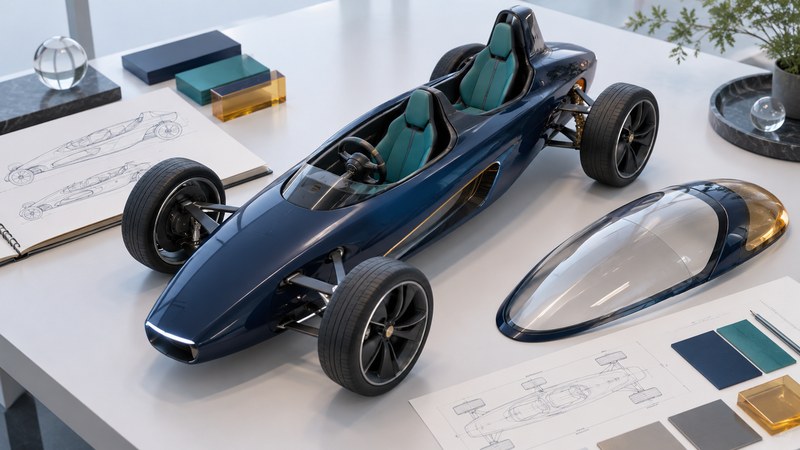
Tramontana's most revealing design feature is the arrangement of its occupants: a driver and passenger placed one behind the other. That decision changes the shape of the cockpit and the questions a designer must answer about access, visibility and individual fit.
A cockpit arranged along the centerline
The manufacturer's Tramontana technical description describes tandem seating and personalized seat positioning. Its fitting section lists the client's measurements alongside steering-wheel, pedal, gear-control and seat adjustments. These details make the cockpit a useful example of how a bespoke vehicle brings a person's dimensions into the design process.
The document is an undated manufacturer description. It is used here for its seating and fitting information; specifications from a particular car or version should remain attached to that car's own dated documentation.
Two occupants, two different layouts
Tandem
Front of vehicle ↑
The seats occupy successive positions along the cockpit.
Side by side
Front of vehicle ↑
The occupants share a row across the cockpit.
Putting the seats in line lets the central seating area be drawn around one occupant's width at a time. Overall vehicle width still includes wheels, suspension, bodywork and the space those systems require. A narrow cockpit therefore needs to be considered within the complete vehicle package.
The same layout also gives the two occupants different relationships to the surroundings. A designer must assess each person's view and access from their own position. An attractive overhead drawing is only the beginning of that investigation.
Fit includes the journey into the seat
For a bespoke cockpit, start with a sequence rather than a single seated pose: approach the vehicle, open the access panel or canopy, enter, settle into the seat, reach the controls and leave again. Each step can expose a different constraint.
- Driver reach: assess the steering wheel, pedals and controls together in the intended seating position.
- Passenger space: examine legroom, support and the view from the rear position.
- Entry and exit: consider the opening, sill, handholds and space around the parked vehicle using the manufacturer's instructions.
- Everyday items: decide where required belongings travel and how they can be reached.
These are general evaluation questions, rather than findings from a hands-on Tramontana test. For an actual car, a supervised fitting and its own operating documentation are the appropriate way to assess the details.
Keep each specification with its version
When comparing rare vehicles, create a short source label for every specification: model or variant, document date, configuration and the wording used for the measurement. A brochure value, an owner modification and an independent test answer different questions.
For a design study, the strongest starting point is simpler: draw both occupants, then the access openings, then the controls. Tramontana makes that exercise memorable because its tandem layout puts the relationship between person and machine at the center of the design.
Continue with concept-car development or custom vehicle planning.
Explore Autos: vehicle guides, technology and design · Cars: buying, maintenance and ownership