Today's tractor market is remarkably broad. A homeowner can buy a diesel sub-compact that mows, lifts, digs and clears snow. A small farm can choose a simple mechanical utility tractor or a cab model with a power-shuttle transmission. Orchard and vineyard growers have narrow machines designed to pass between rows. Large farms can select wheeled, two-track or four-track tractors with satellite guidance, continuously variable transmissions and remote fleet management. Battery-electric and supervised autonomous models have joined the established diesel choices.
Quality is available at many prices and from many manufacturers. The best tractor is not necessarily the most powerful, heaviest or most richly equipped. It is the machine whose dimensions, weight, hydraulic capacity, transmission, tires, implements and local support fit the owner's work. A modest tractor used comfortably with correctly sized attachments is more productive than an impressive model that cannot enter the barn, protect the soil or receive timely service.
The major tractor classes
| Class | Typical power range | Common work | What distinguishes it |
|---|---|---|---|
| Sub-compact | About 18–25 hp | Mowing, light loader work, snow removal and gardening | Small frame, low step-over height and compatibility with mid-mount mower decks |
| Compact | About 25–60 hp | Property maintenance, landscaping, food plots, stables and small farms | Real three-point hitch and PTO capability in a maneuverable package |
| Utility | About 45–140 hp | Livestock, hay, loader work, field maintenance and general farming | More weight, hydraulic capacity, lift and implement flexibility |
| Specialty | About 60–155 hp | Orchards, vineyards, poultry houses, municipalities and high-clearance crops | Narrow, low-profile, high-clearance or protective configurations |
| Row-crop and mid-range | About 100–400 hp | Planting, spraying, transport, cultivation, mowing and baling at scale | Greater hydraulic flow, precision technology, speed and all-day comfort |
| Four-wheel-drive and tracked | About 350–900+ hp | Large tillage tools, air seeders, grain carts, earthmoving and scraper work | High drawbar power, traction, ballast capacity and broad-acre productivity |
These ranges overlap because horsepower alone does not define a tractor. A 50-hp compact and a 50-hp utility machine can differ substantially in wheelbase, operating weight, axle strength, hydraulic flow and three-point lift. Likewise, a specialty orchard tractor may produce substantial power while remaining unusually narrow.
Sub-compact tractors: a step beyond a lawn machine
Sub-compacts bring the basic architecture of an agricultural tractor to large residential properties and small acreages. Most offer four-wheel drive, a rear three-point hitch, 540-rpm power takeoff, hydrostatic transmission, optional front loader and a mid-mount mower. Popular families include the John Deere 1 Series, Kubota BX, Massey Ferguson GC1700, New Holland Workmaster 25S, Yanmar SA, Mahindra eMax, Kioti CS, TYM T1 and Bobcat 1000 platform.
Their greatest advantage is versatility in a package that is easy to store and maneuver. Their greatest limitation is the same small size. Limited ground clearance, light weight, modest loader capacity and small tires constrain work in woods, deep mud, rough fields or heavy round-bale handling. A backhoe attachment is useful for trenches and occasional landscaping, but it is not equivalent to a dedicated excavator.
A sub-compact is a strong fit when finish mowing is a major task and loader work involves mulch, snow, compost and loose materials. Buyers expecting to lift dense soil, large logs or full pallets should compare actual loader capacity at full height and forward reach, not rely on engine horsepower.
Compact tractors: the broadest owner-operator category
Compact tractors cover an unusually wide span, from simple 25-hp machines to premium cab tractors exceeding 50 hp. They can run rotary cutters, tillers, grading scrapers, post-hole diggers, snow blowers, backhoes, pallet forks, flail mowers and small hay equipment. This is the center of the market for landscapers, horse properties, homesteads, nurseries, municipalities and part-time farms.
Kubota's current range moves from BX sub-compacts through B, LX and L compacts before reaching MX and M utility machines. John Deere offers several compact families before its utility, specialty and row-crop lines. New Holland Workmaster and Boomer models separate value-oriented and premium choices. Massey Ferguson's compact and utility selection extends from roughly 23 to 100 hp.
Kioti, Mahindra, Yanmar, TYM, LS Tractor and Bobcat also offer credible compact machines in North America. Some share engines, platforms or manufacturing relationships across brands, but specifications, controls, loaders, warranty administration and dealer support can still differ. A lesser-known badge sold by an excellent long-term dealer may be a better ownership proposition than a famous brand supported from far away.
Hydrostatic or gear transmission?
A hydrostatic transmission uses pedals to vary speed and direction without conventional gear changes. It is intuitive for loader work, mowing around obstacles and jobs requiring frequent forward-reverse cycles. Its tradeoffs can include slightly lower power efficiency, more heat and a continuous transmission sound.
Mechanical gear transmissions are efficient, durable and well suited to steady pulling. A synchronized shuttle or power shuttle makes directional changes easier, while power-shift systems change selected ratios under load. For a buyer doing mostly mowing and loader work, hydrostatic drive is often worth the convenience. For continuous tillage, heavy drawbar work or road transport, a gear or power-shuttle tractor may be preferable.
Utility tractors: the farm's general-purpose machine
Utility tractors occupy the practical middle of agriculture. They feed livestock, move bales, mow pastures, pull spreaders, rake hay, operate augers, clean lots and tow wagons. Models range from straightforward open-station machines with mechanical controls to suspended-cab tractors with electronic hydraulic valves and continuously variable transmissions.
Representative families include John Deere 5 and 6 Series, Kubota M Series, Case IH Farmall, New Holland Workmaster and T4/T5, Massey Ferguson 2600 H and 4700/5700 families, Deutz-Fahr 5 Series, Claas Elios and Arion, Mahindra 6000 and 7000 lines, and utility offerings from Kioti, LS and TYM. Availability and names vary by country.
For livestock operations, loader geometry and stability may matter more than peak engine output. Check lift height against the wagon or stacking requirement, rollback force near ground level, front-axle rating, hydraulic cycle time and whether the tractor can carry the load with suitable rear ballast. A tractor's published loader maximum is not permission to lift that amount in every position or terrain condition.
For hay, PTO horsepower becomes critical. A mower-conditioner, baler or forage tool consumes power at the PTO after transmission and accessory losses. Engine horsepower may therefore overstate the power available to the implement. Tractor weight, cooling capacity and hydraulic remotes also determine whether a combination will work reliably on hills and hot days.
Specialty tractors: quality through purpose-built design
Specialty agriculture demonstrates why one universal tractor cannot serve every farm. Narrow orchard and vineyard tractors fit between permanent crop rows. Low-profile models pass beneath branches, poultry-house structures or other overhead restrictions. High-clearance machines straddle growing crops. Crawler tractors provide traction and stability on steep slopes or cultivated ground.
John Deere, New Holland, Case IH, Fendt, Massey Ferguson, Kubota, Deutz-Fahr, Claas, Landini and SAME offer specialty configurations in various markets. Buyers should examine overall width with the exact tires, turning radius, cab filtration, rollover protection, hydraulic routing and protection from branches. Spraying work may justify an enclosed cab with the appropriate filtration category, but no cab substitutes for following chemical labels and personal-protection requirements.
Row-crop and high-horsepower tractors
Row-crop tractors must be versatile enough to plant, cultivate, spray, haul and power demanding implements while fitting crop spacing. Major families include John Deere 6, 7 and 8 Series; Case IH Maxxum, Puma, Optum and Magnum; New Holland T6, T7 and T8; Massey Ferguson 7S, 8S and 9S; Fendt 500 through 1000 Vario; Claas Arion and Axion; and Deutz-Fahr 6, 7 and 8 Series.
At this level, the tractor is an information platform as well as a power unit. Integrated satellite receivers, implement control, section control, variable-rate prescriptions, telematics, remote diagnostics and headland automation reduce overlap and operator workload. Continuously variable transmissions let the control system coordinate ground speed and engine load, while power-shift transmissions remain valued for directness and familiar operation.
Large four-wheel-drive and tracked tractors are designed for broad-acre draft work. Case IH Steiger, New Holland T9, John Deere 9 Series, Versatile four-wheel drives, Claas Xerion and Fendt's high-horsepower wheeled and tracked models provide different combinations of articulation, fixed-frame steering, two tracks, four tracks and conventional tires.
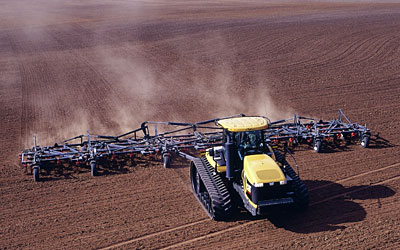
The scale now extends far beyond the 570-hp Challenger MT875B featured when this article was first published. Deere's current high-horsepower 9RX family reaches 830 rated engine horsepower, with four tracks and integrated precision technology. More power, however, is useful only when matched to implement width, traction, transport logistics, fuel supply and enough annual work to justify the capital cost.
Wheels, two tracks or four tracks?
| Configuration | Strengths | Considerations |
|---|---|---|
| Two-wheel drive | Low cost, simplicity and tight steering for light work | Limited traction and loader usefulness; now uncommon in smaller premium tractors |
| Mechanical front-wheel drive | Versatile traction, braking support and loader performance | Front driveline adds cost and requires correct tire matching |
| Dual or flotation tires | Flexible ballast and a larger footprint for field work | Greater width, tire expense and road-transport complexity |
| Two tracks | Strong straight-line traction and low slip | Can disturb soil during tight turns; ride and berming depend on design and conditions |
| Four tracks | Large footprint, traction and more conventional turning behavior | Higher purchase and undercarriage-maintenance costs |
| Articulated four-wheel drive | Efficient transfer of very high drawbar power | Size, turning geometry and implement compatibility favor large open fields |
Tracks do not automatically eliminate compaction. Ground pressure, total axle load, inflation, ballast, soil moisture and the number of passes all matter. A properly ballasted wheeled tractor on correctly inflated radial tires can protect soil better than an unnecessarily heavy tracked machine used in poor conditions.
Electric tractors are real—but duty cycle decides
Battery-electric tractors offer quiet operation, instant torque, no tailpipe emissions and the possibility of charging from farm-generated electricity. They are especially attractive in barns, greenhouses, vineyards, orchards, municipal work and repeated short shifts near charging.
The Monarch MK-V combines battery-electric propulsion, data collection and driver-optional functions in a compact specialty-oriented platform. Fendt's e107 Vario uses a 100-kWh battery and provides 68 rated hp with higher short-duration peak power; Fendt describes approximately five hours of operation under representative partial-load work, with duty cycle having a large effect.
That caveat matters. Pulling hard for an entire day requires far more energy than mowing lightly, feeding livestock or moving between short tasks. Large batteries add weight and cost, while remote fields may lack charging power. Electric tractors should be evaluated with an energy model based on actual implements, load factor, hours, weather and available charging—not a generic runtime claim.
Methane, renewable fuels and hydrogen combustion or fuel-cell concepts are also under development. New Holland offers methane-powered tractors in selected markets. These alternatives can fit farms with suitable fuel production or supply, but infrastructure, lifecycle emissions and service availability remain decisive.
Automation ranges from guidance to out-of-cab work
Many current tractors already automate steering, end-of-row turns, implement height, transmission response and section control while an operator remains in the cab. These functions are mature compared with fully unattended field operation and can produce immediate benefits by reducing overlap and fatigue.
Out-of-cab autonomy is arriving for well-defined tasks. John Deere offers an autonomy pathway for selected 8R, 8RX, 9R and 9RX tractors and compatible tillage implements. Its system uses cameras, obstacle detection, remote monitoring and planned field data; the tractor still must be transported to the field and configured for the task. Deere's autonomy information makes clear that compatible hardware, implements and digital field preparation are part of the system.
Driver-optional compact tractors can repeat mowing or orchard operations, and robotic tractors without traditional cabs are developing for specialty crops. The practical question is not whether a tractor is called autonomous, but which tasks, fields, implements, weather and supervision model are approved. A machine that works independently in a mapped, isolated field is not necessarily capable of safe public-road travel or unpredictable livestock work.
Features that matter more than a specification headline
Three-point hitch and PTO
Confirm hitch category, lift capacity at the industry-specified point, stabilizer design and ease of attachment. PTO options may include independent engagement, economy speeds, 540, 540E, 1,000 rpm, front PTO or ground-speed PTO. The tractor and implement must match in power, shaft speed, hitch geometry and guarding.
Hydraulics
Manufacturers may publish total pump flow, but steering and implement circuits can be separate. Buyers should identify flow actually available to loaders and remote valves, pressure, number of rear remotes, mid valves, power-beyond support and whether flow can be adjusted for sensitive implements.
Weight and ballast
Horsepower helps turn an implement; weight helps transmit that power and resist a raised load. Ballast may include filled tires, cast wheel weights, suitcase weights or a rear implement. It must follow the loader and tractor manuals. More ballast is not always better because unnecessary mass increases compaction, transport load and wear.
Operator station
Seat quality, visibility, step placement, pedal spacing, control effort and noise affect every working hour. A cab adds weather protection, heating, air conditioning and dust control, but also height, cost and glass vulnerable to branches. Try the tractor with a loader attached and test rear visibility to the hitch.
Emissions equipment
Modern diesel tractors may use diesel particulate filters, exhaust-gas recirculation, diesel oxidation catalysts and selective catalytic reduction with diesel exhaust fluid, depending on power and regulation. Owners need to understand regeneration, fuel and oil specifications, low-load operation and storage. Repeatedly interrupting regeneration or operating an oversized tractor at light load can create avoidable problems.
Strong brands and the importance of the dealer
John Deere, Case IH, New Holland, Massey Ferguson, Fendt, Challenger, Kubota, Claas and Deutz-Fahr offer established agricultural lineups, though their regional presence varies. Mahindra, Kioti, Yanmar, TYM and LS have become important compact and utility choices. Versatile remains a specialist in high-horsepower equipment. McCormick and Landini serve utility and specialty markets, while Bobcat has expanded from loaders and compact equipment into tractors.
A list of brands is not a quality ranking. Model families change, and even excellent manufacturers produce machines optimized for different customers. Local evidence is more useful: How many trained technicians work at the dealership? Are common filters, sensors and loader parts stocked? Is mobile field service available? Who handles warranty decisions? Can the dealer support the precision system, not merely the engine?
For a tractor that earns income during narrow planting, hay or harvest windows, service response can outweigh a small difference in purchase price. Residential owners also benefit from a dealer willing to explain ballast, attachment, regeneration and safe operation at delivery.
How to size a tractor
- List recurring jobs. Separate daily work from rare tasks that could be rented or contracted.
- Choose the implements first. Their PTO, hydraulic, hitch, weight and travel requirements define the tractor.
- Measure the property. Record gates, barn doors, row spacing, slopes, soft areas and trailer capacity.
- Calculate loader needs realistically. Include attachment weight, load density, lift height and safe counterweight.
- Select the frame before the horsepower option. Stability, wheelbase and axle capacity may require a larger chassis even when power is adequate.
- Evaluate dealer support. Ask about transport, field calls, parts lead times and diagnostic capability.
- Operate competing machines. Test mounting, controls, visibility, shuttle response, hitch access and loader motion.
- Price a complete working package. Include loader, bucket or forks, implements, ballast, third-function hydraulics, delivery, taxes and maintenance.
New or used?
A new tractor offers warranty coverage, current safety features, financing and known configuration. A recent used model may deliver substantial value if maintenance records and dealer support are strong. Older mechanical tractors appeal for simplicity and repairability, but age brings worn clutches, hydraulic leakage, obsolete parts, deteriorated wiring and uncertain rollover protection.
Inspect a used tractor cold. Look for difficult starting, smoke after warm-up, blow-by, fluid contamination, structural repairs, tire cracking, hitch wear and play in loader pins or front axle pivots. Test every gear, shuttle direction, PTO, differential lock, hydraulic remote, brake and electrical function. Electronic fault history and an oil analysis can be worth the cost on expensive equipment.
Hours alone do not describe condition. A high-hour tractor maintained on schedule and used steadily may be a better purchase than a low-hour machine stored outdoors, repeatedly started for short work or operated without correct ballast.
Safety is part of tractor quality
A rollover protective structure and seat belt work as a system: wear the belt when the ROPS is upright. Foldable structures should be lowered only for a specific low-clearance need and raised again immediately. Never carry an extra rider unless the tractor has a manufacturer-provided instructional seat.
Keep loader loads low while moving, travel slowly on slopes, avoid turning across steep ground and use rear ballast specified by the manufacturer. PTO shafts require intact guards and a complete stop before approach. Lock implements before working beneath them. A tractor's apparent strength can conceal narrow stability margins when a heavy load is raised.
The modern choice is breadth, not a single winner
The tracked Challenger MT800B series described by the original 2005 article represented the leading edge of its time: more engine power, electronic coordination, stronger belts and a quieter cab. That lineage remains part of AGCO's history, while today's market has expanded in every direction—smaller, cleaner and more automated as well as dramatically more powerful.
A quality tractor today might be a 24-hp sub-compact mowing around a home, a straightforward 75-hp utility machine feeding cattle for decades, a narrow orchard tractor with a filtered cab, an electric model working quietly inside a barn, or a four-track machine pulling an air seeder across thousands of acres. The right measure is not where it sits in the horsepower hierarchy. It is how reliably, safely and efficiently it performs the work for which it was chosen.