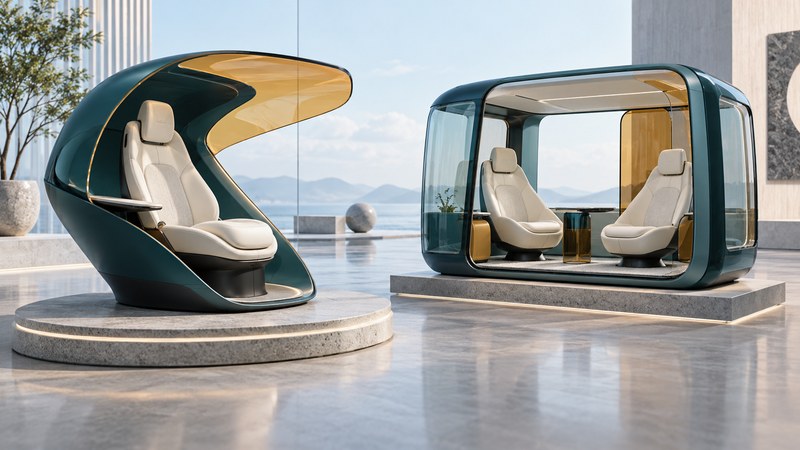
Toyota Boshoku’s VODY and MOOX explored a useful design question in 2017: how might a vehicle interior change when the experience of its occupants becomes the starting point? Read them as cabin mock-ups with different ambitions, then ask what evidence would be needed to turn those ambitions into everyday transport.
Two ideas for the quality of time and space
In its October 10, 2017 Tokyo Motor Show announcement, Toyota Boshoku called both exhibits future concept mock-ups. VODY combines the ideas of void and body; MOOX combines mobile and box. The names describe different relationships between people and an interior.
On a narrow screen, scroll the table sideways. Keyboard users can focus the table and use the arrow keys.
| Concept | Stated design intention | Question for the viewer |
|---|---|---|
| VODY | A space that changes with the occupant, including Drive, Relaxation and Meditation modes. | What changes physically, and who chooses or confirms the change? |
| MOOX | A flexible private space, premised on fully autonomous operation. | Which uses depend on the vehicle taking responsibility for driving? |
The manufacturer's VODY presentation places human-centered, changing interiors at the heart of the idea. That design emphasis provides a starting point for interpretation. Production approval, road behavior and quantified occupant benefits require different records.
Study the transition as closely as the finished arrangement
A drawing of a relaxed seat answers one visual question. A usable cabin also has to support the transition into and out of that position. Consider how a passenger enters, places belongings, selects a mode, interrupts movement and returns to a travel position. Each action changes what needs to be designed and evaluated.
For a changing seat, make a sequence of three sketches: before movement, during movement and after movement. Mark the occupant, nearby surfaces, carried objects and access route in each. The exercise reveals assumptions that a single polished image can hide. It is an editorial design exercise, not an assessment of the actual exhibits' mechanisms.
The same approach applies to shared space. A layout for conversation may differ from one for privacy or luggage. Decide who uses the space, what they bring and how long they stay before deciding which arrangement seems helpful.
Ask what kind of evidence supports each claim
On a narrow screen, scroll the table sideways. Keyboard users can focus the table and use the arrow keys.
| Question | Evidence to seek |
|---|---|
| What was the designer trying to achieve? | Dated manufacturer brief and explanation of the intended users. |
| What was physically shown? | Exhibit photographs, demonstrations and descriptions of the mock-up. |
| How would people use it? | Defined scenarios, user studies, access trials and records of problems found. |
| Could it be used in a moving vehicle? | Engineering, restraint, operational and regulatory evidence for that configuration. |
| Did it become a product? | A later dated production record identifying the specific feature and vehicle. |
Comfort can mean posture, temperature, sound, privacy or a sense of control. State which one is being discussed and how it would be assessed. References to mood or wellness in a concept brief are design aspirations; any measured health benefit needs an appropriate study.
For sensing that responds to an occupant, ask what information is collected, how the interpretation is checked and how the person can override it. For an autonomous-cabin scenario, identify the assumed operating conditions and the responsibility for driving. Those are questions to resolve before treating the arrangement as an available travel experience.
Try a concrete passenger scenario
The purpose is to create an answer that can be examined: a defined user, a clear task and visible tradeoffs. Compare it with the passenger-focused Infiniti Kuraza study, then return to the broader concept-car reading framework.
VODY and MOOX also belong to the wider Tokyo Motor Show 2017 story, where cabin experiments appeared alongside production announcements and other mobility ideas. Keeping those categories clear makes the show more useful to study.