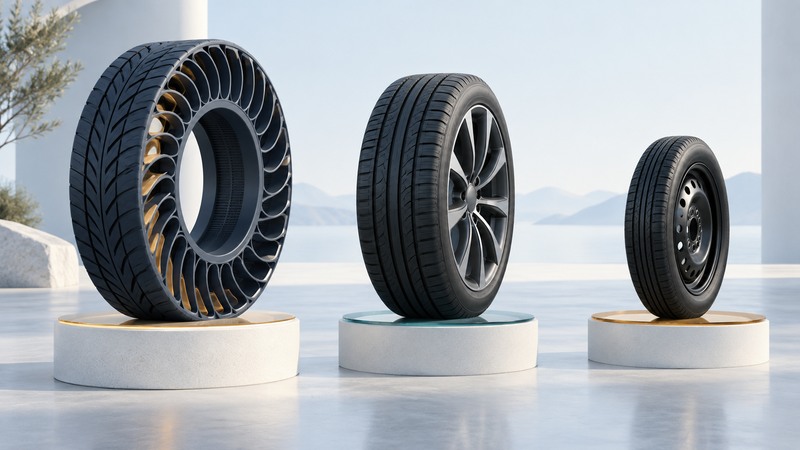
Airless tires support load through a structure instead of relying on an inflated air chamber. Run-flat tires are a different approach: they normally contain pressurized air and provide limited mobility after pressure loss. For an ordinary car, start with the equipment approved for that vehicle and a usable roadside plan, then assess product claims against that application.
Understand what an airless claim establishes
An open-spoke or other non-pneumatic design can remove air-pressure maintenance for that assembly. It still has tread, structural components and application limits that require inspection and manufacturer guidance. A successful demonstration or laboratory test answers only the question actually tested; vehicle compatibility, on-road use and commercial supply need their own evidence.
As checked in September 2026, Michelin’s TWEEL FAQ describes applications such as mowers, skid-steer loaders and low-speed utility vehicles, and says its focus remains lighter-weight, lower-speed uses. Its accounts of automotive prototype demonstrations should be read separately from a purchasable TWEEL fitment. For a claimed road-car airless product, request a current part number, exact approved vehicle application, installation instructions and a supplier who can document those claims.
That verification is the important buying step. A photograph of a tire on a car, a projected launch date or a broad “puncture-proof” phrase provides too little information to choose a replacement assembly. Ask how damage is assessed, who services it and what happens when the tread or structure reaches its limit.
Compare the equipment in the vehicle
On a narrow screen, scroll the table horizontally. Keyboard users can focus its region and use the arrow keys.
| Approach | What it provides | What to verify |
|---|---|---|
| Airless/non-pneumatic assembly | Load support without ordinary tire inflation | Documented vehicle application, permitted use and inspection/service rules |
| Run-flat pneumatic tire | Specified limited mobility after pressure loss | Approved fitment, functioning TPMS and exact speed/distance/condition limits |
| Temporary spare | A temporary replacement wheel/tire | Pressure, age/condition, compatible position and manual’s restrictions |
| Inflator and sealant kit | A limited temporary response to specified punctures | Permitted damage type, expiry, instructions and required follow-up |
| Roadside assistance | Help when the vehicle or location prevents a suitable roadside response | Coverage, contact method, towing terms and reachable service |
Bridgestone explains run-flat construction and TPMS requirements. Use the actual tire and vehicle instructions for limits. Damage, load and operating conditions can reduce usable mobility; a generic distance quoted for another tire cannot establish how far yours can travel.
Build the plan while parked at home
- Open the owner manual and locate the flat-tire, tire-pressure and towing sections. Identify whether the vehicle has a spare, a kit or run-flat tires.
- Check that the equipment is physically present. Record the kit expiry, spare condition, specified pressure and the location of required tools. A used car may have lost equipment that its manual describes.
- Copy the exact restrictions and their source into the worksheet. If a spare has restrictions on wheel position or drivetrain compatibility, make those visible.
- Confirm that the assistance provider can handle your vehicle and typical travel area. Save its number and the vehicle’s towing instructions where they remain available without a mobile-data connection.
NHTSA’s tire-safety guidance directs owners to vehicle placard/manual pressures and includes checking the spare. Use the cold-pressure specification for the vehicle and tire position. A TPMS warning is a reason to investigate pressure loss; it does not identify every form of tire damage.
Choose assistance when conditions make service unsuitable
If a tire problem occurs, follow the vehicle manual’s response and seek a safe stopping location as conditions allow. Roadside traffic, unstable ground, severe damage or uncertain equipment can make a tire change inappropriate. Call roadside assistance; use emergency services for immediate danger. This guide is a preparation record, not a jacking or tire-repair procedure.
Finish the temporary response
After use of a spare, sealant or run-flat capability, arrange the inspection and repair or replacement required by the manufacturer. Tell the tire professional what happened, whether sealant was used and how the vehicle was driven after pressure loss. Replenish used equipment and refresh the worksheet when tires, wheels or the vehicle change. A complete plan includes restoring readiness after the immediate problem is over.
Save a practical worksheet
Download the airless tires, run-flats and spares worksheet (plain text). Open it in any text editor, save a private copy, and fill in the prompts while you work. It includes the article link and supporting references. Record “unknown” when a question still needs evidence.