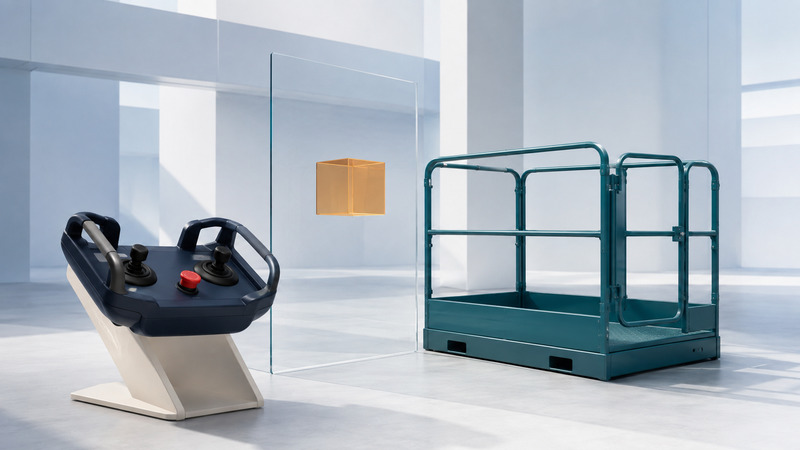
Remote boom control lets an operator command supported telehandler functions from outside the cab. Using a remote while lifting materials and using it from a personnel platform are different operating arrangements. A radio pendant by itself does not make either arrangement suitable for a particular machine.
Start with a documented, manufacturer-approved combination of machine, attachment and controls. This guide helps a site team ask the right questions and identify missing information. The operating and emergency procedures must come from the exact equipment manuals and the site’s plan.
Three arrangements that should not be confused
Remote material handling moves an unoccupied load while the operator stands in a permitted position outside the cab. Better visibility can be useful, but the operator still needs a suitable view, separation from moving equipment and a defined area of operation.
An approved telehandler personnel-platform system combines a particular machine and platform with the required controls, safeguards and operating limitations. A load rating for forks does not establish a personnel-platform rating.
A purpose-built mobile elevating work platform, such as a suitable boom or scissor lift, is a separate equipment option. Compare the access task, working envelope, ground conditions and rescue arrangements. Do not assume that owning a telehandler makes it the best personnel-access solution.
As a concrete manufacturer example, JLG’s discussion of high-capacity telehandlers describes optional remote boom functions and specifies a platform docking station when that control is operated from its fork-mounted work platform. That is a feature of the described system, not an interchangeable accessory rule for every telehandler.
Establish compatibility from the equipment documentation
Record the machine model and serial number, platform identification, remote-control identification, software or configuration information where specified, and every relevant manual or supplement. A familiar brand name or a connector that fits is insufficient evidence of an approved combination.
Use the manufacturer or an authorized support source to resolve unclear combinations. The JLG technical-publications portal, for example, provides operation, safety and supplemental documents. A sales leaflet can identify an option to investigate; it cannot replace the instructions for the equipment delivered to the site.
In U.S. construction, OSHA 1926.602(c) addresses industrial-truck capacities and modifications. Its personnel-platform provisions include securing the platform and a means for occupants to shut off power when the described elevating-control arrangement is used. These provisions are not a blanket permission to use any basket.
OSHA’s interpretation on rough-terrain forklifts supporting personnel platforms explains the relevance of scaffold requirements and manufacturer design restrictions. The letter is dated 2001; read it alongside current applicable regulations and current equipment instructions. Requirements outside U.S. construction must be established separately.
Know what happens when a command stops
Remote control is more than a radio connection. The system must interpret operator commands, enable only the intended functions and respond appropriately when control is interrupted. Those behaviors are model- and mode-specific. Do not infer them from the appearance of a stop button or a phrase such as “spread spectrum.”
On a narrow screen, scroll the table horizontally. Keyboard users can focus the table region and use the arrow keys.
| Situation | Establish before use | Record the evidence |
|---|---|---|
| Control selection | Which station has control and which movements are enabled in that mode? | Manual section, selector arrangement and required indicators. |
| Release of a command | What is the specified response when the operator releases the control? | Manufacturer function-test procedure and observed result. |
| Lost radio link or low battery | What stops, what indication appears, and what is the approved recovery process? | Relevant supplement and limits; no improvised elevated test. |
| Emergency stop | Which controls stop which functions, and what remains available for recovery? | Location, access, manual reference and trained responsible personnel. |
| Return to service | What checks and reset sequence are required after an interruption or fault? | Approved procedure and resolution of the cause. |
Radio pairing and interference-management features do not prove that interference is impossible. Batteries, obstruction, damage and incorrect configuration also deserve attention. If operation is intermittent or a function behaves unexpectedly, take the equipment out of the task and have the fault resolved through the approved service process. Repeatedly resetting a fault is not evidence that the cause has gone away.
JLG’s pre-operation inspection guidance specifically includes checking guards around remote-control switches and locks where fitted. Use the complete inspection and function-test sequence for the actual system, including the platform attachment.
Plan recovery before anyone is elevated
The team needs a practicable response if the operator cannot act, power is lost, a control fails or the platform cannot return by its normal route. Identify the people, access and equipment required by the manufacturer’s emergency procedures and the site’s rescue plan. Make sure those arrangements will be available throughout the job.
Stopping movement and recovering occupants are different tasks. An emergency-stop control does not explain how an elevated platform will be lowered after a power failure. Equally, access to ground controls does not mean any bystander is prepared to use them.
Review trapping and overhead hazards, communications, weather limits, the platform load including people and tools, and any required fall-protection arrangements. Resolve the exact requirements from the approved platform manual and applicable site rules. This page provides no generic switch sequence, harness rule or elevated travel instruction because those details must match the actual system.
Keep the record useful at the worksite
Download the remote-platform readiness record. It captures identifiers, document references, the control-mode review, inspection results, emergency responsibilities and unresolved issues. It is a planning record, not a certification or a substitute for the manufacturer’s checklist.
Repeat the review when the machine, platform, remote, operating mode or work location changes. A clear record of the approved combination helps a new shift understand what was checked and what conditions still apply.